Showing posts with label Cairo. Show all posts

Sunday, March 08, 2015

On Bombs

Yesterday I was greeted on opening Facebook, one of the best sources of information in Egypt, by a post by the daughter of a close friend saying that the police had shown up in a very timely manner to take care of what appeared to be a bomb near their apartment building in Maadi. She had been contacted by a neighbour who informed her of the arrival of the police and her boab (the doorman to the apartment building) told her that someone had seen something near the large electrical box on the corner that had wires and looked very suspicious, so the police had been called. There subsequently was  a small boom, then a larger boom, and the problem seemed to be sorted.

Today her mother called me before bringing a friend visiting from Finland to see me here at the farm and we were talking about the incident. Naturally, everyone is very happy that the object had not blown up the electrical connection or caused any injuries, and she was very happy that she and her friend had been at the beach at Ain Sokhna, thus missing the excitement. I asked if there was any further information about what exactly was involved and what had  happened. She told me that while the object had looked suspicious, as far as she knew there was no official statement that it had been a bomb. Apparently the police brought along a big metal box into which they placed the offending object and then performed a controlled detonation. It might well have been a bomb, but now it is in a thousand bits, so it would be hard to tell. On the other hand, she pointed out that the piles of garbage that were usually surrounding the electricity box on the corner were now gone, so perhaps it was a plot by the neighbourhood to get the spot cleaned up. As usual, no one really knows.

There are odd homemade bombs going off in various parts of Egypt, this we do know. Today one went off at Carrefour in Alexandria killing one and injuring six. Most of these are aimed at the police, much like in the 90's when the police and Islamists were in an informal war. Most of us who live in Egypt do our best to avoid the police or government buildings if it is at all possible (also like during the 90's), but then we try to avoid them most of the time since contact with the government and police is almost never very pleasant. I have to go into the dreaded Mogamma (the abyss of state bureaucracy in Tahrir Square) sometime soon to renew my residence visa, but I keep putting it off simply because I don't want to go there, not out of fear.

Yesterday, while this excitement was going on in Maadi, we had a couple of families at the farm with their children to play in a wading pool and romp with dogs and baby goats. Neither family was particularly concerned, though one had been redirected when driving near the site of the bomb that cleaned up the corner electrical box. I'm sure that somewhere in Egypt people are very worried about all this, but to be quite honest, I don't know them. Most of us accept the fact that much of this falls into the "Shit Happens" category that we really can't do much about in our daily life. You take reasonable precautions, pay attention to the news, and get on with your life. Many people say that they'd rather deal with the odds of these random bombs than the possibility that some unbalanced individual might decide to shoot them over some imagined slight or something.  Death really is one of the unavoidable things in life, so losing time worrying about it doesn't seem terribly logical.


copyright 2015 Maryanne Stroud Gabbani

Saturday, August 09, 2014

Learning To Live And Living to Learn


 I was talking to a friend today about this blog post and he told me that there is an Egyptian saying "If you do something, you might make a mistake and be punished, but if you do nothing you can't make a mistake."

Once a social psychologist, I suspect always a social psychologist. I went off to graduate school at the University of Waterloo in the mid 70's with a lot of illusions, but mostly I went there because they had a very short application form and one of my peculiar oddities is a horror of filling out forms. I can always think of other ways to answer the questions on them, ways that won't fit into little boxes, so I'm always left with a feeling of failure and confusion. Probably Waterloo wasn't the place for me academically, but it was where I met many beloved friends and where I met my late husband who was, in traditional Egyptian fashion, an engineering student. The social psychologists were experimental social psychologists, people who basically played experimental tricks on people to find out things about social behaviour. My advisor, Dr. Melvin Lerner, was an archetypal Jewish psychology professor and specialised in a field that studied victim blaming. He would undoubtedly be turning in his grave these days seeing my stand in social media for a just peace for Palestinians, but that is neither here nor there, because the parting of our ways came as I decided that I wasn't cut out for academia. I was interested in studying the development of verbal concepts of fairness in children, a topic that he didn't find very exciting, and his lack of support made me realise that this was not to be my life. When the graduate officer in our department asked what I was going to do next, I told him that I was considering opening a Mexican restaurant in Toronto...which, by the way, I never got around to. But much of what I learned to question and the concepts that helped me to formulate questions have continued to be useful to me in my very checkered career as a corporate wife, mother of multinational children, unwilling prisoner of corporate life and now living on the farm.

Dr. Sergio Forapani demonstrating dentistry to my staff
Before January 2011 many people in Egypt and beyond the borders never thought that the Egyptian people would rise up against the military rulers of the country. The reasons for this assumption were usually framed in terms of the "eternal patience" of the Egyptian people, citing millennia of authoritarian rule. But having watched methods of childrearing in Egypt, I had my doubts.  My in-laws, who were more or less upper middle class educated Egyptians, found it odd that I spoke to my children from the time that they were infants, explaining the reasons for my decrees as to what was acceptable or unacceptable behaviour.  I was living in Canada most of the year but would spend a month or so every winter with them in Cairo, during which time I drove my mother in law in particular rather mad by insisting that children under the age of three had no need of additional sugar in their diet, so her boxes of candies went untouched, or by refusing to allow a child who passed up a sandwich at lunch a couple of cookies later.  "But he's hungry!" she would cry. "If he were that hungry, he would have eaten lunch, but in the meantime he can have a carrot or a piece of fruit." was my cold-hearted response. I was terrible, I know, by refusing the request for a random toy when we went to a store. "But you have plenty of money!" "But they have to learn that you don't get everything you want it when you want it. Sometimes you have to work for rewards; it's called delay of gratification." She was utterly unappreciative of the value of a master's degree in psychology and thought that everything I did was completely mad, until one day she complimented me on my 16 year old son's skill at being a host at a family iftar and told me that she'd always thought that I was crazy but had decided that perhaps I knew something. I took the compliment with good humour, knowing that was as good as it ever was going to get.

Even one of my husband's uncles, a celebrated gastro-enterologist, told me flat out that it was pointless to talk to children under the age of four because they couldn't understand anything. I asked him how children were taught behaviour in Egypt and he just shrugged. Obviously, he'd never troubled himself with this problem, but his wife certainly had since his children of his first marriage, who were good friends of ours, were lovely people. When I moved out into the villages, my children were independent adults living and studying in the US, but I enjoyed the chance to watch parent/child interactions in the villages. One of the patterns I noticed was a sort of benign neglect. Children ran about under the more or less watchful eyes of parents, aunts and uncles, grandparents and older siblings, but they were not engaged in conversations by individuals older than them. They might talk to each other, but in general they would answer a simple question from an adult with a wide-eyed stare and no comment. This was true of my questions and I noticed that it also happened with most other adults. In my book of upbringing, not to answer a direct question in some fashion would be a major fault, but it seemed fairly normal to most of the adults. The children could speak when they wanted to, that was abundantly clear watching them together, but they rarely spoke to or were spoken to by adults. When I asked how the rules of life were learned, one father told me that people figured that by the age of ten or so a child was assumed to have learned them and would be punished for breaking them.

This fascinated me. Rules were almost never delineated or explained but breaking them brought punishment. It reminded me of the old learned helplessness experiments I'd learned about many years before. Basically, these experiments involved shocking or imposing other unpleasant experiences randomly to individuals in a learning task with the end result that the individual seemed to decide that it was irrelevant what he/she might choose to do because something bad was going to happen no matter what. The individual would no longer seek to do "the right thing" or try to avoid "the wrong thing" because it didn't matter. Essentially outcomes were random and uncontrollable, so why try. That essentially was the life for many children. They weren't told what sort of behaviour would bring a particular response....they had to find out for themselves and the outcome might not actually have anything at all to do with what they'd done. If Dad came home in a bad mood, you'd get hurt, no matter what the behaviour. Since the parents had also been raised in the same fashion, it all made a sort of perverted sense to them.

When I began looking around at day to day life in Egypt, the same random response pattern showed up. Even things like taxes for companies have no cut and dried rules, but are negotiated with someone, with the outcome completely unpredictable unless you figure out the right amount of lubrication to be applied. Students at universities and people competing in sports often find that who you are related to has much more to do with your success than what you do. One of my friends who visits me in Egypt from New Zealand on a regular basis always posts a blog of her trip and one year it was entitled "Egypt: We Do Random Well", so it isn't me who notices the tendency to random outcomes, punishments and rewards. The Egyptian school system is a prime candidate for the imposition of learned helplessness. In the first place, most teachers are just people who couldn't get another job. They aren't trained in any way at all. They are certainly not qualified to impart knowledge since their main qualification is a lack of qualifications for any other work. The curriculum could honestly be said to have been created by that famous room full of monkeys with typewriters. I've tutored village children with their English homework, and it is utterly insane. One little boy was given a text to read that went something like this:
"Fatima and Hamza are brother and sister. Their father is a doctor who works in a hospital and their mother is a teacher who works in a school. Every day they go to school, study their lessons and come home to do their homework after school. On Friday their father washes his car and then the family goes out to the park or perhaps to the swimming pool."

My first job was just to see if any of this made any sense to this boy. No women in his household worked outside the home. It is considered shameful if they do. Of course the fact that there is little in the way of transportation that could take women to jobs and even less in terms of jobs out here might also be a factor. None of the children in our village have a doctor for a father. Most of them rarely see doctors. Their fathers are labourers or farmers. In Egypt, NO ONE but possibly a cab driver washes his own car! If you can afford to buy a car,  you can afford to have someone else wash it for you..so this part of the story is fantasy. And finally, the little boy had to ask what a park was. He'd never seen one. He's seen pictures of swimming pools and maybe even seen one once but he's never been in one.  How could a primary school child make any sense of this, especially considering the fact that probably the teach was mispronouncing the words so much that the language hardly resembled English at all? And then,  even now corporal punishment is still common in schools and most of the people I've spoken to from our area experienced it and, in fact, quit school because of it. When I asked them why they quit, often the answer was something along the lines of "I could get hit at home, so why go somewhere else and have a stranger do it. I was too stupid to learn."

Dr. Sergio Forapani chatting with Dr. Mohsen Mohsen (right)
Dr. Sergio (left) and Dr. Mohsen (right) at a clinic
I have a staff of ten at my farm, five young men in their mid-twenties, three younger boys whose parents asked me to take them on to teach them, a housekeeper and my late husband's driver who is now my right hand after twenty years. Only Mohamed has any education. The rest never finished school and were convinced that they were too stupid to learn. I had often talked to them about going back to school but the answer was always the same....they thought there was no point.  After the revolution, when there was no work in tourism for us, I noticed that the guys were getting really, really bored with just the daily chores, so I sent them  out in ones and twos to work with the Donkey Sanctuary to learn to trim donkey feet. At first they were very reluctant, sensing another evil experience with the dreaded learning situation, but they came home energised and enthusiastic. The vet they were working under Dr. Mohsen Mohsen, is a skilled teacher who encouraged their learning instead of punishing their every mistake. They were happy to realise that the training I'd given them in horse and donkey care actually made them quite experienced in the field, which gave them more confidence.

Italian farriers showing the best treatment for a donkey at a clinic
Egyptian and Italian farriers demonstrating for my staff at a clinic
One of the biomechanics classes with farriers, vets and grooms
A biomechanics class with Dr. Sergio and vets, farriers, and grooms
After some months, after talking to some large animal vets who were saying how the gas price increases and increases in veterinary medicine prices were making it almost impossible to work with farmers who didn't have the cash to pay increased fees, a vet friend and I decided to try setting up a veterinary charity in our neighbourhood to help the farmers with their animals. We got a number of vets to work with us, both experienced and fresh from school. My guys were amazed to find that while they didn't have the technical knowledge of the new graduates, they did have much more experience and much more comfort in handling the animals, who ranged from pigeons to even the odd camel, with the majority being donkeys, goats, sheep, cows, water buffalo and poultry. This again was an enormous morale boost. We've been doing our work now for two years and every day farmers and cart drivers bring animals to the farm for treatment. We've had master farriers and a professor of veterinary science from Italy come to stay and give classes and practical lessons, often extremely technical work, and the guys are there for every class and every lesson, even coming in on their days off.  One of my gardeners has set up a chicken raising project for his wife and other women in his family to supplement their income, and they are raising some wonderful chicken. Friends from town make the trip to come to buy them, and there is an ego factor in knowing that professors and such are making a special effort just for your produce. Their veterinary knowledge is being used to raise better, cleaner, healthier animals and to teach others how to do it too.

I've watch typical learned helplessness victims turn their lives around and change their attitudes completely with giving them the chance to learn and use their knowledge to help others. One of the most impressive things, and something that I think has been extremely important, is the fact that they are not being paid for their veterinary work. It is all voluntary, even the work that occurs almost every day after working hours at the farm. This is a point of pride. Not only do they know things, but they can help people and do so without benefit to themselves. It isn't enough to give them knowledge...much of it they had before we started the veterinary work...they need to use it too.


copyright 2014 Maryanne Stroud Gabbani

Monday, February 03, 2014

The Power of One

Tomorrow we will be driving downtown to Sednaoui hospital with my housekeeper's son Ali and a friend of mine here who works as a groom and has a son with cerebral palsy so bad that he has fallen over many times and broken his chin. We are going to consult with my friend Dr. Mostafa Shokry, who is one of the best orthopedic surgeons I know (he's reconstructed one of my shoulders and replaced both my knees) and also the administrator of Sednaoui hospital, one of the  dreaded governmental hospitals...but one that he is transforming into a real hospital.  For some odd reason, an orthopedic surgeon has always been one of the first doctors that our family would have to find when we moved somewhere.

Ali was kicked by one of my horses over a year ago, an accident that broke his upper arm in about 5 places. It was in the evening and I had clients about to go out, so I splinted it carefully and sent him off to a local doctor who xrayed it and put it in a cast. The next day we xrayed it again and it was clear that the initial cast was NOT going to suffice so I sent a photo of the xray to Dr. Mostafa. He had us bring Ali to Rabaa Adaweya hospital for the initial surgery to put a titanium plate in his arm to keep all the pieces in place while they healed. We did the surgery to remove the plate at Sednaoui about ten days ago and now we will remove the stitches and that will be that.  Khamis is bringing Omar for an assessment of what they can do to help the repeated injuries to his chin. Caring for a disabled child in the villages is a really tough job but Khamis and his wife have done their best.

Government hospitals in Egypt have a well deserved horrific reputation. They are underfunded, understaffed, have had almost no security since the revolution 2011when the Ministry of the Interior decided essentially to go on strike.  One of my first experiences in Egypt when we moved here in 1988 was with the government hospital in Alexandria whose ICU was the only place we could get the correct medication for my husband who had suffered a heart attack. It was all I could do not to run out of the place screaming because it was like my worst nightmares of Dickens. He was there for two weeks and survived, but it certainly wasn't because of the hospital. So when we were going to Sednaoui I was apprehensive to say the least. What I found was a real surprise.

Once we got Ali settled in his room to wait for his day surgery, Dr. Mostafa took me to see what he's been doing at Sednaoui. Since he's very important to the maintenance of my arthritic old body, I hadn't been all that thrilled when they'd named him hospital administrator, and I'd sympathised with his stories of frustration and exhaustion as he first undertook the task, taking courses in hospital administration at the American University in Cairo as well as working all day at the hospital and evenings in his clinic with his private practice. We had chats about how to  encourage more active participation by staff members in the process of improvement as I was working on changing my staff from labourers to real partners at my farm. It has been a very tough year for him.

The first place that we noticed a difference was in the room that Ali was assigned. It wasn't large or fancy, but it was very clean and bright. I've had much worse rooms at some private hospitals in Cairo. In fact the first time Dr. Mostafa had to do surgery to reconstruct one of my shoulders after a fall, we were in a private hospital that was so horrible that we all agreed to get me out of there absolutely as quickly as possible. The nursing in my home would certainly be better than at St. Peter's in Heliopolis, and the premises were a thousand times cleaner. As we walked around the hospital I could see that our conversations about staff motivation had paid off at Sednaoui. All of the staff from the doctors to the men doing the renovations were welcome to speak to Dr. Mostafa and clearly respected and liked him.  Well, from my point of view, of course they would since he is a terrific person.


One of the initial things that the hospital had to do when Dr. Mostafa was trying to upgrade it was to improve security. Since 2011 there had been many incidents of people attacking doctors and nurses either in frustration at a lack of service or, sadly, to acquire the drugs available at hospitals. There is a security company working at Sednaoui now that is responsible for maintaining security at the gate. One of the more difficult day to day problems is the fact that if a poor Egyptian (Most of the users of government hospitals fall into this category.) is in hospital, vast numbers of his family and friends will come to see and want to stay with him. Unfortunately dealing with more than one companion in a hospital is not conducive to effective work, so the numbers have to be restricted. As well, since we all know that hospital food is boring at best, most people bring home cooking, which can wreak havoc on a prescriptive diet. A major part of the security staff's job is trying to thin out the visitors. Unfortunately, last summer Sednaoui was the receiving point for many people killed and injured in protests at Fath mosque near Ramses and the courtyard became a triage stage to try to facilitate treatment. Dr. Mostafa's usually cheerful face went a bit grey at the memory. Orthopedic surgeons, pretty much by definition, don't generally have to deal with people who are dying of wounds.


One of the things that I was very impressed with was the way that the hospital working areas were being redesigned. The doctors' offices have examination areas and computers, along with a small room with a cot for the residents whoh have to stay at the hospital at nights.

A long sunny room that is currently being used as a cafeteria for the staff will be a waiting area for families of cancer patients who are visiting to receive chemotherapy or radiation treatment.
The bathrooms were in serious need of renovation. New tiles, fixtures and doors have been installed. This isn't luxurious, but it is clean and functional, which is what one needs in a hospital after all. On the public wings where treatment is free, if not extremely in expensive, there are these joint bathrooms. On the private wing, where two patients may share a room, they also share a bathroom.


The old design for the ward bathrooms had very little or no privacy. These are being torn out for renovations.

The nurses' station prior to renovation, kept the nurses away from the patients and their families, tucked away behind glass windows, but for nurses to be effective they need to be aware of what is going on around them and accessible to the patients.


The newly renovated nurses' station is  open and the nurses are accessible to the patients and their families. Not that the nurses' dress is  very neat and clean. Government hospital nurses are not generally known for this.

This is a shot of one of the wards after renovation. It could be any private hospital.

We look around Egypt and we see problems and difficulties in every direction. It is incredibly easy to feel that bringing things around to the way they need to be is a hopeless task. To do everything at once is a hopeless task really, but seeing what one intelligent, caring, hospital administrator/doctor can accomplish gives us all hope. We just have to keep working one step at a time.

copyright 2014 Maryanne Stroud Gabbani

Saturday, January 25, 2014

Another Year Another Anniversary

 It's 6 am and I find myself awake on this Jan 25 without any apparent reason. The older I get, the more anniversaries of different events I have crowding my life. I remember well the Police Day three years ago. I had one of my daughter's friends staying with me at the farm and neither of us had any real intimation that the day was going to be so momentous. We'd heard rumours of marches and such being planned but no one really had any idea what would be started that day and we still don't know how it will end. Today I will be staying out here in the countryside with my animals and staff. It looks like a lovely winter day in Egypt, but I'm hoping that I won't be following timelines of pain and damage online as I check Twitter and Facebook feeds. The one thing that changed for me forever that January 25 three years ago was my connection to current events through social media. It was the only way to keep track of what was going on here during those 18 days, and I developed an addiction to knowing what was happening in Egypt without having to wait for events to pass through the innumerable filters that are the ordinary media in the world.

Yesterday I, like everyone else in Egypt and probably in the world, was shocked by the news of the explosion in front of the Islamic Museum early in the morning. A friend who had been planning to bring her daughter out to the farm texted me at about 8 am saying that they'd felt/heard the explosion all the way out in New Cairo. The shockwaves must not have traveled so well through the Nile, because I had to admit that I'd slept well and soundly without disturbance.  The bomb that went off in a car parked in front of the police headquarters in downtown Cairo was aimed at the police, not the newly renovated Islamic Museum...the museum was simply collateral damage, but that is the problem with car bombs. They really don't aim well. The fact that it went off at 6:30 am on a Friday morning was a real blessing, since no self-respecting Egyptian would be out and about at that hour on a Friday (This is the only day off for many, so a lie in is essential!) and the street by the police building was essentially empty. I wonder why this is a detail that most news reports fail to mention. Had it gone off even three or four hours later, the death toll would have been much, much greater.

Following Twitter, the subsequent bomb at a Metro station (again near a police station) in Dokki, an apparently ineffective bomb at the police station across from the Mena House at Giza (somehow that seems fitting since my experience with that particular place of social "justice" has shown it to be dubious at best) and then another bomb attack on a police official in Giza filled the day with ever increasing amounts of concern. Maybe I've lived too long in the Middle East, or maybe I've just lived too long period, but from my angle we were blessed with either some incredibly inept bombers yesterday or they were people who really didn't want to hurt that many people. Who, at this point in time, is to say what the truth of the situation is.

Meanwhile back at the ranch, I had some women come out for a ride in the countryside, I did my grocery shopping in the village of Abu Sir, and I spent some time in the afternoon with some very lovely Italian Egyptologists who had been visiting the pyramids of Abu Sir and the Sun Temple just across the road from us. Overall, the contrast between my Twitter feed that was full of anger, fear and lots of finger-pointing and the relatively idyllic afternoon in the garden couldn't have been more stark. The government press has done a brilliant job of cranking up anti-Muslim Brotherhood anger since the end of June, a job that honestly didn't need much amplification since by the end of June most people in Egypt were well and truly fed up with them, their incompetence, their unwillingness to negotiate anything or to cooperate with anyone and the general sense of depression at the thought of having to spend more precious time in this particular funk. We have had enough free-floating anxiety, fear, and worry, thank you.

Reports of groups chanting against the MB floated across the news feeds along with some reports of clashes where anti-MB types were actually prevented by police from taking out their anger on some hapless bearded person. This was not the sort of scenes that I like hearing about. A mob is dangerous, no matter what it's orientation. By evening, I'd had it with what was being called reality beyond my bubble and I turned off my computer to watch a Coen Brothers film, but not before I got a concerned message from my son in New York.  He was only seeing the filtered, amplified "Cairo Is Burning" news reports on the mainsteam media, so of course he wanted to know how I was.  I reassured him that nothing at all was blowing up out among the water buffalo, that all the targets for the bombs seemed to be the security/police forces, and that he had to remember I've been through all that before here in the 90's when the world was screaming about terrorists in Egypt, while what was actually happening was that there was a pretty focused battle going on between various groups and, again, the police/security forces. Back then, we kept an eye out on where the security/police people were and simply made sure that we were somewhere else. While life in Egypt is not all that it could be, it was certainly also not at all what it was being portrayed as being.  And at the end of the day, the security people could certainly be trusted to follow through on these bombs....after all the prosecutor general was investigating Pepsi ads that were supposed to be inciting demonstrations. Some things in Egypt don't change.


copyright 2014 Maryanne Stroud Gabbani

Tuesday, September 18, 2012

The Mogamma Game in 2012


I went downtown today. I went to the Ministry of Justice on Lazoughly Square to get a paper stamped for a friend. There I was told that I had to take the paper to the Ministry of Foreign Affairs. When I pointed out that I'd been sent to the Ministry of Justice by the people at the Ministry of Foreign Affairs, they told me that I had to go to the BIG Ministry of Foreign Affairs, the one on the Corniche next to Maspero. Terrific.

Mohamed drove me over there as we passed through the area of downtown Cairo that has been "in flames", "melting down" and "filled with rioters". Other than the usual Cairo traffic, the trip took no time at all as there were no road blocks, no protesters, no fire bombs, not even very many police. It only took half an hour to find the door. Egypt's foggy bottom tends to be really foggy even in broad daylight and just happens to be across the road from what has to be the world's largest used clothing market. 

I found my way in and told them that the people at the Ahmed Orabi Department of Foreign Affairs had sent me to the Department of Justice who had sent me to this Department of Foreign Affairs. "Why?" they asked. "I haven't the slightest idea, but I need this paper stamped." I replied. They looked at the paper and told me that it was dated 1988 and was a marriage contract. I agreed and pointed out that it was stamped by the Consulate in New York. They told me that it should have been stamped by Foreign Affairs and/or the Justice Department over twenty years ago. I pointed out that as the groom on the paper had been dead for about a year and the bride was living in the US, there wasn't much they could do about that, but I was trying to get the inheritance papers sorted out for my friend and that if they woulf be so kind as to  help me, I would really appreciate it. A small whispered consultation took place and I was suddenly given a numbered tag and marched over to a tent where apparently the one man in all of Egypt who could sign this paper and stamp it for the Ministry of Foreign Affairs in lieu of the Department of Justice was working. This very kind and polite elderly gentleman did so and then directed me to a third Department of Foreign Affairs.

According to the guys at the big Department of Foreign Affairs, this third office was “just behind the Semiramis Hotel near the US embassy”. Wonderful. This was exactly where I had promised my two currently long-distance kids not to go after the excitement of the past few days. Back into the car, a trip through the madness that is Cairo’s roadways near the Ramses Hilton (a place that I absolutely refuse to drive myself) and we found our way to the back of the Semiramis Hotel. Mohamed had to drop me and leave because there were no parking places and no way the police around there were going to allow him to wait around. Once I asked for the building with this office, I was pointed to a spot about two or three blocks south. “Behind” is a very relative term in Egypt. If you are in our foggy bottom looking south, then the other Foreign Affairs IS behind the Semiramis, but it is also behind the Shepheard’s Hotel and behind a couple of other buildings as well. To my untutored mind, I naturally assumed that “behind” required “in front of” being facing the Nile, but obviously to them it meant “in front of” being facing them. Interesting world view.

As I made my way to the hopefully last office of the Ministry of Foreign Affairs, the shortest route was blocked by a four meter wall of enormous concrete blocks recently placed across the road to block protesters from the US embassy, so I had to walk around the Shepheard’s to the Corniche along the Nile, turn left away from the Nile and then zigzag around roads blocked with razor wire and very bored Central Security Forces. A couple of friendly secret police not so secretly gave me directions to the entrance of the ministry, which was guarded by even more bored CSF personnel. The brass plate told me that the office was on the fifth floor but someone obligingly pointed out that it was actually on the first. Naturally. This is an odd office that seems to work only with embassies, which would explain why it was practically next door to the US and British embassies, among others. Again I had to go through the entire sequence of events, was told quite brusquely by a very nasty little man to go sit down outside and dismissed. This wasn’t looking good, especially when the same nasty little man came out and shouted at a couple of the people who were waiting outside for whatever they were waiting for….but, miracle of miracles, after twenty minutes I finally received my properly stamped paper so that the lawyer can work on the statement of heirs for my friends.

Years ago, people used to joke about the Mogamma Game, a sort of sadistic snakes and ladders that would be experienced by people trying to do paperwork in the Mogamma, things like visa renewals. At the time, I had a very conscientious husband who made sure that the most I ever had to do was to show up at the appropriate time and sign something. Since his death I’ve learned how to do things the hard way, like everyone else in Egypt, and luckily most of the time I can keep a sense of humour about it. So I wandered all over melted down Cairo today and except for the fact that a lot of pavement was being held down by snoozy CSF personnel and I had to walk over four blocks out of my way because of yet another unnecessary wall (wish I had the commission on that franchise with all the walls built over the past year). But the good news is that Cairo is alive and the system of bureaucratic torture is very well indeed.

copyright 2012 Maryanne Stroud Gabbani

Saturday, February 19, 2011

Thoughts on Recent Events

I began this blog about 18 months after 9/11 in an effort to help friends and acquaintances of mine, mostly from the US, understand why I insisted on living in this backward, terrorist-ridden woman-hating country...that was pretty much how Egypt was described in the media back then. I looked online for webpages or information about the joys of living in Egypt (and there are many) but I couldn't find anything. So with all good intentions, I decided to write about living here as a long term resident and lover of Egyptian society and life. In March, my blog will be about eight years old.

From the beginning, I chose to avoid discussions of local politics, partly because I'm not an Egyptian citizen, not for want of trying but because of some utterly inane bureaucratic hitch in the Mogamma that prevents me from being given citizenship even though my husband and children carry it. As someone without formal citizenship I was very aware of my precarious position under a regime that was notoriously touchy about criticism and I had no wish at all to be deported or barred from entering the country that I consider my only home. In addition, I don't read or write Arabic and I really felt that it was rather inappropriate for me to be sounding off about things here that I could only partly understand for lack of complete information...and I was quick to find a group of much younger Egyptian bloggers who were doing an infinitely better job, at great personal cost.

I chose instead to try to talk about aspects of daily life here that could give the country a more human face, things that anyone could relate to in terms of family life, philosophy, those smaller things that keep us going when the larger events threaten to trample our souls and that are universal to all people. Sometimes I feel that maybe I did too good a job as I get a lot of email from people who for various reasons want to come here to live and work. I always have to point out that Egypt has never been without its problems (no country is), that it is essential to learn to speak (at least) Arabic so that there is a possibility of communication, and that this isn't Indiana with pyramids. Egypt has its own culture and way of life and doesn't need to have anyone else's imposed upon it. With my children grown and studying in the US, I had a constant pressure to remember to be tactful as they were not keen on hopping a flight to try to dig their old mother out of one of the Egyptian prisons.

With the January 25 protests and in the days following, I found myself sitting by the television at the farm, following events on Twitter and the net, and biting my tongue almost off. My son and daughter are still in New York studying and working, and they pointed out the wisdom of not being in Tahrir given my citizenship and the knee surgery that I underwent last summer. (I'm not so nimble on the ground although I am still fine on horseback.) I was devastated like everyone when Mubarak unexpectedly did not step down on Thursday night and cheered with most Egyptians when he finally left on Friday. And again, I was constantly asking myself if it would have been right for me to be there or not. A large part of my spirit says "Hell, yes!", while the part that probably keeps me alive, fed and safe, says "Maybe no". In the end, the deciding vote was cast by my work and lifestyle which meant that if I disappeared a group of people who depended on me for their living and a bunch of animals to whom I am terribly attached, would be set adrift with no one to provide for them. In addition, I actually hold my farm in trust for my daughter and I need to protect that trust. So discretion won out, at least for the short term.

Watching the revolution from the safety of the countryside was rather surreal. Out here the main difference in life was that many of us had a very hard time getting hay and feed for our animals. In our area people helped each other out with supplies so that no one would suffer too much. Thankfully, I'd withdrawn a reasonably large amount of cash from the bank before they all closed during the protests, and this helped a lot. I still had staff responsibilities even if the banks were closed, and animals could care less about politics...they simply want to be fed. Out here the neighbourhood watch was quickly instated and extremely efficient. At the height of the problems you had to go through about 6 checkpoints to get near my farm. If the driver and/or passenger wasn't recognised, they had to show ID, declare who they were coming to visit, and they had to call that person to verify the fact. Even now the checkpoints are in place and cars are carefully vetted. We could hear the tanks rolling around in the desert for much of the revolution. I understand that some archaeological warehouses were raided the first night that the police vanished, but things were quiet here other than the odd time the villagers caught people who had been stealing from stores in the Pyramids Road area trying to smuggle their loot through this area.

My staff, like many rural Egyptians, are mostly at the lower end of the educational scale with many of them illiterate. Even those who could read were incredibly confused. They were accustomed to reading the usual newspapers and watching state TV, so when Al Jazeera began showing what was actually happening in the streets, they didn't know what to think as the government newspapers and TV shouted out that A) Nothing was happening at all; B)There were small protests instigated by foreign powers variously and sometimes simultaneously identified as Israeli, Iranian, Hamas or simply "foreign"and C) Al Jazeera was lying about everything just to make Egypt look bad. I guess that the unspoken word there was that Qatar was also trying to bring down the Egyptian state. When the government satellite cut Al Jazeera Arabic, we would let people come to the house to see it in English, as that hadn't been cut. I spent hours talking to them about what was happening, what was hoped and why it was so important to them...and how it might change their lives but that it would not be an easy road.

Family and friends were, naturally, concerned. My children offered me a flight to NYC, but I declined saying that I felt safe and I wouldn't miss this for the world. As long as it was possible we spoke to each other daily. I don't want to think about my long distance bill. When the net returned after being cut off for a bit, reception out here was still a bit dicey and it took days to respond to people who were writing worried about me. And at the end of it all, I felt drained, happy, bewildered, concerned and frustrated. It's taken a week at least to work out all those emotions.

I was drained as many of the young people who were involved in this revolution were those who I'd been following online for many years. After a while they feel like friends, although I'd never met them, and concern for their safety and relief when they were released from custody was enormous. I was delighted with the outcome inasmuch as our unesteemed head of state departed finally with his family. The cronyism, corruption, and violence were never far from anyone's sight, so I was cheering for the revolution from day one. I think everyone in Egypt is a bit bewildered at this point. This is the first time in probably over eight thousand years that Egyptians have had a say in their government. They have gone through any number of systems of monarchy to military dictatorship and now finally have a chance to have the people of the country speak for their needs. In a sense, they have the chance now to reinvent democracy on their terms. There certainly isn't much in the way of baggage to encumber them since everyone acknowledges that what existed here was certainly not any kind of real democracy. Everyone is looking about asking where to go from here, but they are not simply looking. This afternoon a neighbour took Catherine (a friend of my daughter who is staying here and helping me) into Zamalek for a meeting of a group of people who are wanting to help to rebuild Egypt. There are many groups of this sort on Facebook that I know of and quite likely many more being organised offline. People are collecting money and hospital supplies to help the victims of violence during the protests, they are establishing food banks, going out and sweeping and repairing the streets, directing traffic and taking care of neighbourhood security. Many of the police are either on strike (the lower ranks do get appallingly bad wages and working conditions) or in hiding.

While in many respects, the country seems to be quite normal in these post-revolutionary times, in many others it is not. The stock exchange has been closed indefinitely for some time now. I don't understand stock exchanges when everything is terrific, so I have nothing to say about that now. The strikes that are being held are totally understandable in that no one has had the freedom to complain about anything for longer than anyone can remember, but they are definitely inconvenient at times. Banks were closed all last week and we have had no assurance that they will open this week. This is primarily because the employees of the National Bank are on strike. But the strikes are not indefinite, they come and go causing temporary problems. These are growing pains and I remember being inconvenienced plenty of times by strikes in Canada. In Egypt, people simply have not become accustomed to any labour unrest. A group of my neighbours got together on Friday morning to check out the situation for horseback riding in the desert here, something that is important for both our sanity and some of our budgets. On Friday it was fine, but one neighbour reported seeing soldiers jogging in the desert on Thursday morning. No one is quite sure what that means.

My theory is that Egypt works on a special chaos filter and very close to the red line at the best of times, so when things aren't quite normal...they really aren't that far off normal. On February 12, Catherine and I drove down to Beni Suef (with the ever protective Mohamed of course) to buy some goats to improve our flock. We picked up two males (one Alpine/Syrian cross and the other Saanen/Syrian cross) and three females (all Saanen/Syrian cross) to breed with our flock of baladi goats. The males were named Google and Twitter while the females were dubbed Mona, Zeinobia, and Nadia, after three of my favourite Twitter posters during the protests. We saw nothing unusual other than a couple of burned cars on the side of the road, a couple of tanks and a four year old boy in the village where we bought the goats who picked up a stone and brandished it at us shouting "Horreya" (Freedom)...only to be firmly scolded by his mother who told him that was enough. The revolution is over.

But is it over? Not really. The military leaders are the same military leaders who were in power under Mubarak, while the cabinet is largely made up of the same old gang of suspects. There is still an awful lot of housecleaning to do. Much of the frustration I mentioned has to do with the influence of other countries in Egypt's affairs through the use of the aid given, primarily to the military. Most of the US aid was given in the form of credit that could be spent in the US arms industry to buy tanks, planes, guns and tear gas canisters...though oddly enough many of the latter were way beyond their expiration dates apparently. Wonder where the money for the new tear gas went...or are there huge warehouses of the stuff lying about? Basically the aid went to prop up a regime that was everything the US government claims to hate. They've gone into Iraq and Afghanistan to rid the poor citizens there of repressive regimes supposedly...while causing major collateral damage to both countries. When the protests in Egypt began, the leaders of the free world sided with Mubarak, although no one can believe that they were unaware of the real situation here. Maybe they only lead the "free" world and don't really have anything to do with the oppressed world except to sell the governments there arms. At any rate, the Egyptians "freed" themselves and with a much lower cost than we would have had with help from the US military.

During the protests there was much discussion of the "Tunisia" effect referring to the overthrow of the Ben Ali regime only a short while earlier. Of course, there are still issues there as the "interim" government of Tunisia has also kept on entirely too many of the old regime. Within days of February 11, protesters in Bahrain marched to demand reform and more voice in their government, perhaps a constitutional monarchy rather than what currently exists. Like the Egyptians, they marched without weapons, chanting in peace, and when the government soldiers, mercenaries for the most part unlike the Egyptian army, encountered the protesters, they were fired on with tear gas canisters at point blank range. The army's responses to peaceful protest has been so violent in Bahrain as to be termed a massacre at times. And the governmental tactic has been to ban the press, penning them in the airport so that there can be no international oversight...except that there is no such thing as no oversight anymore. Telephones shoot videos and can transmit them abroad. The protesters across North Africa (Libya is fighting a vicious battle with largely foreign troups as well against the citizens) are for the most part following the nonviolent doctrines of Gandhi and the governments opposing them fail to realise that they'd get further by allowing discussion and participation than by reacting with violence. Watching the idiocy of the regimes' responses is wildly frustrating. We all know that they have huge stakes to protect, but the violent approach in the long run simply does not work. Soldiers might be able to shoot 10, 20, 100 people...but can they hold out over 1000 or 1,000,000? What the Egyptians learned early in February is that you are as free as you can imagine, or you are as oppressed as you allow yourself to be, and that lesson seems to be one that is easy to learn.


Photos of Tahrir by Zena Sallam

copyright 2011 Maryanne Stroud Gabbani

Sunday, May 23, 2010

A Walk Along A Mameluke Street

A couple of weeks ago a close friend of mine, Patricia Canfield, decided to take one of the walks in Cairo sponsored by ARCE (The American Research Center in Egypt). ARCE offers some amazing tours of Cairo and sites further afield for very reasonable prices. You do have register with ARCE beforehand and to show up on time for the bus as they absolutely depart at the advertised hour, but the tours are some of the best in Egypt. Pat is a freelance writer living here for some twenty odd years and when she showed me the photographs and told me about the places she'd seen, I begged her to write it up for me for my blog. These days my arthritic knees have taken me away from any ideas I have of three hour walks, although knee replacement surgery scheduled for this summer should have me back pounding the pavements, however gingerly, in the fall. Here is her story:

Al Mu’izz Li Din Allah Street

One of the highlights of tours to Cairo is the Khan El Khalili which is an intricate warren of over 1,000 shops, craftsmen and workshops and an astonishing group of Medieval and Islamic monuments which have occupied the same cramped area for well over 1,000 years.
The most spectacular group of these monuments is on Al Mu’izz Street which is part of the main thoroughfare that ran through the Medieval walled city. It is an area called Bayn El Qasrayn (Between the Two Palaces). This was the Mameluke (1250 – 1517 AD) ceremonial parade route which ran between the two palaces of the Royal complex. At that time it was said to be wide enough for 10,000 troops on horseback to pass. These palaces were built on the site of the earlier Fatimid (969 – 1171 AD) era buildings which were the heart of what was then the city of Al Qahira (Cairo).
An extraordinary group of these monuments was painstakingly restored and has recently been reopened to the public. These three adjacent complexes below were built by Mamluke Sultans who traveled extensively during military campaigns and incorporated much of what they saw into their own buildings.
The oldest complex was built by Sultan Al-Mansour Qalawun (1279 – 1290) and is a magnificent grouping of the highest examples of Islamic architecture. It included a Maristan or hospital that handled hundreds of patients each day with a highly specialized medical staff and surrounded the patients with beautiful gardens and soothing musicians. An eye hospital still exists on the site. There was a Madrasa or religious school. However, the most spectacular feature is the Mausoleum which is an absolute treasure trove of marble inlay, intricately carved gilded wood, Islamic calligraphy and stucco that looks like lacework and which houses a cenotaph with several royal burials.
The next building was constructed by Qalawun’s son, Sultan Al-Nasir Mohamed, who was one of the most prolific builders in Cairo’s history. A white marble Gothic style doorway that was brought from Syria opens into the passage which separates the Madrasa from the Mausoleum. The door to the entrance is well-aged silver and marble inlaid floors form a carpet like passage between areas. Colored stained glass windows play with light and color throughout the buildings.
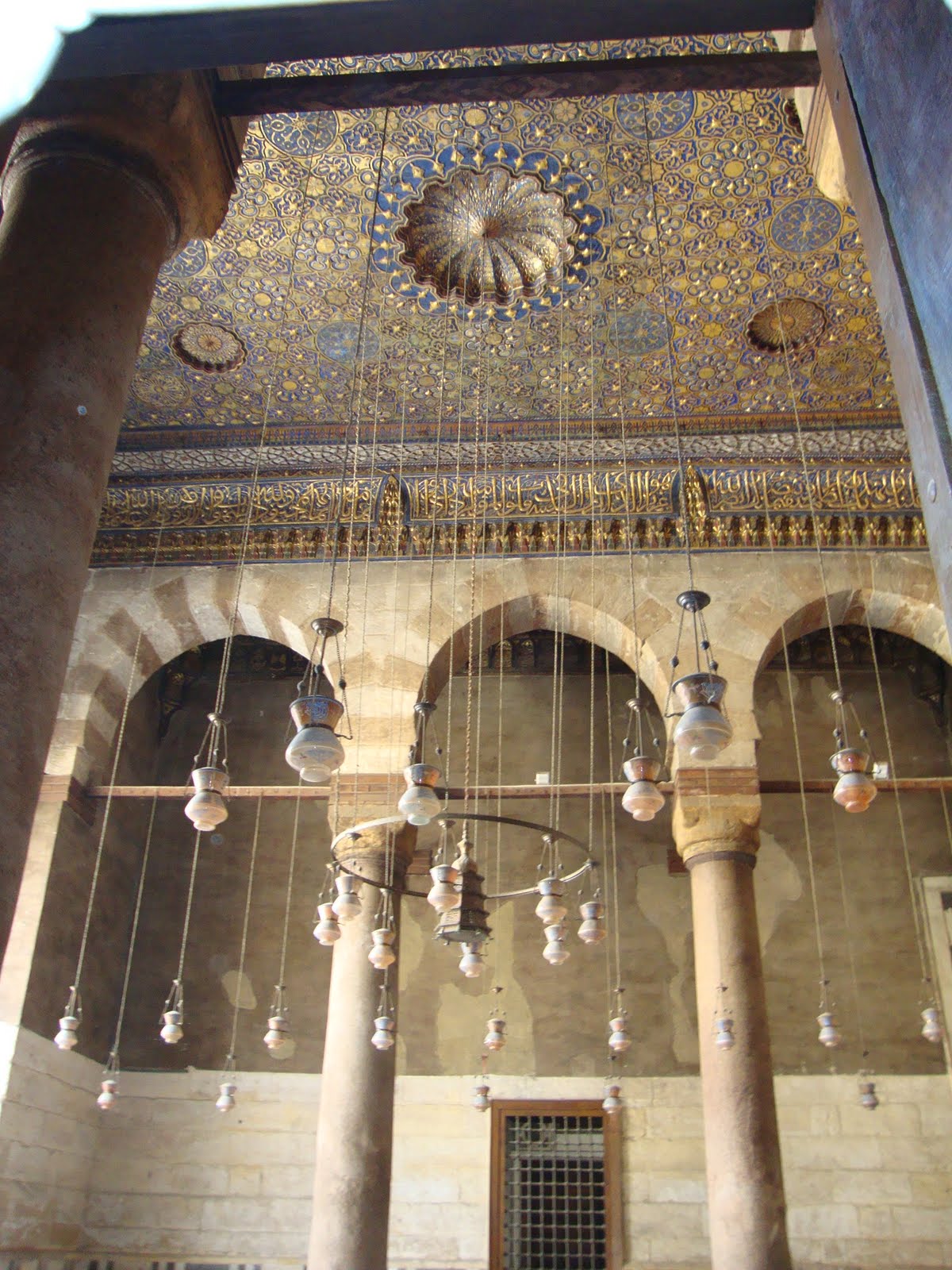
The third building of this contiguous façade is the Khanqah (Sufi monastery) and Madrasa of Sultan Al-Zahir Barquq (1382 – 1399). There are exquisite examples of gilded Arabesque stalactites on the domed ceiling and bands of Koranic inscriptions stretching across the walls of marble inlay and carved Mashrabiyya wood. Colored glass mosque lamps are hung from chains in graceful groupings.
From the street, you can see the interplay of light and form in the recesses which give so much texture to the buildings and the minarets that top the structures are a study in different styles of design and calligraphy. It is a place that constantly affords you a new sight to study and a new treasure at which to marvel.


copyright 2010 Maryanne Stroud Gabbani

Thursday, March 04, 2010

Seeing In A New Way


This has been a very busy spring for me. We've been trying out a new type of work, equestrian tourism, at the farm and all of us have been spending a lot of time in the saddle. As well, I've had some friends come to visit during February, right in the middle of one of the riding tours of course, and wanted to have some time to arrange some things for them. Laurie and I have been friends on email for over 15 years and friends face to face for almost 10 years. We got to know each other on Equine-L so it was only natural that, having recently retired from her work, she should decide to come and visit me in Egypt and go riding. What might not seem so completely natural is the fact that she brought a friend along to "see" Egypt who is blind. I was a bit taken aback at the idea of Gail wandering around our stretch of the Sahara with only someone calling out directions, but all went well and will be in a Sarcophagus post soon. When we were planning activities for Laurie and Gail the seeing issue was an interesting parameter. We talked about museums, but as Gail said "Once you've felt one glass case, you've felt them all". So true.

BUT...I'd read that the Egyptian Museum was instituting special tours for the blind so I called them. Mona, the assistant to the director Dr. Wafaa el-Saddik, told me that so far the tours had been done for school children and not for adults but she would see what they could do. I was totally delighted when Mona called me back to say that they would be happy to do a special tour for Gail, but not nearly as delighted when I realised that I wouldn't be able to participate because I would be working with some riders.

The museum has taken their tours for the blind very seriously and has engaged blind guides to give them. They know the pieces that they present to visitors and also understand how best to "show" them. So not only are blind visitors benefiting from this new service but it is creating work for blind guides as well. Because Gail and Laurie don't speak Arabic, Dr. Wafaa arranged a translator to go with them as well to enable the conversation among everyone concerned. The lovely photographs of Gail examining pieces were taken by a professional photographer since photography is forbidden in the museum.

Gail and Laurie had a great time exploring the museum and many of the more ordinary patrons were rather jealous that she was allowed to touch things while they were being told not to...but there have to be some perks to being blind after all. The last day of their visit we went to the Coptic Museum as well where many of the displays on the ground floor are stone carvings that could be "seen" by Gail. No one minded that she was "seeing" them with her fingers there as well, but without an official photographer to take photos inside the museum, I could do nothing with my camera for my sighted friends to enjoy.


copyright 2010 Maryanne Stroud Gabbani

Tuesday, June 16, 2009

Young Eyes


Each June my niece from California brings a small group of secondary students from Besant Hill School in the Ojai Valley for a two week visit to Egypt. They've stayed at my farm in the midst of Egyptian farmers and visited some of the less touristy sites of Cairo...and naturally the pyramids of Giza. Gotta do the Pyramids. These are relatively privileged American kids and Jen's idea is that two weeks in Egypt will open their eyes to the richness and variety of life in a country that they've previously seen in a fairly two dimensional aspect. The hope is that they will return to assess their own lives and country in a new way.

This year we arranged a minibus for them with a very personable young driver who has learned to enjoy hip-hop music as well as local Egyptian music. They were accompanied on many of their day trips by a young male friend of ours who acted as interpreter and who has taken the kids out to an Egyptian movie and bowling as well as to visit the Citadel and Khan el Khalili. They've spent time at an orphanage in Mokattem and walked around Zamalek after visiting the Sudanese refugee center at All Saints Cathedral there with Reem, a young Sudanese woman. Family dinners Reem and Tamer have alternated with local fast food (koshari and such) and card games in my garden with a refugee film festival tonight before catching an early flight home tomorrow morning. It's been delightful having them and listening to their thoughts and questions. This is Jen's fifth trip here (many previous were family visits) and hopefully far from her last as the trip gets better organised every time. You can read their blog entries by clicking the title. It's a lot of fun.

copyright 2009 Maryanne Stroud Gabbani

Thursday, June 04, 2009

The Words In Cairo


Text of President Barack Obama's speech at Cairo University, as transcribed by CQ Transcriptions.

___

I am honored to be in the timeless city of Cairo, and to be hosted by two remarkable institutions. For over a thousand years, Al-Azhar has stood as a beacon of Islamic learning, and for over a century, Cairo University has been a source of Egypt's advancement. Together, you represent the harmony between tradition and progress. I am grateful for your hospitality, and the hospitality of the people of Egypt. I am also proud to carry with me the goodwill of the American people, and a greeting of peace from Muslim communities in my country: assalaamu alaykum.

We meet at a time of tension between the United States and Muslims around the world - tension rooted in historical forces that go beyond any current policy debate. The relationship between Islam and the West includes centuries of coexistence and cooperation, but also conflict and religious wars. More recently, tension has been fed by colonialism that denied rights and opportunities to many Muslims, and a Cold War in which Muslim-majority countries were too often treated as proxies without regard to their own aspirations. Moreover, the sweeping change brought by modernity and globalization led many Muslims to view the West as hostile to the traditions of Islam.

Violent extremists have exploited these tensions in a small but potent minority of Muslims. The attacks of September 11th, 2001 and the continued efforts of these extremists to engage in violence against civilians has led some in my country to view Islam as inevitably hostile not only to America and Western countries, but also to human rights. This has bred more fear and mistrust.

So long as our relationship is defined by our differences, we will empower those who sow hatred rather than peace, and who promote conflict rather than the cooperation that can help all of our people achieve justice and prosperity. This cycle of suspicion and discord must end.

I have come here to seek a new beginning between the United States and Muslims around the world; one based upon mutual interest and mutual respect; and one based upon the truth that America and Islam are not exclusive, and need not be in competition. Instead, they overlap, and share common principles - principles of justice and progress; tolerance and the dignity of all human beings.

I do so recognizing that change cannot happen overnight. No single speech can eradicate years of mistrust, nor can I answer in the time that I have all the complex questions that brought us to this point. But I am convinced that in order to move forward, we must say openly the things we hold in our hearts, and that too often are said only behind closed doors. There must be a sustained effort to listen to each other; to learn from each other; to respect one another; and to seek common ground. As the Holy Quran tells us, Be conscious of God and speak always the truth. That is what I will try to do - to speak the truth as best I can, humbled by the task before us, and firm in my belief that the interests we share as human beings are far more powerful than the forces that drive us apart.

Part of this conviction is rooted in my own experience. I am a Christian, but my father came from a Kenyan family that includes generations of Muslims. As a boy, I spent several years in Indonesia and heard the call of the azaan at the break of dawn and the fall of dusk. As a young man, I worked in Chicago communities where many found dignity and peace in their Muslim faith.

As a student of history, I also know civilization's debt to Islam. It was Islam - at places like Al-Azhar University - that carried the light of learning through so many centuries, paving the way for Europe's Renaissance and Enlightenment. It was innovation in Muslim communities that developed the order of algebra; our magnetic compass and tools of navigation; our mastery of pens and printing; our understanding of how disease spreads and how it can be healed. Islamic culture has given us majestic arches and soaring spires; timeless poetry and cherished music; elegant calligraphy and places of peaceful contemplation. And throughout history, Islam has demonstrated through words and deeds the possibilities of religious tolerance and racial equality.

I know, too, that Islam has always been a part of America's story. The first nation to recognize my country was Morocco. In signing the Treaty of Tripoli in 1796, our second President John Adams wrote, The United States has in itself no character of enmity against the laws, religion or tranquility of Muslims. And since our founding, American Muslims have enriched the United States. They have fought in our wars, served in government, stood for civil rights, started businesses, taught at our Universities, excelled in our sports arenas, won Nobel Prizes, built our tallest building, and lit the Olympic Torch. And when the first Muslim-American was recently elected to Congress, he took the oath to defend our Constitution using the same Holy Quran that one of our Founding Fathers - Thomas Jefferson - kept in his personal library.

So I have known Islam on three continents before coming to the region where it was first revealed. That experience guides my conviction that partnership between America and Islam must be based on what Islam is, not what it isn't. And I consider it part of my responsibility as President of the United States to fight against negative stereotypes of Islam wherever they appear.

But that same principle must apply to Muslim perceptions of America. Just as Muslims do not fit a crude stereotype, America is not the crude stereotype of a self-interested empire. The United States has been one of the greatest sources of progress that the world has ever known. We were born out of revolution against an empire. We were founded upon the ideal that all are created equal, and we have shed blood and struggled for centuries to give meaning to those words - within our borders, and around the world. We are shaped by every culture, drawn from every end of the Earth, and dedicated to a simple concept: E pluribus unum: Out of many, one.

Much has been made of the fact that an African-American with the name Barack Hussein Obama could be elected President. But my personal story is not so unique. The dream of opportunity for all people has not come true for everyone in America, but its promise exists for all who come to our shores - that includes nearly seven million American Muslims in our country today who enjoy incomes and education that are higher than average.

Moreover, freedom in America is indivisible from the freedom to practice one's religion. That is why there is a mosque in every state of our union, and over 1,200 mosques within our borders. That is why the U.S. government has gone to court to protect the right of women and girls to wear the hijab, and to punish those who would deny it.

So let there be no doubt: Islam is a part of America. And I believe that America holds within her the truth that regardless of race, religion, or station in life, all of us share common aspirations - to live in peace and security; to get an education and to work with dignity; to love our families, our communities, and our God. These things we share. This is the hope of all humanity.

Of course, recognizing our common humanity is only the beginning of our task. Words alone cannot meet the needs of our people. These needs will be met only if we act boldly in the years ahead; and if we understand that the challenges we face are shared, and our failure to meet them will hurt us all.

For we have learned from recent experience that when a financial system weakens in one country, prosperity is hurt everywhere. When a new flu infects one human being, all are at risk. When one nation pursues a nuclear weapon, the risk of nuclear attack rises for all nations. When violent extremists operate in one stretch of mountains, people are endangered across an ocean. And when innocents in Bosnia and Darfur are slaughtered, that is a stain on our collective conscience. That is what it means to share this world in the 21st century. That is the responsibility we have to one another as human beings.

This is a difficult responsibility to embrace. For human history has often been a record of nations and tribes subjugating one another to serve their own interests. Yet in this new age, such attitudes are self-defeating. Given our interdependence, any world order that elevates one nation or group of people over another will inevitably fail. So whatever we think of the past, we must not be prisoners of it. Our problems must be dealt with through partnership; progress must be shared.

That does not mean we should ignore sources of tension. Indeed, it suggests the opposite: we must face these tensions squarely. And so in that spirit, let me speak as clearly and plainly as I can about some specific issues that I believe we must finally confront together.

The first issue that we have to confront is violent extremism in all of its forms.

In Ankara, I made clear that America is not - and never will be - at war with Islam. We will, however, relentlessly confront violent extremists who pose a grave threat to our security. Because we reject the same thing that people of all faiths reject: the killing of innocent men, women, and children. And it is my first duty as President to protect the American people.

The situation in Afghanistan demonstrates America's goals, and our need to work together. Over seven years ago, the United States pursued al Qaida and the Taliban with broad international support. We did not go by choice, we went because of necessity. I am aware that some question or justify the events of 9/11. But let us be clear: al Qaida killed nearly 3,000 people on that day. The victims were innocent men, women and children from America and many other nations who had done nothing to harm anybody. And yet Al Qaeda chose to ruthlessly murder these people, claimed credit for the attack, and even now states their determination to kill on a massive scale. They have affiliates in many countries and are trying to expand their reach. These are not opinions to be debated; these are facts to be dealt with.

Make no mistake: we do not want to keep our troops in Afghanistan. We seek no military bases there. It is agonizing for America to lose our young men and women. It is costly and politically difficult to continue this conflict. We would gladly bring every single one of our troops home if we could be confident that there were not violent extremists in Afghanistan and Pakistan determined to kill as many Americans as they possibly can. But that is not yet the case.

That's why we're partnering with a coalition of forty-six countries. And despite the costs involved, America's commitment will not weaken. Indeed, none of us should tolerate these extremists. They have killed in many countries. They have killed people of different faiths - more than any other, they have killed Muslims. Their actions are irreconcilable with the rights of human beings, the progress of nations, and with Islam. The Holy Quran teaches that whoever kills an innocent, it is as if he has killed all mankind; and whoever saves a person, it is as if he has saved all mankind. The enduring faith of over a billion people is so much bigger than the narrow hatred of a few. Islam is not part of the problem in combating violent extremism - it is an important part of promoting peace.

We also know that military power alone is not going to solve the problems in Afghanistan and Pakistan. That is why we plan to invest $1.5 billion each year over the next five years to partner with Pakistanis to build schools and hospitals, roads and businesses, and hundreds of millions to help those who have been displaced. And that is why we are providing more than $2.8 billion to help Afghans develop their economy and deliver services that people depend upon.

Let me also address the issue of Iraq. Unlike Afghanistan, Iraq was a war of choice that provoked strong differences in my country and around the world. Although I believe that the Iraqi people are ultimately better off without the tyranny of Saddam Hussein, I also believe that events in Iraq have reminded America of the need to use diplomacy and build international consensus to resolve our problems whenever possible. Indeed, we can recall the words of Thomas Jefferson, who said: I hope that our wisdom will grow with our power, and teach us that the less we use our power the greater it will be.

Today, America has a dual responsibility: to help Iraq forge a better future - and to leave Iraq to Iraqis. I have made it clear to the Iraqi people that we pursue no bases, and no claim on their territory or resources. Iraq's sovereignty is its own. That is why I ordered the removal of our combat brigades by next August. That is why we will honor our agreement with Iraq's democratically-elected government to remove combat troops from Iraqi cities by July, and to remove all our troops from Iraq by 2012. We will help Iraq train its Security Forces and develop its economy. But we will support a secure and united Iraq as a partner, and never as a patron.

And finally, just as America can never tolerate violence by extremists, we must never alter our principles. 9/11 was an enormous trauma to our country. The fear and anger that it provoked was understandable, but in some cases, it led us to act contrary to our ideals. We are taking concrete actions to change course. I have unequivocally prohibited the use of torture by the United States, and I have ordered the prison at Guantanamo Bay closed by early next year.

So America will defend itself respectful of the sovereignty of nations and the rule of law. And we will do so in partnership with Muslim communities which are also threatened. The sooner the extremists are isolated and unwelcome in Muslim communities, the sooner we will all be safer.

The second major source of tension that we need to discuss is the situation between Israelis, Palestinians and the Arab world.

America's strong bonds with Israel are well known. This bond is unbreakable. It is based upon cultural and historical ties, and the recognition that the aspiration for a Jewish homeland is rooted in a tragic history that cannot be denied.

Around the world, the Jewish people were persecuted for centuries, and anti-Semitism in Europe culminated in an unprecedented Holocaust. Tomorrow, I will visit Buchenwald, which was part of a network of camps where Jews were enslaved, tortured, shot and gassed to death by the Third Reich. Six million Jews were killed - more than the entire Jewish population of Israel today. Denying that fact is baseless, ignorant, and hateful. Threatening Israel with destruction - or repeating vile stereotypes about Jews - is deeply wrong, and only serves to evoke in the minds of Israelis this most painful of memories while preventing the peace that the people of this region deserve.

On the other hand, it is also undeniable that the Palestinian people - Muslims and Christians - have suffered in pursuit of a homeland. For more than sixty years they have endured the pain of dislocation. Many wait in refugee camps in the West Bank, Gaza, and neighboring lands for a life of peace and security that they have never been able to lead. They endure the daily humiliations - large and small - that come with occupation. So let there be no doubt: the situation for the Palestinian people is intolerable. America will not turn our backs on the legitimate Palestinian aspiration for dignity, opportunity, and a state of their own.

(APPLAUSE)

For decades, there has been a stalemate: two peoples with legitimate aspirations, each with a painful history that makes compromise elusive. It is easy to point fingers - for Palestinians to point to the displacement brought by Israel's founding, and for Israelis to point to the constant hostility and attacks throughout its history from within its borders as well as beyond. But if we see this conflict only from one side or the other, then we will be blind to the truth: the only resolution is for the aspirations of both sides to be met through two states, where Israelis and Palestinians each live in peace and security.

(APPLAUSE)

That is in Israel's interest, Palestine's interest, America's interest, and the world's interest. That is why I intend to personally pursue this outcome with all the patience that the task requires. The obligations that the parties have agreed to under the Road Map are clear. For peace to come, it is time for them - and all of us - to live up to our responsibilities.

Palestinians must abandon violence. Resistance through violence and killing is wrong and does not succeed. For centuries, black people in America suffered the lash of the whip as slaves and the humiliation of segregation. But it was not violence that won full and equal rights. It was a peaceful and determined insistence upon the ideals at the center of America's founding. This same story can be told by people from South Africa to South Asia; from Eastern Europe to Indonesia. It's a story with a simple truth: that violence is a dead end. It is a sign of neither courage nor power to shoot rockets at sleeping children, or to blow up old women on a bus. That is not how moral authority is claimed; that is how it is surrendered.

Now is the time for Palestinians to focus on what they can build. The Palestinian Authority must develop its capacity to govern, with institutions that serve the needs of its people. Hamas does have support among some Palestinians, but they also have responsibilities. To play a role in fulfilling Palestinian aspirations, and to unify the Palestinian people, Hamas must put an end to violence, recognize past agreements, and recognize Israel's right to exist.

At the same time, Israelis must acknowledge that just as Israel's right to exist cannot be denied, neither can Palestine's. The United States does not accept the legitimacy of continued Israeli settlements. This construction violates previous agreements and undermines efforts to achieve peace. It is time for these settlements to stop.

(APPLAUSE)

Israel must also live up to its obligations to ensure that Palestinians can live, and work, and develop their society. And just as it devastates Palestinian families, the continuing humanitarian crisis in Gaza does not serve Israel's security; neither does the continuing lack of opportunity in the West Bank. Progress in the daily lives of the Palestinian people must be part of a road to peace, and Israel must take concrete steps to enable such progress.

Finally, the Arab States must recognize that the Arab Peace Initiative was an important beginning, but not the end of their responsibilities. The Arab-Israeli conflict should no longer be used to distract the people of Arab nations from other problems. Instead, it must be a cause for action to help the Palestinian people develop the institutions that will sustain their state; to recognize Israel's legitimacy; and to choose progress over a self-defeating focus on the past.

America will align our policies with those who pursue peace, and say in public what we say in private to Israelis and Palestinians and Arabs. We cannot impose peace. But privately, many Muslims recognize that Israel will not go away. Likewise, many Israelis recognize the need for a Palestinian state. It is time for us to act on what everyone knows to be true.

Too many tears have flowed. Too much blood has been shed. All of us have a responsibility to work for the day when the mothers of Israelis and Palestinians can see their children grow up without fear; when the Holy Land of three great faiths is the place of peace that God intended it to be; when Jerusalem is a secure and lasting home for Jews and Christians and Muslims, and a place for all of the children of Abraham to mingle peacefully together.

(APPLAUSE)

... as in the story of Isra.

(APPLAUSE)

... as in the story of Isra, when Moses, Jesus, and Mohammed -- peace be upon them -- joined in prayer.

(APPLAUSE)

The third source of tension is our shared interest in the rights and responsibilities of nations on nuclear weapons.

(APPLAUSE)

This issue has been a source of tension between the United States and the Islamic Republic of Iran. For many years, Iran has defined itself in part by its opposition to my country, and there is indeed a tumultuous history between us. In the middle of the Cold War, the United States played a role in the overthrow of a democratically- elected Iranian government. Since the Islamic Revolution, Iran has played a role in acts of hostage-taking and violence against U.S. troops and civilians. This history is well known. Rather than remain trapped in the past, I have made it clear to Iran's leaders and people that my country is prepared to move forward. The question, now, is not what Iran is against, but rather what future it wants to build.

It will be hard to overcome decades of mistrust, but we will proceed with courage, rectitude and resolve. There will be many issues to discuss between our two countries, and we are willing to move forward without preconditions on the basis of mutual respect. But it is clear to all concerned that when it comes to nuclear weapons, we have reached a decisive point. This is not simply about America's interests. It is about preventing a nuclear arms race in the Middle East that could lead this region and the world down a hugely dangerous path.

I understand those who protest that some countries have weapons that others do not. No single nation should pick and choose which nations hold nuclear weapons. That is why I strongly reaffirmed America's commitment to seek a world in which no nations hold nuclear weapons. And any nation - including Iran - should have the right to access peaceful nuclear power if it complies with its responsibilities under the nuclear Non-Proliferation Treaty. That commitment is at the core of the Treaty, and it must be kept for all who fully abide by it. And I am hopeful that all countries in the region can share in this goal.

The fourth issue that I will address is democracy.

(APPLAUSE)

I know there has been controversy about the promotion of democracy in recent years, and much of this controversy is connected to the war in Iraq. So let me be clear: no system of government can or should be imposed upon one nation by any other.

That does not lessen my commitment, however, to governments that reflect the will of the people. Each nation gives life to this principle in its own way, grounded in the traditions of its own people. America does not presume to know what is best for everyone, just as we would not presume to pick the outcome of a peaceful election. But I do have an unyielding belief that all people yearn for certain things: the ability to speak your mind and have a say in how you are governed; confidence in the rule of law and the equal administration of justice; government that is transparent and doesn't steal from the people; the freedom to live as you choose. Those are not just American ideas, they are human rights, and that is why we will support them everywhere.

There is no straight line to realize this promise. But this much is clear: governments that protect these rights are ultimately more stable, successful and secure. Suppressing ideas never succeeds in making them go away. America respects the right of all peaceful and law-abiding voices to be heard around the world, even if we disagree with them. And we will welcome all elected, peaceful governments - provided they govern with respect for all their people.

This last point is important because there are some who advocate for democracy only when they are out of power; once in power, they are ruthless in suppressing the rights of others. No matter where it takes hold, government of the people and by the people sets a single standard for all who hold power: you must maintain your power through consent, not coercion; you must respect the rights of minorities, and participate with a spirit of tolerance and compromise; you must place the interests of your people and the legitimate workings of the political process above your party. Without these ingredients, elections alone do not make true democracy.

The fifth issue that we must address together is religious freedom.

Islam has a proud tradition of tolerance. We see it in the history of Andalusia and Cordoba during the Inquisition. I saw it firsthand as a child in Indonesia, where devout Christians worshipped freely in an overwhelmingly Muslim country. That is the spirit we need today. People in every country should be free to choose and live their faith based upon the persuasion of the mind, heart, and soul. This tolerance is essential for religion to thrive, but it is being challenged in many different ways.

Among some Muslims, there is a disturbing tendency to measure one's own faith by the rejection of another's. The richness of religious diversity must be upheld - whether it is for Maronites in Lebanon or the Copts in Egypt.

(APPLAUSE)

And fault lines must be closed among Muslims as well, as the divisions between Sunni and Shia have led to tragic violence, particularly in Iraq.

Freedom of religion is central to the ability of peoples to live together. We must always examine the ways in which we protect it. For instance, in the United States, rules on charitable giving have made it harder for Muslims to fulfill their religious obligation. That is why I am committed to working with American Muslims to ensure that they can fulfill zakat.

Likewise, it is important for Western countries to avoid impeding Muslim citizens from practicing religion as they see fit - for instance, by dictating what clothes a Muslim woman should wear. We cannot disguise hostility towards any religion behind the pretence of liberalism.

Indeed, faith should bring us together. That is why we are forging service projects in America that bring together Christians, Muslims, and Jews. That is why we welcome efforts like Saudi Arabian King Abdullah's Interfaith dialogue and Turkey's leadership in the Alliance of Civilizations. Around the world, we can turn dialogue into Interfaith service, so bridges between peoples lead to action - whether it is combating malaria in Africa, or providing relief after a natural disaster.

The sixth issue -- the sixth issue that I want to address is women's rights.

(APPLAUSE)

I know...

(APPLAUSE)

I know, and you can tell from this audience, that there is a healthy debate about this issue. I reject the view of some in the West that a woman who chooses to cover her hair is somehow less equal. But I do believe that a woman who is denied an education is denied equality.

(APPLAUSE)

And it is no coincidence that countries where women are well- educated are far more likely to be prosperous.

Now let me be clear, issues of women's equality are by no means simply an issue for Islam. In Turkey, Pakistan, Bangladesh, Indonesia, we've seen Muslim-majority countries elect a woman to lead.

Meanwhile, the struggle for women's equality continues in many aspects of American life and in countries around the world. I am convinced that our daughters can contribute just as much to society as our sons.

(APPLAUSE)

Our common prosperity will be advanced by allowing all humanity, men and women, to reach their full potential. I do not believe that women must make the same choices as men in order to be equal. And I respect those women who choose to live their lives in traditional roles. But it should be their choice.

That is why the United States will partner with any Muslim- majority country to support expanded literacy for girls and to help young women pursue employment through micro-financing that helps people live their dreams.

The issues that I have described will not be easy to address, but we have a responsibility to join together to behalf of the world that we seek, a world where extremists no longer threaten our people and American troops have come home; a world where Israelis and Palestinians are each secure in a state of their own and nuclear energy is used for peaceful purposes, a world where governments serve their citizens and the rights of all God's children are respected. Those are mutual interests. That is the world we seek. But we can only achieve it together. I know there are many, Muslim and non-Muslim, who question whether we can forge this new beginning. Some are eager to stoke the flames of division and to stand in the way of progress. Some suggest that it isn't worth the effort, that we are fated to disagree and civilizations are doomed to clash.

Many more are simply skeptical that real change can occur. There is so much fear, so much mistrust that has built up over the years. But if we choose to be bound by the past, we will never move forward. And I want to particularly say this to young people of every faith in every country. You more than anyone have the ability to reimagine the world, the remake this world.

All of us share this world for but a brief moment in time. The question is whether we spend that time focused on what pushes us apart or whether we commit ourselves to an effort, a sustained effort to find common ground, to focus on the future we seek for our children and to respect the dignity of all human beings.

It's easier to start wars than to end them. It's easier to blame others than to look inward. It's easier to see what is different about someone than to find the things we share. But we should choose the right path, not just the easy path. There is one rule that lies at the heart of every religion, that we do unto others as we would have them do unto us.

(APPLAUSE)

This truth transcends nations and peoples, a belief that isn't new, that isn't black or white or brown, that isn't Christian or Muslim or Jew. It's a belief that pulsed in the cradle of civilization and that still beats in the hearts of billions around the world. It's a faith in other people. And it's what brought me here today.

We have the power to make the world we seek, but only if we have the courage to make a new beginning, keeping in mind what has been written. The Holy Quran tells us, Mankind, we have created you male and a female. And we have made you into nations and tribes so that you may know one another.

The Talmud tells us, The whole of the Torah is for the purpose of promoting peace.

The Holy Bible tells us, Blessed are the peacemakers, for they shall be called sons of God.

(APPLAUSE)

The people of the world can live together in peace. We know that is God's vision. Now that must be our work here on Earth.

Thank you. And may God's peace be upon you. Thank you very much.

Thank you.

END


copyright 2009 Maryanne Stroud Gabbani