Showing posts with label food. Show all posts

Monday, December 07, 2009

The Egyptian Onion


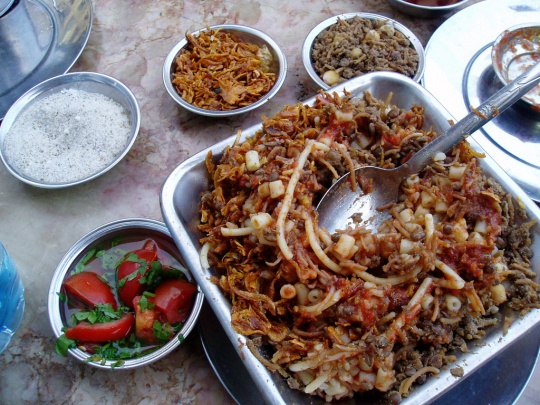
As someone whose favourite "news" shows are the Daily Show with Jon Stewart and The Colbert Report, I have also long been a fan of The Onion, a American satirical "news" source. My theory is that these things aren't funny unless you have a fairly good idea of what news is the basis for the satire, so they are a reasonable jumping off point for news. Recently a group of young Egyptian writers who are only known by their pseudonyms: Makarona (pasta), Ward Zeyada (extra fried onions), and Subar Lox (a term for a standard size for koshary) have started up an Egyptian version of The Onion. El-Koshary Today is named after an Egyptian dish that is a conglomeration of dark lentils, chickpeas, rice, and pasta topped with fried onions, a spicy tomato sauce and a garlic/vinegar sauce. Cheap and filling, koshary is a streetside favourite in Egypt and this literary version is fast on its way to becoming just as enjoyable. While locals like myself can laugh at their send-ups of Egyptian news, the stories might entice people elsewhere to explore some of the issues brought up in some of the more mainstream sources.

You can make up a batch of koshary with this recipe and giggle your way through the wesite.

Happy nibbling!

copyright 2009 Maryanne Stroud Gabbani

Monday, September 28, 2009

A Watering Place Dries Up

For many, many years Christo, the fish restaurant across the road from the Mena House Oberoi at Giza, has been a favourite place to take visitors for a nice fish dinner and a beer or glass of wine while watching the lights of the Sound And Light play across the pyramids on the hill. Yesterday I met some friends of friends in the US who were visiting Cairo for dinner there and found to my disappointment that the restaurant has been bought by new owners who have decided that they will no longer serve alcohol. Christo was never exactly a riotous beer brawl sort of establishment in the first place, but nibbling on calamari and shrimp while sipping a cool Stella was a lovely way to spend a summer evening. My friends were still happy with the dinner, having no real reference point, but I found that not only did I miss the liquid refreshments, but the food isn't as good as it used to be either. Salads and fish were not as fresh. Another tradition falls by the wayside.

copyright 2009 Maryanne Stroud Gabbani

Wednesday, August 05, 2009

Watch For This Film Somewhere

I've been really remiss in my posting to my blogs lately but it's really hard to type with one arm tied to one's body. My shoulder surgery is slowing me down. I am, however, still able to wander the net reading interesting articles. This is an interview with Mai Iskander who created a film about some of the young men in the zebaleen culture here in Cairo. One of the points that she brings up is the fact that the garbage of Cairo is roughly 50% organic and this organic waste was fed to the pigs that the government slaughtered a few months back. Not having pigs has caused the closure of a number of shops where Cairo residents could buy pork products, which is an inconvenience, has cost the zebaleen considerable income, which is a tragedy...but what I want to know is what is happening to the organic waste of roughly 15 million people? And in this summer heat? EWWWWWW!

copyright 2009 Maryanne Stroud Gabbani

Friday, May 01, 2009

Watching out for Influenza A (H1N1)

Having watched the drop in trade in pork (a perfectly reasonable meat when prepared properly) and the slaughter of many innocent pigs, the WHO has changed the name of this version of influenza to the slightly less inflammatory Influenza A (H1N1). Probably a case of closing the barn door after inviting the butcher in, however. My condolences to the pigs who really have nothing at all to do with anything. No pigs have been ill from the erstwhile "swine flu" and forcing the slaughter of them is a serious hardship for the zebaleen of Mokattam who are one of the best recycling services in the world.

copyright 2009 Maryanne Stroud Gabbani

Thursday, April 30, 2009

Issuing The Pigs Their Wings


It was announced on international news that the Egyptian government would force farmers to slaughter all their pigs to prevent swine flu. This is almost as intelligent as Paris Hilton telling people that she wasn't worried about it because she doesn't eat pork. The pigs are irrelevant at this stage. The flu is transmitted from human contact and according to some WHO officials isn't nearly the threat that the bird flu is. I suspect the combination of the word "swine", the cultural taboo on pork, and the almost universal ignorance among bureuacrats of how disease is spread is almost irresistible. There are quite a number of modern, properly run pig farms in Egypt...just as we have quite a few properly run examples of almost anything here...except maybe government officials.

copyright 2009 Maryanne Stroud Gabbani

Sunday, September 28, 2008

Bananas and Other Samples


One of the best things about having a farm is being able to plant fun things all around you. We planted fruit trees: apple, peach, guava, pomegranate, ishta, oranges, lemons, tangerines, and bananas, as well as very playful crops like sugar cane. The cane is tall now and visitors over the Feast that begins on Tuesday will get to cut stalks down and chew the sweet juice out. What's left over is more than appreciated by the horses, donkeys and goats.

Banana trees were some of the first things planted here and I have a couple of varieties. One type is the larger banana that is familiar in Europe or the US, but my favourite is the smaller type, what my kids used to call "banana samples". These tiny bananas are only a couple of bites but the flavour is wonderful and they don't go immediately to banana mush as they ripen. When I began visting Egypt in the late 70's, one of the first things to be imported here was a total mystery to me because they were importing Dole bananas...big tasteless yellow things in a country where the tiny bananas were so good. My husband's family learned very quickly that I was not at all impressed with imported bananas. These were simply not in the same class as the sweet little local bananas like the stalk being inspected in the photo by some of the dogs who were hoping for bones.

Now as we prepare for about four days of complete idleness (well, maybe not depending on how many people decide to take advantage of the holidays to stay and play in Cairo possibly at the farm rather than going to the beach...it's still hot here) I've taken more time on my collection of Egypt blogs and would suggest that they are a marvelous way to realise the richness of the experience here. I've found blogs from students here in Arabic courses, professors at the American University, housewives caring for young and not so young children while husbands pursue their careers, and locals of all flavours. They talk about so many aspects of life here, both good and bad, that a wander through the blogs will give you a wonderful tour. I know that elsewhere the Feast is not an occasion of idleness, but maybe during low points in news programs or evening TV you might pick one or two to try out. These samples of Egyptian life are just as tempting and tasty as our tiny bananas.


copyright 2008 Maryanne Stroud Gabbani

Sunday, March 30, 2008

A Problem For Everyone


There have been stories in the press here and abroad about the problems at the government bread bakeries due to flour shortages. We are definitely in the midst of a serious problem in Egypt with inflation, especially as it affects food. But we are not alone, as detailed by the writer of the Globe and Mail article I've linked to with the title. People are experiencing similar problems all over the world.

I don't go into the city that much, especially since there is almost nothing that can be done there that doesn't cost money, and with a farm to support, I really don't want to go about spending unnecessarily. Today I went into Maadi to pick up a replacement pair of glasses and to do my month's grocery shopping. Shopping every day the price increases sort of sneak up on you, but shopping once a month, they smack you in the face. I have to admit that I'm spoiled rotten by having the wonderful Mohamed...driver, accountant, supervisor of workers, right hand man....who does my day to day shopping. He has the advantage of living near one of the best fruit and vegetable markets in Cairo but we've been watching the price fluctuations in that realm with a jaundiced eye.

Going to the market once a month for the essentials puts a special light on pricing. I am a boring shopper. I buy the same basics month after month: some chicken breasts, corn meal for parrot bread, skim milk and skim milk yogurt, some oil, some rice, lentils, chick peas...simple stuff. It's only me in the house after all and I like my food real and freshly cooked, so I don't need too much.

I do this shopping in one of the largest supermarkets in Maadi. There are things that I like that I can find in a place like that, such as cherry preserves, that I like. Yeah, like I said, I'm a bit spoiled. Metro, the supermarket, has a cheese section, a meat section, a poultry section, a fish market, and a delicatessen...it's a normal supermarket. Last time I was there, I bought a tray of chicken breast for about 30 LE...that's for about 8 half breasts. Today the same tray was over 40 LE. My skim milk that was about 3.5 LE 6 months ago is now almost 5 LE a litre. A small jar of nice green pepper salsa, locally produced, was 3.5 LE last month and is 5 LE this month. Rice that was 2.5 LE is now almost 5 LE.

As I wandered around the aisles gazing in horror at the costs of living exploding before me, I noticed that there was almost no one else in the store. Ordinarily, I'd see families doing their shopping, mothers with toddlers in tow picking up cereal and pampers, all nationalities...but today there was an older gentleman moving about looking at more things than he was buying and a young woman picking up item after item only to put them down with a snort of disgust. The store, while not empty, was significantly less crowded than I'd ever seen it.

My staff have been telling me about the price increases over the past months, but it isn't the same thing as walking in and being assaulted by the price increases at every turn. We are living and working in a farming area where we can grow some of our food. How are people who are on very limited incomes in cities and have no way to provide for themselves going to manage?

In my reading about the price issues in the grain trade I've seen that there are some interesting issues involved in the shortages and high prices. One of the issues that one article was discussing was the abnormal trading and pricing patterns over the past few years since investment funds were allowed to trade commodities. This means in addition to stocks and bonds, these investment funds could speculate on commodities that are the bases of our food supply. As the widow of a grain trader, I have some understanding of the general workings of this field, and I really think that the trading of something as important as food should not be in the hands of speculators. I realise that everyone in the grain trade is also speculating to a certain extent, but at the end of the day they are trying to move the grain from Point A to Point B. Mutual funds aren't moving food from producers to consumers. I also have to question the wisdom of the current field of biofuels. If we are using food for people to power vehicles that many of the people needing food don't even have...what is the point? It's all very well to try to develop a renewable fuel source, but do we want to compete with our own cars and buses for our food supply? These aren't just Egyptian concerns and problems. They are affecting us all. Shortages in rice, corn, and wheat are causing price increases in staples and meats all over the world. A Canadian friend of mine confided that a loaf of bread in her area was about $2.50. Looks like we are all in this together.

copyright 2008 Maryanne Stroud Gabbani

Thursday, August 30, 2007

Time Enough To Eat

Egyptian food is wonderful. Much of the wonderfulness of it comes from the freshness of the ingredients. I was cruising the news on the internet and found an interesting piece on Time online (you can reach it by clicking the title here) about how much of the cultural aspects of eating are being lost in the globalisation of fast food. My closest fast food place is probably about 15 km, a fact which never fails to please me. In Egypt fast food places all deliver, making it even easier to destroy yourself with food. On the other hand, sometimes I get an invitation to Mabrouka's and that is much, much better. Mabrouka is a widow about my own age with four sons and two daughters. Two of the sons are married, two are not yet...all of them live in the family house. The daughters are married and live nearby. Mabrouka grows her own poultry and buys produce in the village that is grown by her neighbours. She is a wonderful cook, as you can see in the photo. Dinner included chicken cooked with sliced potatoes in a tomato sauce (fresh tomatoes of course...not a can in her house) that were baked in a wood burning oven. The roast chicken was also baked in the oven and the stuffed aubergine, peppers, zucchini, and cabbage leaves were cooked on a stone top to the oven. It's more work than I want to do, but boy, do I appreciate her work. Dessert is usually fruit.

I wish I could say that since moving to the farm I've lost a ton of weight and become sleek and svelte, but that would be fibbing. I haven't but I know that my diet is a lot healthier than it was in the city. The temptation to just call for a pizza was always really a tough one. Now most of my meals are prepared from the things that we are growing on the farm. This depends on the season, but being able to freeze or dry vegetables makes them last. Like most of our neighbours, we are growing the summer crop of bamia, or okra. Part of the reason for this is because I find the flowers lovely. Fresh okra is eaten while still small, but the parrots and poultry appreciate the larger pods. When dried and ground into a powder, the pods are the basis of a Sudanese stew, moolah, of which I am inordinately fond in the winter. The pods have small spines on them and I'm always struck by the dedication of the okra farmers who have to pick their crop in the summer heat while completely wrapped in fabric to keep the spines out of their fingers, arms, legs, and faces. Much of the crop is frozen to provide okra for winter meals, since when it is cooked with the rich tomato sauce and small chunks of meat, it makes for a very filling meal...much more filling than is needed in summer.

Another summer crop that is more appreciated in the winter is molokheya, which could be called the Egyptian national dish. Molokheya is essentially a weed called swamp mallow other places, a tall plant with shiny oval leaves and small yellow flowers. It grows almost anywhere wild and is also planted in fields. The leaves are chopped if fresh, or crumbled when dry, and cooked in a chicken, rabbit, or beef stock to which is added a fried garlic, coriander and a bit of cumin. Hot pepper can be added to taste as well. The molokheya makes a rather mucilaginous soup...another word for sort of slimy...but it is known to be good for digestion. Once you get past the texture, and some people never do, it is wonderfully delicious over rice. We have a small field of it growing next to the longeing ring and I find the plants all over the garden popping up next to roses or behind palm trees. Welcome.
My parrots like peppers, my grooms love peppers, and I like them too. This year we planted hot peppers and I learned that if you pick them young, they are usually sweet, but if you wait for them to ripen to red, they pick up a lot on the heat scale. Peppers have a ton of Vitamin C among other things and are very good for you. I never had any idea how many peppers can be produced by relatively few plants. It's quite astonishing and I haven't had to buy peppers all year. We also are still working our way through the braided onions and garlic in the verandah, while it is almost time to plant again.

Zucchini is a vegetable that is planted all year round and it only takes about two months to complete the growing cycle. One of my friends in Alexandria called Egypt "the land of the eternal zucchini" because of the omnipresence of this vegetable. Yesterday I made a salad from gargeer (aka: Arugula) cut fresh from the garden, tomatoes and red onions also just picked, the first zucchini from our garden sauteed with garlic and mushrooms (the only bought items), with chopped roast chicken. Zucchini just out of the garden tastes NOTHING like the stuff that you get from the supermarket. In another week I'll be sending zucchini home with my grooms because there really are limits to how much I can eat, even with the poultry, rabbits, parrots, and tortoises helping.

Finally, being on the cusp of the mango and date seasons, we have a number of sweet options. The mangoes this year had a hard time with the summer heat, but they are just as juicy as ever. The new dates are just coming on the market in time for Ramadan in a couple of weeks, and the sweet red Zaghlouls are already being sold on the roadsides. Left for a couple of days they turn brown and softer, resembling the dates that are more common in Europe and North America. The grapes, both seedless and with seeds are still in season as are the guavas. As the weather cools, apples, oranges, and bananas will take their places.

The farmers here for the most part eat a vegetarian diet. Vegetables grown in the fields, cheese and yogurt from the family cow or buffalo, and bread or rice are the staples. Breakfast is often cooked beans known as foul (pronounced "fool") cooked with onions, garlic, cumin and lemon, and eaten with cheese and bread. Lunch may be bread, cheese, onions, and then dinner might be a vegetable stew. It's a healthier diet than is followed in the city by a long shot. Sometimes it's easy not to miss junk food.
copyright 2007 Maryanne Stroud Gabbani
Thursday, July 05, 2007

The World's Best Hamburger Is in Egypt


This is the kind of story about Egypt that I really love...well, I liked the crocodile a lot even if it may or may not be absolutely true. And I'm more than willing to toss my vote in with Scott Macleod for Lucille's cheesburger. It may not look like anything special, but Lucille's is the only place where I will eat a cheeseburger. Their apple crumble pie with vanilla ice cream is rather bewitching as well.

I was up at 6 am this morning to take a family of four who had been staying with me for a few days to the airport to catch a plane to Sharm el Sheikh. They wanted to get a sense of Cairo that wasn't bounded by the walls of a hotel, so they stayed in my guesthouse for a while, enjoying the heat and my pitiful excuse of air conditioning, being woken at 7 am by the grooms preparing breakfast for the animals, and trying out some of the local family restaurants. I sent them to Abou Sid in Maadi for dinner last night because they wanted some Egyptian cooking. Abou Sid is a chain of family restaurants that may just serve some of the best Egyptian food in the country, aside from a number of grandmothers that I know.


As I was driving back to the farm, I realised that I have some errands to do in Maadi and decided to treat myself to lunch at Lucille's as a reward for going into town. So imagine my delight to run across this article in my Google alerts. I promptly emailed it to my kids and some of their friends for whom Lucille's was a regular hangout.

Who wouldn't like to live in the country with the best hamburger in the world?

copyright 2007 Maryanne Stroud Gabbani