Showing posts with label tourism. Show all posts

Friday, July 30, 2010

Beads And Baubles

Post courtesy of Pat Canfield

As readers of this blog will know, Maryanne often has friends and guests from abroad visiting her. Recently a friend from New Zealand came for an extended visit --- her fourth so far. Since Maryanne is recuperating from her knee surgery, she asked me to take her friend to the Khan El Khalili to do some shopping. For those of you who have been here, you understand what that can entail.
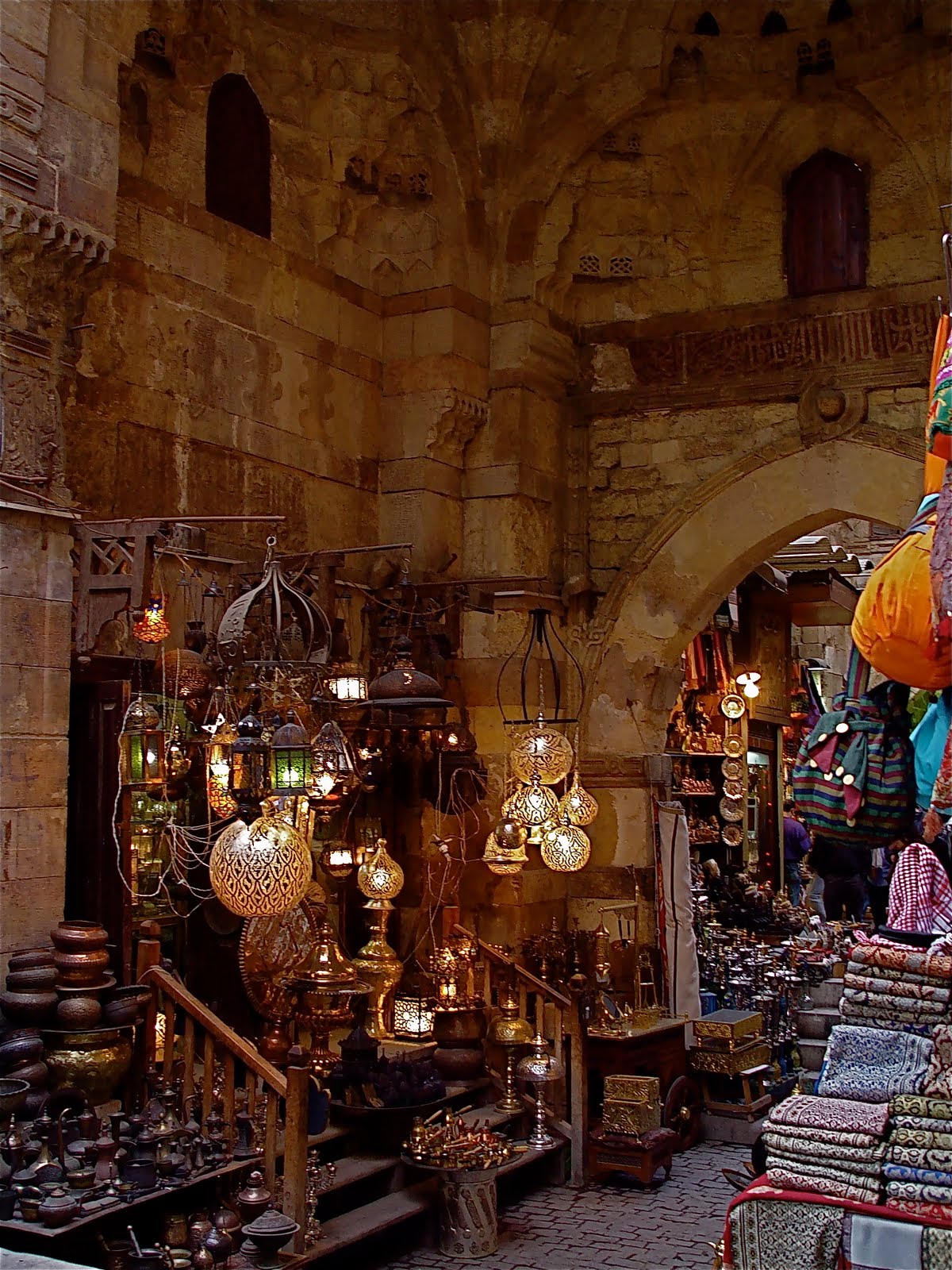
On a good day, the vendors can allow people to wander and peruse the shops at leisure. On a day where the planets are in the wrong alignment, they have the mentality and finesse of street hustlers the world over who make one want to bring in the Terminator to deal with them. Sadly, since we went early in the morning, their energy levels were high and we had the warm cuddly feeling of turkeys running the gauntlet on the day before Thanksgiving.

However, Kelly wanted to buy some belly dancing costumes and so off we went (not even fortified by cappuccino I might add). As she is a veteran of Khan shopping, we were able to negotiate without hysteria or total breakdown as I have occasionally witnessed with un-warned tourists. We did stop at one of the shops where they have a wonderful selection of crystal goblets, ornaments, t-shirts and folkloric dresses. The owner, Maged, is always pleasant, helpful and charges correct prices. This sadly lulls you before going back out into the battlefield.

We then dodged and ducked through the medieval passages that make up the centuries old market and ignored some terrifying displays of belly dancing outfits that were hanging from doors and archways. The current selection of tourist souvenirs that come in from China would be lucky to only have high lead content as opposed to scary design elements. Fortunately on one of the main streets, we found a man who makes the costumes and sells from his workshop and showroom. He is on the fifth floor of a multi-bazaar shop and does not sell to other vendors.
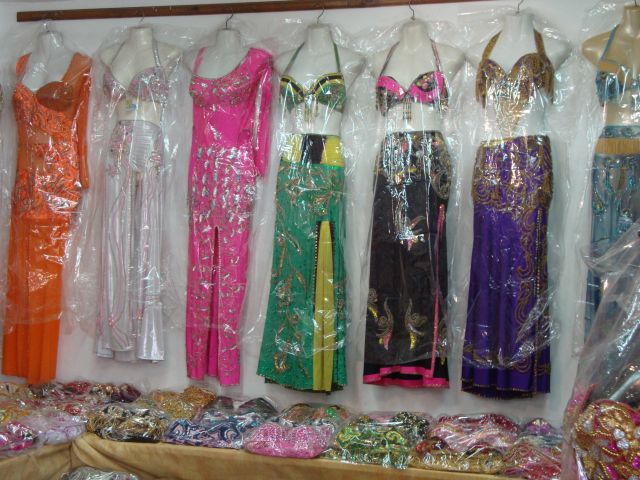
We were surrounded by displays of costumes swathed in plastic covers lining the walls and displayed on headless plastic torsos that looked like a rather unfortunate chorus line but everything was clean. Shelves were neatly stacked with scarves and belts edged with coins. One room had the flowing skirts for beginners and another room had tables of the beaded costumes wrapped in clear plastic bags looking all of the world like brightly beaded cocktail purses.

The owner and haberdasher, Ahmed, has been in the business since he was 12 years old and prides himself on matching the customer to the costume. Kelly had great fun trying on scarves and a flowing skirt over her jeans and t-shirt. Then she moved on to requests from some of her friends back in New Zealand.

Sitting on the tapestry sofas and happily drinking cold soda, we got a bit of a lesson on why there are different price levels on the street. The beads, which are hand sewn onto the costumes, are imported from the Czech Republic at 100 – 150 LE / kilo. Others come from China at 10 LE and Taiwan at 24 / kilo. A good costume takes over a half kilo of the beads. A belt takes 1,000 coins – copper are 35 LE / thousand and metal are 13 LE. This makes for a lot of clinking noise.

After discussion of her friends’ hair color, size and performance level, a group of costumes were selected and some headless torsos hit the dust. Fortunately dancers’ costumes and t-shirts make for light luggage on the trip back home. And they certainly don’t break.

By the time we finished the shopping, the street hustlers had re-fortified so our departure was truly fast and a bit like broken field running on the football field. The good part of the day was that we had one happy traveler and her escort who had learned something new and had managed to not inflict bodily harm on anyone on the street. Basically, a productive day.

Note from Maryanne: Maged Mustafa is an old friend and the printer of our farm tshirts. He is a pleasure to work with and has some of the best handblown glass in Cairo. His phone number is 010 5193691

Ahmed Omar, for belly dancing enthusiasts, can be reached at (02) 2592 7452.


copyright 2010 Maryanne Stroud Gabbani

Thursday, March 04, 2010

Seeing In A New Way


This has been a very busy spring for me. We've been trying out a new type of work, equestrian tourism, at the farm and all of us have been spending a lot of time in the saddle. As well, I've had some friends come to visit during February, right in the middle of one of the riding tours of course, and wanted to have some time to arrange some things for them. Laurie and I have been friends on email for over 15 years and friends face to face for almost 10 years. We got to know each other on Equine-L so it was only natural that, having recently retired from her work, she should decide to come and visit me in Egypt and go riding. What might not seem so completely natural is the fact that she brought a friend along to "see" Egypt who is blind. I was a bit taken aback at the idea of Gail wandering around our stretch of the Sahara with only someone calling out directions, but all went well and will be in a Sarcophagus post soon. When we were planning activities for Laurie and Gail the seeing issue was an interesting parameter. We talked about museums, but as Gail said "Once you've felt one glass case, you've felt them all". So true.

BUT...I'd read that the Egyptian Museum was instituting special tours for the blind so I called them. Mona, the assistant to the director Dr. Wafaa el-Saddik, told me that so far the tours had been done for school children and not for adults but she would see what they could do. I was totally delighted when Mona called me back to say that they would be happy to do a special tour for Gail, but not nearly as delighted when I realised that I wouldn't be able to participate because I would be working with some riders.

The museum has taken their tours for the blind very seriously and has engaged blind guides to give them. They know the pieces that they present to visitors and also understand how best to "show" them. So not only are blind visitors benefiting from this new service but it is creating work for blind guides as well. Because Gail and Laurie don't speak Arabic, Dr. Wafaa arranged a translator to go with them as well to enable the conversation among everyone concerned. The lovely photographs of Gail examining pieces were taken by a professional photographer since photography is forbidden in the museum.

Gail and Laurie had a great time exploring the museum and many of the more ordinary patrons were rather jealous that she was allowed to touch things while they were being told not to...but there have to be some perks to being blind after all. The last day of their visit we went to the Coptic Museum as well where many of the displays on the ground floor are stone carvings that could be "seen" by Gail. No one minded that she was "seeing" them with her fingers there as well, but without an official photographer to take photos inside the museum, I could do nothing with my camera for my sighted friends to enjoy.


copyright 2010 Maryanne Stroud Gabbani

Monday, September 28, 2009

A Watering Place Dries Up

For many, many years Christo, the fish restaurant across the road from the Mena House Oberoi at Giza, has been a favourite place to take visitors for a nice fish dinner and a beer or glass of wine while watching the lights of the Sound And Light play across the pyramids on the hill. Yesterday I met some friends of friends in the US who were visiting Cairo for dinner there and found to my disappointment that the restaurant has been bought by new owners who have decided that they will no longer serve alcohol. Christo was never exactly a riotous beer brawl sort of establishment in the first place, but nibbling on calamari and shrimp while sipping a cool Stella was a lovely way to spend a summer evening. My friends were still happy with the dinner, having no real reference point, but I found that not only did I miss the liquid refreshments, but the food isn't as good as it used to be either. Salads and fish were not as fresh. Another tradition falls by the wayside.

copyright 2009 Maryanne Stroud Gabbani

Tuesday, June 16, 2009

Young Eyes


Each June my niece from California brings a small group of secondary students from Besant Hill School in the Ojai Valley for a two week visit to Egypt. They've stayed at my farm in the midst of Egyptian farmers and visited some of the less touristy sites of Cairo...and naturally the pyramids of Giza. Gotta do the Pyramids. These are relatively privileged American kids and Jen's idea is that two weeks in Egypt will open their eyes to the richness and variety of life in a country that they've previously seen in a fairly two dimensional aspect. The hope is that they will return to assess their own lives and country in a new way.

This year we arranged a minibus for them with a very personable young driver who has learned to enjoy hip-hop music as well as local Egyptian music. They were accompanied on many of their day trips by a young male friend of ours who acted as interpreter and who has taken the kids out to an Egyptian movie and bowling as well as to visit the Citadel and Khan el Khalili. They've spent time at an orphanage in Mokattem and walked around Zamalek after visiting the Sudanese refugee center at All Saints Cathedral there with Reem, a young Sudanese woman. Family dinners Reem and Tamer have alternated with local fast food (koshari and such) and card games in my garden with a refugee film festival tonight before catching an early flight home tomorrow morning. It's been delightful having them and listening to their thoughts and questions. This is Jen's fifth trip here (many previous were family visits) and hopefully far from her last as the trip gets better organised every time. You can read their blog entries by clicking the title. It's a lot of fun.

copyright 2009 Maryanne Stroud Gabbani

Friday, May 15, 2009

Observing The Pilgrims


I had a nice couple from the UK staying at the farm for a weekend not long ago and they wanted, naturally, to visit the pyramids at Giza. Even more, they wanted to go inside the Great Pyramid, a trip that takes some organising these days. We got up at 6:30 am to be at the pyramids at 7:30 so that we could be first in line for the tickets to the area and the pyramids. In the old days things weren't nearly so organised and it was just a matter of showing up, but now you have to buy a ticket to the plateau and another to go into either the Great Pyramid or the Middle Pyramid at the entrance. There are two entrances, one down by the Sphinx in Nazlit Semman and one up the road from the Mena House. Once you are wandering around the plateau, it is a long dusty hike back to the ticket offices to get entrance tickets to the pyramids. We were first in line, and they got their tickets to see inside the pyramid.

They wanted to wander around for a few hours and I said that I would amuse myself at the pyramid while they did whatever it was they wanted. Sometimes my visitors want my company, but they were very independent, so I settled down to watch and photograph visitors to the pyramid. It didn't take long for the crowds and buses to begin arriving and soon I had more than enough to watch. It was a Friday morning and there were people from every nation on earth, along with Egyptian families and some school trips towing crowds of children around the area. At first I sat on the stones facing the pyramid and taking photos of people having their pictures taken. I find people posing next to one of the wonders of the ancient world to be utterly enchanting. Their delight in being there is written all over their faces and the poses are marvelous.

The photographers in the groups were so intent on their shooting that no one noticed the fact that I was shooting people rather than stones. Their subjects would climb up a few steps to stand on some of the lower stones, or they might pretend to push. Some people would simply stand quietly at the side of an enormous block of limestone resting their hands on it, as though feeling the pulse of the stone.

Moods varied from solemn and awed to hilarious enjoyment of the experience. As someone who has been visiting Giza for the past thirty years, watching the visitors awoke the delight and awe that I felt the first time I came and gazed at these unbelievably enormous structures. The first time I came to Egypt my husband brought me to the Sound and Light the first evening and the next day we came out to the pyramids with a group of his teen-aged cousins. They had all seen the pyramids before and their enjoyment of my delight was obvious. We had bought a good camera for that trip and were having a marvelous time taking photos of everything...everyone assumed that my husband was a foreigner since why would an Egyptian take pictures at the pyramids? Times have definitely changed.

As the morning progressed, I took shelter in a shady niche about three stones up the pyramid from which vantage point I watched the visitors as they faced me. It was almost ceremonial. The footing at the base of the pyramid is quite uneven and the SCA have built a wooden walkway over the rocky platform along which many of the first time visitors approach. It's a lot to take in and there is a moment for each one when they stop and try to take in the enormity of what is in front of them. From a distance they must turn their heads from left to right to see the expanse of the one face and then they must lean back, back, back to try to see all the way to the top. After a few moments of orientation, the group photographer begins to motion people to stand in front of the pyramid to commemorate the day.

I was there about four hours and have to say that I never had a moment to get bored. The parade of visitors was unending, the buses filling the parking lot never thinned out, and I took about four hundred photos that one morning. I did a lot of critical trashing of bad shots but I was left with almost one hundred that I felt were worth keeping. I always feel that there is a peace in the pyramids that tolerates our human foolishness. They have seen it all over the millenia. They had their centuries of glory, of neglect and even abuse, but over all they persist. I'm quite aware of my anthropormorphising large piles of stone but when you live with them as neighbours, it's easy to do. So a Friday morning watching the endless games of the pilgrims who come in wonder and delight to play out the ancient rite of celebrating these ancient observers of our history made a perfect day.

copyright 2009 Maryanne Stroud Gabbani

Friday, September 26, 2008

A Geography Lesson


Last weekend a group of tourists were abducted by a group of armed men in southwestern Egypt. The initial reports in the papers online were enough to make me want to tear my hair out. Headlines of "Tourists Kidnapped in Aswan" gave the world a totally incorrect view of what had happened. Amid much confusion, the story is finally coming out, even if the the tourists have not.

Apparently a group of 11 tourists from Italy, Germany and Romania hired a desert safari company to take them to Gilf el Kabir, a remote area of the Libyan desert in the southwest corner of Egypt. This is not an expedition to be taken lightly at all. The area was only first explored thoroughly by Ahmed Hassenein Bey who wrote an article for National Geographic in 1924.


Modern explorers use SUV's in convoy in order to carry the enormous amount of supplies necessary for a trip to the area. Safari leaders recommend groups of at least four to six cars with experienced drivers and plenty of gas and the Egyptian government requires a police presence on such expeditions. In fact, at least one of the hostages is an Egyptian police officer. As usual, there have been more articles in the international press about this situation than there have been locally. But to get the geography correct, the incident took place at the far southwestern corner of Egypt, nowhere near any of the cities or ordinary tourist venues...roughly on the back of the moon. As far as anyone can tell the kidnappers are desert pirates from Sudan or Chad, since the hostages have indicated that they do not speak Arabic. Such desert pirates in armed vehicles have been seen in this area for about a year. As marvelous as the area is, I think that this will likely deter some visitors for a time.

copyright 2008 Maryanne Stroud Gabbani

Thursday, July 17, 2008

Keeping a Cultural Mix

A Washington Post article on the boom in business for the Cairo Hard Rock Cafe which is owned by the Binladen family underscores the wonderful mix that is Cairo. When the Grand Hyatt was built a few years back, it was advertised as a 5 or 6 star hotel, but when a Saudi bought it recently and poured the entire alcohol stock into the Nile, making it a DRY hotel, it's star rating plummeted in the eyes of many tourists. We used to like the sushi restaurant in the Grand Hyatt, but I do like my sushi with a beer. Now most of the guests who want to refresh after a hot summer day are wandering over to the Hard Rock Cafe which is in an annex to the Grand Hyatt. I love the quote in the article from the Cafe manager who when asked about the fact that both owners are Saudi commented that no two fingers on the same hand are alike. That is so true and is the saving grace of the world. In fact, not all Saudi's are followers of the Wahhabi sect and many of them are not enamoured of the strict rules that the Wahhabi's enforce.

So raise a glass to variety!


copyright 2008 Maryanne Stroud Gabbani

Sunday, February 10, 2008

Fouling The Nest


Most days when I go out into the desert with my horses, I feel blessed. I have equestrian friends all over the world who have to load horses into a trailer and drive for hours to get to someplace where they can ride for a morning. I can saddle horses, get on, ride for about ten minutes through a village full of friendly children calling out to me, and find myself in some of the most beautiful desert in the world. With the amazing pyramids of Abu Sir, Sakkara, Giza and Dahshur within riding distance, I have what most riders just dream of.

When I first began riding in the desert around Abu Sir and Sakkara, there weren't very many riders out there. During the early 90's we didn't have that many four-wheel drive vehicles in Egypt, so there weren't many vehicles out there either. The desert, once you were well away from the three-ring circus that is the Giza Plateau, was clean, unmarked and silent. The few riders who went out exploring on horseback left a few hoofprints, but that was about it.
A big revolution came with the introduction of the desert endurance races under the "guidance" of the UAE/FEI...races that saw as many, if not more, SUV's racing across the desert as there were horses, with passengers in the cars passing water bottles to riders who simply dropped them onto the sand. Many of these bottles were eventually collected by the villagers who recycled them, but many more remained to remind us of the racers. Not only did the racers leave their trash (water bottles, electrolyte syringes, and power bar wraps) but the cars' tires tore up the desert sand in a way that horses never could. The fact that the desert is a delicate environment seems to have evaded the notice of most of the organisers of these events.

There has always been an understanding of sorts between the riders in our area and the antiquities department that riders would maintain a good distance between ourselves and the antiquities. We don't bother the archaeologists who are excavating their sites, we don't interfere with the antiquities' activities, we don't dump our trash in the desert. After all, that would be self-defeating, wouldn't it? We have the world's best riding area...so why ruin it? Lately, however, the Antiquities Council have joined the ranks of polluters of the very place that they are supposed to be protecting. When archaeologists are excavating an area, a lot of sand, dirt, rock and debris is generated. A lot of time this excess is just piled near the dig after it's been sifted to remove any important objects, however small. Over the past few years, however, piles of debris that are obviously from digs have been appearing along a track that leads from the main Sakkara pyramid area to a hill that the Japanese have been excavating for quite a long time.

These piles include very old mud bricks, pottery fragments, pieces of old wood, and quite a lot of old human bones. Even with only the basic understanding of human anatomy, a skull is pretty identifiable. One might feel that it was inappropriate to simply dump human remains in the desert, that perhaps they could have been sifted out and then reburied, but on the other hand, all the old stuff kind of goes with the area, after all. What definitely does not go with the area, however, are old paint cans, plastic bags full of ordinary day-to-day garbage, and bricks, tiles and old steel reinforcement rods that have been removed from the remains of a building that the Antiquities Council decided to remove. These are definitely eyesores.

I suppose that the logic is that the piles of trash can't be seen by the tourists who are walking around the Step Pyramid compound. Well, if they don't know what to look for, probably this is true. They can be seen on Google Earth however, and they are certainly seen by the riders who pass by this area as we exercise our horses. Maybe because we live here, we don't really count. It isn't as though there is no place to put all of this rubbish, after all. The Giza Municipal Dump is also within eyesight (read: eyesore) of the Sakkara Antiquities Area, a fact that has been brought to the attention of Dr. Hawass. Sure, the dig crews might have to arrange a truck to carry it to the dump about 20 minutes away, but since they are using a truck to dump it all in the desert, this shouldn't be much of a problem. Maybe it's time for the Antiquities folks at Sakkara to start cleaning up after themselves. We don't see this sort of mess around Abu Sir or many of the other antiquities areas that are currently being excavated. Come on, guys, clean up your act.
copyright 2008 Maryanne Stroud Gabbani

Thursday, July 12, 2007

A Summer Blessing?

Christian Science Monitor is not a newspaper that most people who know me would assume that I'd read right off the bat. It is, however, a very good one with articles that are not simply rehashes of various wire service stories. The one that will come up if you click on the title here is one of the good ones about the mixed blessing of Arab tourism.

Long before we moved to Egypt I would accompany my husband on business trips with the children until they got old enough for real school...as opposed to nursery school. One of my strongest, and least favourite memories of these trips was the frequency with which I would be sharing an empty restaurant at the Marriott in Zamalek at some ungodly early hour when small children wanted breakfast RIGHT NOW with Saudi and Gulf Arab men who would stagger in blind drunk for coffee at 7 am. I'm not particularly opposed to people on holiday going out on a bender. What would drive me nuts was the hypocrisy of the the whole scene. These are people who take a lot of pride in being the bastion of "real Islam" and keepers of the faith. That's the sort of behaviour that truly gives Islam a bad name, and it is unfortunately not particularly seen as a problem by the tourists from the peninsula and gulf.

There are villages out here in Giza that are well known for the fact that basically every summer young girls are sold into a temporary marriage for a sum of money that is then used to arrange another marriage later after the wealthy client has departed, often leaving the girl in a family way. It's essentially long term prostitution and it has become a way of life, but it wouldn't be one if people who have a LOT of money didn't feel that gave them the right to offer to buy. One of my neighbours told me that once it was accepted in a village, it became a way for the girls to be able to afford nicer houses when they married whoever it was that they were actually planning to marry. Funny how money can change morals, isn't it?


copyright 2007 Maryanne Stroud Gabbani