
It's been a long time. I had a young friend of the family come to stay a month with me mid-November. Georganna went to high school with my son and daughter here in Cairo and then traveled to the US to study graphic design. She's an oil brat, raised all over the world by parents who get transfered to some pretty strange places every four years or so, and she's probably more comfortable in airports than most of us are in the corner store. While she was still in school, she was given an assignment of designing a children's book and contacted my daughter in New York wondering about where she was going to find a story for her book. Dependable daughter just told her to contact me since I have had a number of children's stories hanging around on my computer for a number of years, George did so, and I sent her a story. But her professor told her to wait to use it on her own, and we have ended up collaborating on a number of stories for four to roughly eight year olds that will hopefully teach them various things about Egypt in a gentle way. Having been away from Egypt for about five years, George felt that she needed some time here to absorb the time, the smells, the light, and the special balance between ancient and modern that infuses life here. Like many ex-Egyptians (what do you call an ex-pat from another country who would love to be able to stay here but hasn't been able to?) George has been frustrated by the astonishing lack of comprehension of the realities of life in Egypt and we both see the children's books as being a good possibility of reaching young minds before they are warped by the evening news, so we want the illustrations to be excellent. She traveled back to the States this morning with more than a thousand photographs to use as a base for her drawings for the stories.

One of the additions to the farm that we accomplished during her visit was a baladi oven, a wood-fired brick oven that was constructed behind the ridiculously large barbecue...well ridiculously large is relative because most of the men I've introduced to it begin drooling. The oven didn't take long to build from red brick and even before the mud coating was finished the grooms were building a big fire in the lower portion under the direction of the builder. The bread or the pan with a casserole goes into the upper portion of the oven where it rests on a thick plate made of some special concrete-like material that is heated by the fire in the lower part of the oven. Building a fire immediately in the oven apparently cures the cement properly. My housekeeper was looking forward to baking bread for her household and mine in the new oven but so far we haven't had the chance . Poor Magda, already the mother of five children, was pregnant with a sixth child and expected to give birth sometime in the next month or so. Last week one of her daughters came to say that she wasn't feeling well and the next thing I heard was that the baby aborted rather late in the pregnancy. She wasn't actually thrilled to be having a sixth child, but this definitely wasn't what she had in mind either. So life, already busy with my visitor, went into fast forward while George and I picked up the household slack, however slackly we did it.

Many days I was busy with clients at the farm and George went out with the faithful Mohamed Said to photograph parts of town, shops, museums, children, cats, houses....you name it...all over Cairo. Toward the end of her stay, however, a friend of hers from South Carolina en route to Lithuania for Christmas with her parents, stopped by. George and Asta wanted to go to old Cairo to see some of the old mosques, so I tagged along for the day. We started at Ibn Tulun, one of Cairo's oldest, built in 879 and modeled on a famous mosque in Samarra, Iraq. At the time of building, Cairo didn't exist as the capital of Egypt. This is one of the simplest mosques in Cairo, and to my mind one of the loveliest. The huge open area in the center of the mosque is open to the sky, while the arcades along the walls provide shelter from the sun.

Just next door to Ibn Tulun is one of Egypt's less known museums, the Gayer Anderson house, which is probably best known as a movie set in the James Bond film, The Spy Who Loved Me...a film that plays hilariously with the geography of Egypt. The Gayer Anderson house was actually two adjoining houses dating to the 1500's and 1600's that were rented by a British army doctor and then renovated in the styles of various periods of Arab decoration. One of the most fascinating spots of this house is the series of small rooms overlooking the main audience hall. This hall was designed on the Mameluke model in which the male and female parts of the house were kept separate, so the audience hall was for the men of the house.
The women, on the other hand, had access to the events of the meeting from a vantage point high above the chamber. The wooden screens kept the women from the eyes of male guests below while also cooling the air that moved through them.

Benches
provided places for the women to sit comfortably while listening to the male gossip and discussions below. Having been the victim of many, many business dinners during which the primary topic of conversation was usually a complex piece of machinery, the idea of being able to come and go, enjoy my own refreshments, and ignore the boring parts of the evening in private is rather appealing.

Most of the windows in the house are covered with the wooden mashrabiya screens, collected by the doctor from various buildings that were being demolished in the 1930's and 40's. Dr. Gayer Anderson's collection of screens, furniture, rugs, and marble fountains was donated to the Egyptian government for this museum when the doctor left Egypt. The house preserves the traditional spaces of medieval Egyptian homes, the winter rooms and the summer rooms and the interweaving of the sexes for us to wonder at.

From the museum and the mosque of Ibn Tulun we moved to a spot just under the wall of the Citadel where the Refa'i and Sultan Hassan mosques were built. The Refa'i mosque is the most recent, built in the 1800's and home to the tombs of many of Egypt's kings/khedives/sultans, as well as the tomb of the late Shah of Iran. The Refa'i is on the right of the passageway. It was built on the site of the tomb of a sufi sheikh from whom it takes its name. The stone work inside this massive building is astonishing. As time was getting along, we decided to move on to the much older Sultan Hassan mosque just across the road. Many years ago, in 1976 to be exact, I'd visited these same mosques with my husband on our first visit. Then, Cairo was in the grip of a housing crisis with many rural families having moved to the city.

I can recall families living in these enormous buildings and much activity of daily life taking place in the various corners of the buildings. Now that the families have moved out, the mosques are places of peace and tranquility. Both the girls found the mosques fascinating both architecturally and emotionally.

Moving through the rooms that had been designed for schools in the 1500's and that were now, for the most part, empty other than isolated individuals praying, perhaps just resting, or chatting quietly with a friend. Given much of the sorts of things that one reads in the papers online or hears on television, it's a bit surprising to realise what havens of peace these places are in the rush of the city. It had been a long time for me since I'd seen these famous places, but I was very happy to renew acquaintance.
One of the tasks that the girls had was to buy Egyptian Christmas presents for their families. I took the chance to have some small gifts taken back to the US for my children and one of the items I sent back was a book that had been recommended to me by a good friend. "Sharon And My Mother In Law" by Suad Amiry. This book was based on a series of emails written to family and friends by Suad during the time when she was living in Ramallah, Palestine, while the Israelis had the area under curfew, making it impossible for the residents to leave their homes. Much of the incidents described in the book are disturbing, puzzling, or even heart-wrenching, but somehow Suad Amiry maintains a wry humour that brings even more poignancy to the tales. I've read many more "serious" books about Palestine, but I don't know when I've read one that made many things truly as understandable. This is definitely a book to read.


 It included a Maristan or hospital that handled hundreds of patients each day with a highly specialized medical staff and surrounded the patients with beautiful gardens and soothing musicians. An eye hospital still exists on the site. There was a Madrasa or religious school.
 However, the most spectacular feature is the Mausoleum which is an absolute treasure trove of marble inlay, intricately carved gilded wood, Islamic calligraphy and stucco that looks like lacework and which houses a cenotaph with several royal burials.
 The door to the entrance is well-aged silver and marble inlaid floors form a carpet like passage between areas. Colored stained glass windows play with light and color throughout the buildings.
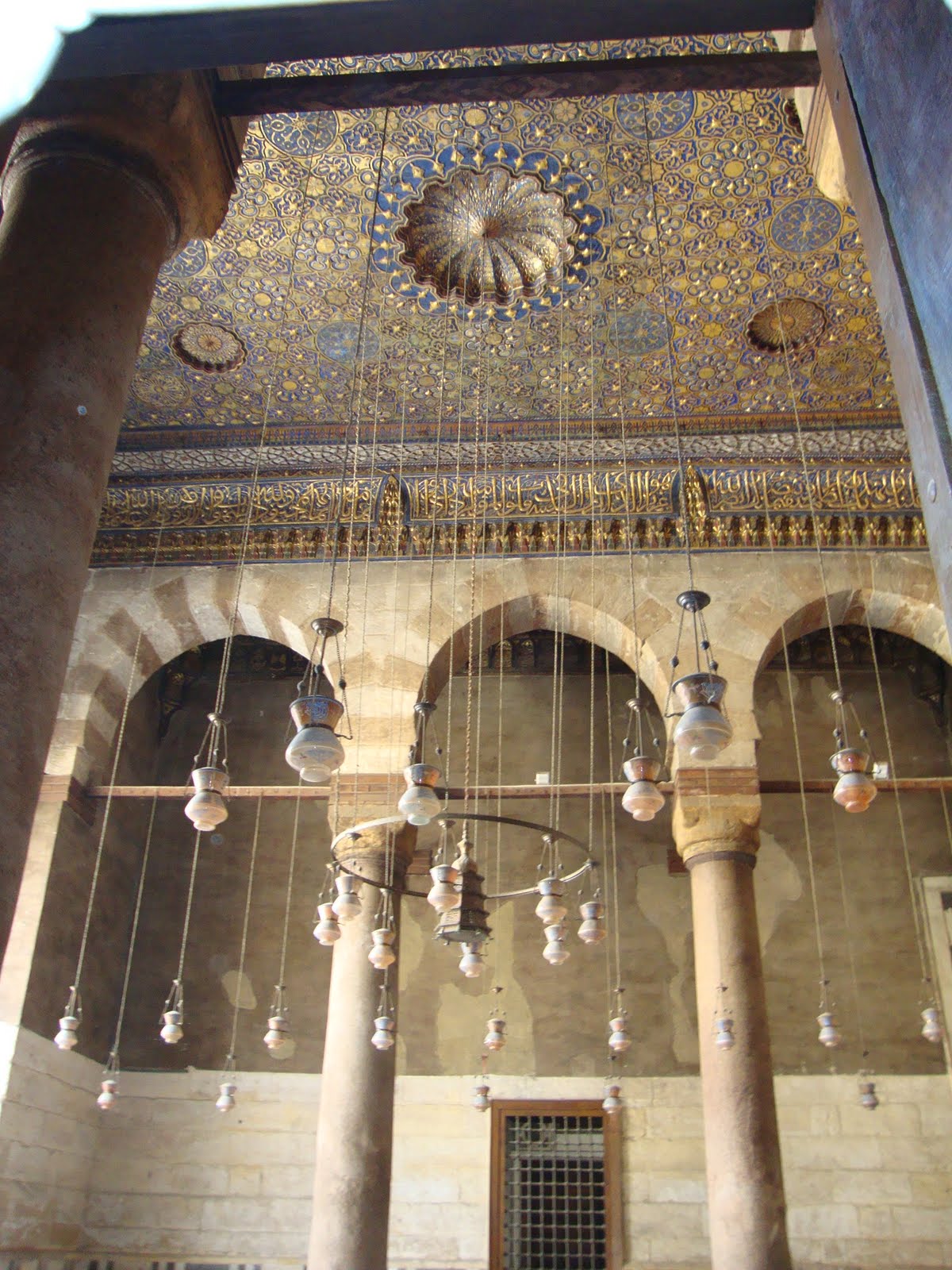 There are exquisite examples of gilded Arabesque stalactites on the domed ceiling and bands of Koranic inscriptions stretching across the walls of marble inlay and carved Mashrabiyya wood. Colored glass mosque lamps are hung from chains in graceful groupings.


