Showing posts with label antiquities. Show all posts

Sunday, May 23, 2010

A Walk Along A Mameluke Street

A couple of weeks ago a close friend of mine, Patricia Canfield, decided to take one of the walks in Cairo sponsored by ARCE (The American Research Center in Egypt). ARCE offers some amazing tours of Cairo and sites further afield for very reasonable prices. You do have register with ARCE beforehand and to show up on time for the bus as they absolutely depart at the advertised hour, but the tours are some of the best in Egypt. Pat is a freelance writer living here for some twenty odd years and when she showed me the photographs and told me about the places she'd seen, I begged her to write it up for me for my blog. These days my arthritic knees have taken me away from any ideas I have of three hour walks, although knee replacement surgery scheduled for this summer should have me back pounding the pavements, however gingerly, in the fall. Here is her story:

Al Mu’izz Li Din Allah Street

One of the highlights of tours to Cairo is the Khan El Khalili which is an intricate warren of over 1,000 shops, craftsmen and workshops and an astonishing group of Medieval and Islamic monuments which have occupied the same cramped area for well over 1,000 years.
The most spectacular group of these monuments is on Al Mu’izz Street which is part of the main thoroughfare that ran through the Medieval walled city. It is an area called Bayn El Qasrayn (Between the Two Palaces). This was the Mameluke (1250 – 1517 AD) ceremonial parade route which ran between the two palaces of the Royal complex. At that time it was said to be wide enough for 10,000 troops on horseback to pass. These palaces were built on the site of the earlier Fatimid (969 – 1171 AD) era buildings which were the heart of what was then the city of Al Qahira (Cairo).
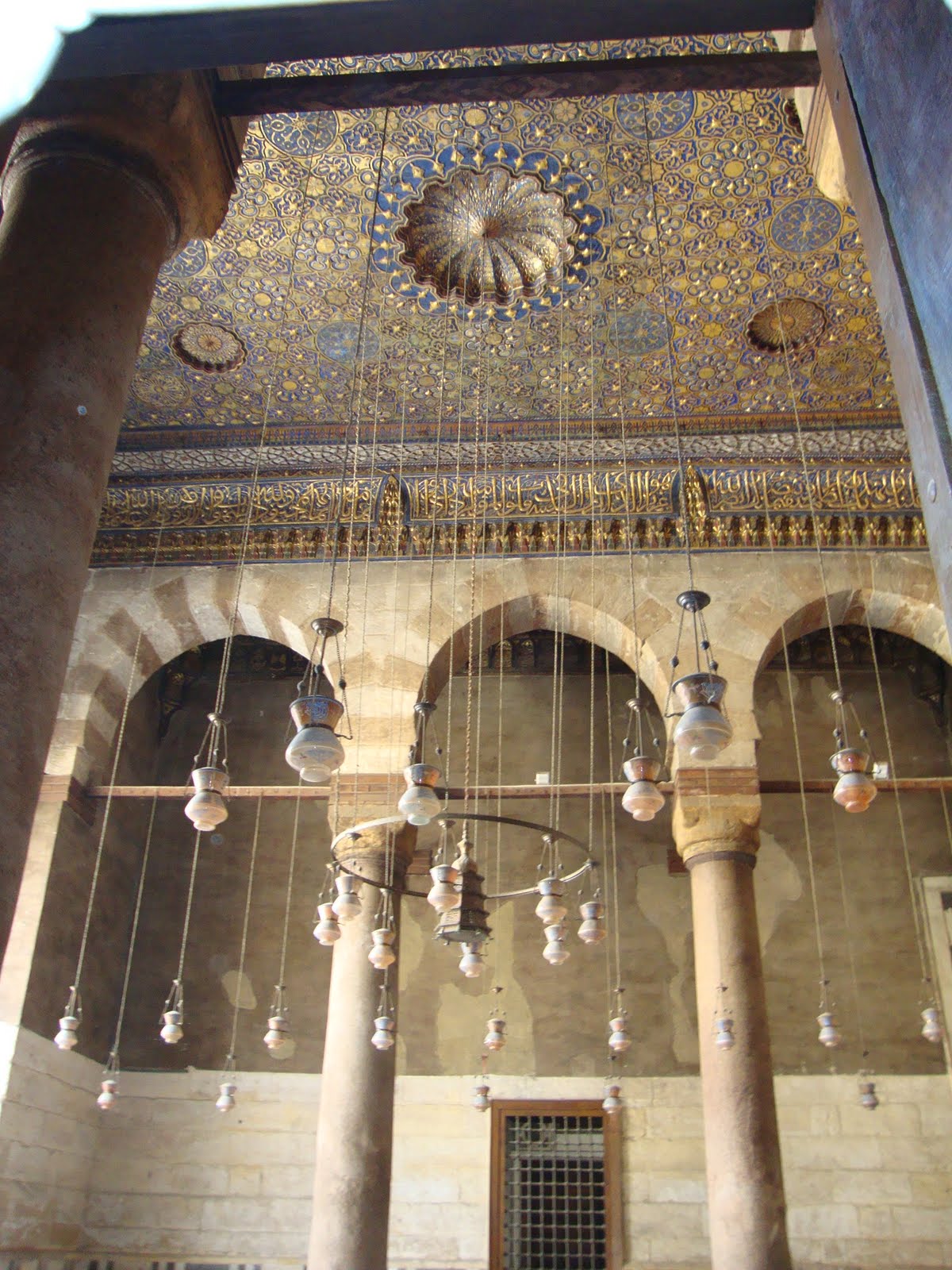
An extraordinary group of these monuments was painstakingly restored and has recently been reopened to the public. These three adjacent complexes below were built by Mamluke Sultans who traveled extensively during military campaigns and incorporated much of what they saw into their own buildings.
The oldest complex was built by Sultan Al-Mansour Qalawun (1279 – 1290) and is a magnificent grouping of the highest examples of Islamic architecture. It included a Maristan or hospital that handled hundreds of patients each day with a highly specialized medical staff and surrounded the patients with beautiful gardens and soothing musicians. An eye hospital still exists on the site. There was a Madrasa or religious school. However, the most spectacular feature is the Mausoleum which is an absolute treasure trove of marble inlay, intricately carved gilded wood, Islamic calligraphy and stucco that looks like lacework and which houses a cenotaph with several royal burials.
The next building was constructed by Qalawun’s son, Sultan Al-Nasir Mohamed, who was one of the most prolific builders in Cairo’s history. A white marble Gothic style doorway that was brought from Syria opens into the passage which separates the Madrasa from the Mausoleum. The door to the entrance is well-aged silver and marble inlaid floors form a carpet like passage between areas. Colored stained glass windows play with light and color throughout the buildings.
The third building of this contiguous façade is the Khanqah (Sufi monastery) and Madrasa of Sultan Al-Zahir Barquq (1382 – 1399). There are exquisite examples of gilded Arabesque stalactites on the domed ceiling and bands of Koranic inscriptions stretching across the walls of marble inlay and carved Mashrabiyya wood. Colored glass mosque lamps are hung from chains in graceful groupings.
From the street, you can see the interplay of light and form in the recesses which give so much texture to the buildings and the minarets that top the structures are a study in different styles of design and calligraphy. It is a place that constantly affords you a new sight to study and a new treasure at which to marvel.


copyright 2010 Maryanne Stroud Gabbani

Thursday, March 04, 2010

Seeing In A New Way


This has been a very busy spring for me. We've been trying out a new type of work, equestrian tourism, at the farm and all of us have been spending a lot of time in the saddle. As well, I've had some friends come to visit during February, right in the middle of one of the riding tours of course, and wanted to have some time to arrange some things for them. Laurie and I have been friends on email for over 15 years and friends face to face for almost 10 years. We got to know each other on Equine-L so it was only natural that, having recently retired from her work, she should decide to come and visit me in Egypt and go riding. What might not seem so completely natural is the fact that she brought a friend along to "see" Egypt who is blind. I was a bit taken aback at the idea of Gail wandering around our stretch of the Sahara with only someone calling out directions, but all went well and will be in a Sarcophagus post soon. When we were planning activities for Laurie and Gail the seeing issue was an interesting parameter. We talked about museums, but as Gail said "Once you've felt one glass case, you've felt them all". So true.

BUT...I'd read that the Egyptian Museum was instituting special tours for the blind so I called them. Mona, the assistant to the director Dr. Wafaa el-Saddik, told me that so far the tours had been done for school children and not for adults but she would see what they could do. I was totally delighted when Mona called me back to say that they would be happy to do a special tour for Gail, but not nearly as delighted when I realised that I wouldn't be able to participate because I would be working with some riders.

The museum has taken their tours for the blind very seriously and has engaged blind guides to give them. They know the pieces that they present to visitors and also understand how best to "show" them. So not only are blind visitors benefiting from this new service but it is creating work for blind guides as well. Because Gail and Laurie don't speak Arabic, Dr. Wafaa arranged a translator to go with them as well to enable the conversation among everyone concerned. The lovely photographs of Gail examining pieces were taken by a professional photographer since photography is forbidden in the museum.

Gail and Laurie had a great time exploring the museum and many of the more ordinary patrons were rather jealous that she was allowed to touch things while they were being told not to...but there have to be some perks to being blind after all. The last day of their visit we went to the Coptic Museum as well where many of the displays on the ground floor are stone carvings that could be "seen" by Gail. No one minded that she was "seeing" them with her fingers there as well, but without an official photographer to take photos inside the museum, I could do nothing with my camera for my sighted friends to enjoy.


copyright 2010 Maryanne Stroud Gabbani

Sunday, May 31, 2009

Shutting Out the Neighbourhood


I've been a little less than thrilled with the Supreme Council for Antiquities for a while, and last night I got even more reason not to be impressed. I heard from a fairly reliable source that they'd decided to go forward with the wall that they've been talking about for a while in this part of the desert and are starting out with building it in the Abu Sir area, specifically from the pyramids of Abu Sir to just a bit beyond the Sun Temple. I actually understand the building of the wall in Giza, although they didn't have to make it so ugly. There is a densely populated area surrounding the plateau there, but down here the desert is bordered by large houses and gardens belonging to people who are keeping people out of the desert quite effectively. We've had to negotiate a close by access, which if the story is true, will no longer be available after the summer.

So what's the problem other than the fact that I wll probably be inconvenienced? One of the problems is the fact that the edge of the desert that will be closed off by the wall is where the local kids play football (soccer to you, Mericans)in the afternoons. There aren't any open spaces for a football field for these kids. Sure, they are better off than city kids in many ways having much, much more space and less pollution, but it seems pretty raw that a government that can't seem to upgrade the electric power, provide enough telephone lines, provide running water, sewage and trash collection to the people out here has money to toss away on a wall that isn't really going to do anything but make life difficult.

But if the point of the wall is to protect the antiquities in our area from unauthorised digging, how is it going to do this with an open area of sand and gravel mining immediately to the west? Sure the farmers live in the valley, but the Sahara extends all the way to the Atlantic Ocean and they can't possibly wall off all the the area...it's huge! When I first began riding out here about 16 years ago there was a large sandy plateau just west of Sakkara Country Club. Over the years the mining families have dug up that plateau creating a moonscape that is even beginning to spill over the edge into the desert leading down to the pyramids. Naturally, the SCA has been aware of this activity just as they are aware of the Giza dump that is also on the plateau and crawling towards the wadis that lead down to the pyramids of Abu Sir and Sakkara, the same dump that so graciously sends us all the extra plastic bags every time we get a strong northwest wind.

Now THAT'S something that they could wall off. But, no, it's much more important to wall off the homes and farms bordering the desert, places that have a vested interest in keeping the desert clean and enjoyable. It's also interesting that while they could be building their wall between the cliff face housing the archaic tombs and the very crowded village of Abu Sir, they did not move on that option. They've also chosen to leave the Sakkara Country Club an access to the desert so that they can send out their marvelous, noisy and intrusive dune buggies into the desert to be driven by teenage Cairenes through the antiquities areas. Those things do more harm to the desert than any of our horses and football players.

So not only are they dumping the trash from the archaeologists (at least I assume that it is dig trash) out in the desert just west of Sakkara, but they want to keep the people who have been noticing this and commenting on it out of the desert. I don't get it. These are supposed to be people who care about the area, not people who want to trash it. But I guess that one can be mistaken about the responsibilities of government.

So for now, the village kids and I will be enjoying our summer evenings in the desert waiting for the concrete to be poured walling us off from our desert neighbourhood. The wall won't stop people from going out in the desert. There are too many ways to go in even if they do build the wall here blocking all the homes off. And the dune buggies from the Club will still be running all over the pyramids as they wish since they seem to have been considered less harmful than a few football playing children and some riders.

copyright 2009 Maryanne Stroud Gabbani

Sunday, March 01, 2009

Circumnavigation


I've had visitors this winter, as I do most winters, and we've had some unseasonably warm clear days to explore the Cairo area. Of course, one of the required visits is to the Giza plateau and on one of my visits there I took a series of photos as we walked around the Great Pyramid so that I could share the experience. The imagination soars with the mention of the Pyramids of Giza and most people who haven't visited Egypt visualise three lonely silhouettes in the desert against a blue sky, a view of them that must be achieved from a distance. The reality of the pyramids is quite different, a reality that some people find disappointing but one that I find never fails to engage me.

To approach the Giza plateau, one drives up an asphalt road from Pyramids Road dodging young men who run out into the road to try to convince the drivers of incoming cars that the ONLY way to see the pyramids is by following them to an area below the plateau where visitors will be mounted on camels, horses, or carriages (sometimes at great expense if the touts are lucky) in the stables opposite the Mena House Hotel and transported up the hill. Their claims are utter rubbish and it is quite possible, and in my mind preferable, to drive up to the entrance, buy tickets for the visitors and the car and then drive on in. There is a parking lot that overlooks the camel stables opposite the Mena House which provides a good spot from which to foray out to explore the pyramids.

As we walk across the stone to the Great Pyramid on a Friday morning, the sheer size of the pyramid never fails to strike. From a distance tiny figures gather along the eastern face of Khufu's pyramid facing the Nile Valley, crawling part way up the stones...as we approach it becomes clear that these are people who are climbing the staircase that has been cut into the enormous stones so that they might enter the tiny cramped passage that leads up to the chamber in the center with the enormous sarcophagus. The impressive weight of the stones, the size of each one, the effort that must have been expended to pile all of them up, is stupifying...but still the passages are extremely uncomfortable and visits inside pyramids are highly overrated in my mind.

As we make our way along the face, we pass Egyptian families out for a day in the open air. Fathers photograph offspring with mobile phone cameras while mothers sit comfortably on the lowest layer of stones dispensing sandwiches and chips. The children are all over the place. Most families in Cairo live in apartments, so to be out in this much space with virtually nothing breakable at hand induces a state of exhilaration in the younger set that is only matched perhaps by watching a set of goat kids bouncing madly around ricocheting off each other and any other object in their immediate vicinity.

As we round the southern side of the pyramid we find ourselves in the area where iron railings protect some of the more active albeit less observant of the young visitors from pitching headlong into the pits that once held the solar boats, beautiful graceful craft made of Lebanese cedar and held together with palm fiber rope. The best preserved of these is in the Solar Boat Museum on the western side of the pyramid, an odd rather banana-shaped structure that provides a climate controlled environment to preserve the reconstructed boat.

The new regulations restrict the camel and horse men who offer the services of their sometimes rather dubious mounts to the south side of the Great Pyramid, the area around the parking lot by the middle pyramid, and the panoramic view point out in the desert where it is still possible to photograph the pyramids in their lonely majesty. After glancing around quickly to determine that a collision with one of the plateau's four footed denizens was not imminent, we had to look up and admire the view of the stones reaching up into the sky. We are so physically lazy in our lives now that it seems quite impossible that these massive boulders should have been moved simply by muscle power, but in those days there were four months during the summer when most of the population of Egypt was available for labour such as this while they waited for the Nile flood to recede. Four months is a long time to go fishing and it makes the concept of the masses of labourers much more understandable.

Rounding the southwest corner of the pyramid we could see the middle pyramid with its limestone sheath still intact at the tip and the oddly shaped Solar Boat Museum next to our pyramid. The middle pyramid always looks larger than the Great Pyramid but this apparently is because it is built on a higher platform of rock. Just before the museum a pair of female visitors were debating with some camel handlers for a ride. As we wandered past we were regaled with squeals and laughter as they experienced the seesaw action of a camel rising to its feet and starting off.

As we headed back towards the parking lot along the north face of the pyramid, we were reminded of the winter winds that we had avoided on the west face. Other visitors were coming towards us with pauses for photographs as they wandered along. At Giza, photographing photographers is inevitable. Some young men tried to look tough and strong while surreptitiously zipping up jackets against the chill of the wind whenever the sun crept behind a cloud, and later we assisted a pair of newlyweds from the Delta with a photo on a mobile phone against the background of the middle pyramid of Khafre.

As we approached our starting point on the east face of Khufu's pyramid, we noticed that the crowds were getting thicker as more and more visitors arrived. Some of them were visiting the nobles' tombs at the northeastern corner while others were making their ways in carriages, on foot, on horseback or camelback towards the smaller pyramids or the panoramic view point out in the desert.

Once back on the eastern face of the pyramid we wandered over to admire the view over the valley. My friend had last been in Cairo in 1971 and remembered how the area before the Giza plateau had been green fields. Now it is so built up as to be unrecognisable to early visitors, but the pollution had been blown away by the winds and we had a clear view of the Citadel across the valley. When we turned to the pyramid again and saw it as a backdrop to the cars in the parking lot, we were definitely brought back to reality and present day.
copyright 2009 Maryanne Stroud Gabbani

Friday, June 06, 2008

So Now We Know

The news clippings (the title provides a link) this morning were full of the announcements by the Supreme Council for Antiquiities that a new pyramid had been found in the Sakkara Antiquities Area. This pyramid, called a "headless pyramid" by its initial finder the German Egyptologist Lepsius over 150 years ago, had been lost when covered with sand over the years. Lately the SCA has been rediscovering the site and in the process having to find a way of disposing of all the sand, rock and rubble that had covered it.

For about a year now, people riding their horses in the desert just east of the Step Pyramid at Sakkara have been treated to increasing mounds of sand, stone, and unfortunately as well, some garbage in the area fondly known as the Boneyard, the Antiquities Council dumping site. While the sand, stone, pottery shards and bone are fairly naturally occurring items, the sheer volume of the dumping has been quite impressive. Happily, the garbage dumping has been rather less in volume and hopefully now that the archaeologists have found what they were looking for, will be even less.

Dr. Hawass is probably quite right in his statements that only a third (I'd guess even less than that) of the antiquities in the Sakkara area have been found. I'm quite sure that the locals of the village of Abu Sir, who have been as intimately involved in amateur archaeological expeditions in the area as their more famous colleagues from Gurna in the Luxor area, would agree with me. I would like to suggest, and in fact I have suggested, to the Antiquities Council that the dumping of debris so close to the area is perhaps not the most brilliant idea in the world.

Most fishermen and divers know that the surest way to attract sharks to the area of a boat is to dump trash overboard in the vicinity of boat. The sharks will come for the trash and stay for a meal of the fish that are being caught or the odd diver. Human sharks are no different. By dumping truckloads of sand and rock in which can be found the odd pottery fragment, piece of alabaster pot, bead, bit of pharaonic woodwork or even mummy wrappings, the local scavengers are being lured to an area in which ideally, for the sake of Egyptology, they really shouldn't be scavenging.

copyright 2008 Maryanne Stroud Gabbani

Tuesday, March 11, 2008

The Second Day on the River


The next morning we had breakfast at Kom Ombo and then set sail for Edu. This was my favourite part of the trip, heading down the Nile with the northwind in our faces. We passed farms much like those of my area, and fishermen working their boats in the river while their children played on sandbars nearby. Mango, orange, and banana orchards lined the river, but the date palms here in the south were not as well-trimmed as those in our neighourhood.

We weren't the only ship on the river. In addition to the fishing skiffs, there were some smaller motor craft for travel or cargo and, of course, other cruise boats. Since we were all supposed to be going through the locks at Esna that evening, sometimes things looked like an old fashioned river boat race. The weather had warmed up quite a bit, but most of us were looking abit askance at some of the travelers on other boats who were sunbathing on the top deck. Maybe our boat was colder on the topdeck or something but we were quite happy in tshirts.

When we got to Edfu we were told that we would take a horse-drawn carriage to the temple and back. To my delight, the majority of the horses presenting themselves to us at the riverside were in excellent condition. As a horse owner and someone who works with horses, I really can't tolerate working abused horses. The Brooke Hospital group have been working really hard in Upper Egypt constructing shades where the horses can rest and visiting veterinary services.

The temple at Edfu is amazing. It is wonderfully preserved temple that was constructed for the most part during Greco-Roman times and was buried in sand until the 1800's. I remember being incredibly impressed with its halls and decoration years ago. Many of the halls are stained with soot near the ceilings from people taking shelter in them many centuries ago.

After Edfu, we set sail once again, heading for the locks at Esna. At times we could see desert on one side or another, and there were some beautiful buildings along the river. One sand coloured house in the traditional Nubian style particularly caught my eye. The way that it blended into the surrounding desert hills was lovely.

Finally, as the sun was setting, we came to Esna where we moored with a number of other boats while waiting our turn to pass through the locks. South of Esna the river is significantly higher than it is below Esna. Nile cruisers traveling south from Luxor wait in pairs to enter the lock, have about 4 metres of water pumped in to raise them to the southern level, and then after the southbound boats leave the lock, the northbound boats, like ours, enter to have the lock pumped out to lower us to the northern level. From Esna we traveled north to Luxor to find ourselves moored at the corniche in Luxor the next morning.
copyright 2008 Maryanne Stroud Gabbani

Wednesday, February 27, 2008

Cruisin'

This has been a week for old friends in many senses of the word. For the past year, one of my childhood friends has been working out the details of a visit to Egypt with her husband, a woman friend of hers and the woman’s husband. At the very last minute, her friend’s husband couldn’t make it on the trip and we had to reorganise a few things. They had planned to come to Cairo for a few days to see some things and catch their temporal breath at the farm. Flying to Egypt from California does really knock one’s time sense askew in a big way. Then they had booked five days during which they would take a three day cruise from Aswan to Luxor with a following flight to Sharm el Sheikh for a couple of days. When one of the party couldn’t come, they invited me to join them and after working out the logistics of getting away from the farm and work for five days, I did. We flew up to Aswan early in the morning to catch the Movenpick Royal Lily, a lovely boat for a vacation. The rooms were beautiful and the food was great. Each day we visited some of the sites along the Nile between Aswan and Luxor and in between we would sail along some gorgeous countryside. It was my first Nile cruise, despite the fact that I’ve lived here for about twenty years.

In Aswan before we sailed, we hopped into a minibus with a guide to visit three sites, the unfinished obelisk, the Aswan High Dam, and the Temple of Philae. My only other visit to Aswan was in about 1992 with my brother and his family at New Years. We had driven up from Luxor (this was in the old days when you could still do that easily) and we opted to see the High Dam, Abu Simbel, which involved a flight from Aswan and back, and a felucca trip to the west bank for a camel ride. This trip involved seeing two new things and revisiting one old friend. The High Dam hasn’t changed much and standing on top looking out at Lake Nasser was a familiar sight. The site of the unfinished obelisk, on the other hand, was totally new and interesting. The site is an enormous granite quarry, where for thousands of years the ancient Egyptians cut the famous red Aswan granite for pyramids, obelisks, and other statues. I’m not sure how many of you have had to buy countertop for a kitchen but Aswan granite still goes for a pretty penny in the market today. The unfinished obelisk is a 42 meter slab of granite that cracked as it was being carved and was then left in place. Undamaged obelisks were carefully removed from the site of their carving and placed on barges that could be floated to the Nile directly from the quarry via a canal that’s only recently been discovered.

Driving from the quarry to the High Dam we crossed channels where the Nile flows out of the dam and some of the old rocky empty channels that are used for excess run off. Aswan’s main characteristic is the amazing amount and variety of rock. The High Dam hasn’t changed in the 16 years since I was here last. It’s still high, still windy and the view of the lake is still lovely. The jury is still out as to whether it was a Good Thing or a Bad Thing as well. In addition to losing many important archaeological sites to the lake, Egypt and the Mediterranean Sea lost the important silt that was washed down the river yearly. This has cost the farmers of Egypt a lot and the fishermen of the Med perhaps even more, since the silt gave nutrients to the fish of the area. At the time that they were building the dam, no one was interested in ecological impact statements so we are pretty much stuck with the results.

Our next stop was one that I’d wanted to see for ages, the Temple of Philae which is between the old Aswan Dam and the High Dam. Like many sites in this area it has been relocated to keep it from being lost in the waters, but unlike Abu Simbel and others, the relocation didn’t involve that much of a move. It was built in Greco-Roman times to honor the goddess Isis, whose tears over the loss of her husband/brother Osiris were believed to be the source of the Nile flood. The carvings there are beautiful and interesting, as the Greeks who were then ruling Egypt added their own little touches to the décor. The juxtaposition of the huge raw boulders of the river, the harsh stone of the riverbank, and the lovely workmanship of the temple were a marvel, as were the warm tones of the stone and the cool clarity of the unpolluted sky and the sapphire of the lake. I grew up near the sea and any time spent by water always seems a blessing, twice so in the desert like the high deserts of California or in Egypt where water that pours over the hot rocks gleams with a light more lovely than any diamond.

We returned to the boat where we laid into dinner with the special gusto of those who have been hiking over rocks and learning more than they’d bargained for as the boat sailed for Kom Ombo. Kom Ombo is the site of a temple to the crocodile god Sobek and to Horus. Apparently this area of the Nile was notorious for its crocodiles and one reason for the temple was to try to encourage the crocodiles to play nicely with the locals, while on the other hand Sobek was a fertility god and this seems to have been a temple for the practice of medicine. There are carvings on one of the walls that detail medical practices and tools. We visited the site by moonlight as there was a full moon, at least a 10 on the romance scale. There was plenty of light to see the carvings between the moonlight and the illumination provided by the antiquities staff. As we walked to and from the temple along the Nile embankment, I was struck with the loveliness of the night (definitely the most powerful feeling) and with the enormous numbers of visitors to this part of Egypt. There must have been at least ten cruisers the same size as ours tied up along the river bank and in many cases they were moored in flotillas at least three deep. That night we slept the deep sleep of weary travelers who had risen at 3 am to spend a day time traveling on the river.


copyright 2008 Maryanne Stroud Gabbani