Showing posts with label art. Show all posts

Sunday, May 23, 2010

A Walk Along A Mameluke Street

A couple of weeks ago a close friend of mine, Patricia Canfield, decided to take one of the walks in Cairo sponsored by ARCE (The American Research Center in Egypt). ARCE offers some amazing tours of Cairo and sites further afield for very reasonable prices. You do have register with ARCE beforehand and to show up on time for the bus as they absolutely depart at the advertised hour, but the tours are some of the best in Egypt. Pat is a freelance writer living here for some twenty odd years and when she showed me the photographs and told me about the places she'd seen, I begged her to write it up for me for my blog. These days my arthritic knees have taken me away from any ideas I have of three hour walks, although knee replacement surgery scheduled for this summer should have me back pounding the pavements, however gingerly, in the fall. Here is her story:

Al Mu’izz Li Din Allah Street

One of the highlights of tours to Cairo is the Khan El Khalili which is an intricate warren of over 1,000 shops, craftsmen and workshops and an astonishing group of Medieval and Islamic monuments which have occupied the same cramped area for well over 1,000 years.
The most spectacular group of these monuments is on Al Mu’izz Street which is part of the main thoroughfare that ran through the Medieval walled city. It is an area called Bayn El Qasrayn (Between the Two Palaces). This was the Mameluke (1250 – 1517 AD) ceremonial parade route which ran between the two palaces of the Royal complex. At that time it was said to be wide enough for 10,000 troops on horseback to pass. These palaces were built on the site of the earlier Fatimid (969 – 1171 AD) era buildings which were the heart of what was then the city of Al Qahira (Cairo).
An extraordinary group of these monuments was painstakingly restored and has recently been reopened to the public. These three adjacent complexes below were built by Mamluke Sultans who traveled extensively during military campaigns and incorporated much of what they saw into their own buildings.
The oldest complex was built by Sultan Al-Mansour Qalawun (1279 – 1290) and is a magnificent grouping of the highest examples of Islamic architecture. It included a Maristan or hospital that handled hundreds of patients each day with a highly specialized medical staff and surrounded the patients with beautiful gardens and soothing musicians. An eye hospital still exists on the site. There was a Madrasa or religious school. However, the most spectacular feature is the Mausoleum which is an absolute treasure trove of marble inlay, intricately carved gilded wood, Islamic calligraphy and stucco that looks like lacework and which houses a cenotaph with several royal burials.
The next building was constructed by Qalawun’s son, Sultan Al-Nasir Mohamed, who was one of the most prolific builders in Cairo’s history. A white marble Gothic style doorway that was brought from Syria opens into the passage which separates the Madrasa from the Mausoleum. The door to the entrance is well-aged silver and marble inlaid floors form a carpet like passage between areas. Colored stained glass windows play with light and color throughout the buildings.
The third building of this contiguous façade is the Khanqah (Sufi monastery) and Madrasa of Sultan Al-Zahir Barquq (1382 – 1399). There are exquisite examples of gilded Arabesque stalactites on the domed ceiling and bands of Koranic inscriptions stretching across the walls of marble inlay and carved Mashrabiyya wood. Colored glass mosque lamps are hung from chains in graceful groupings.
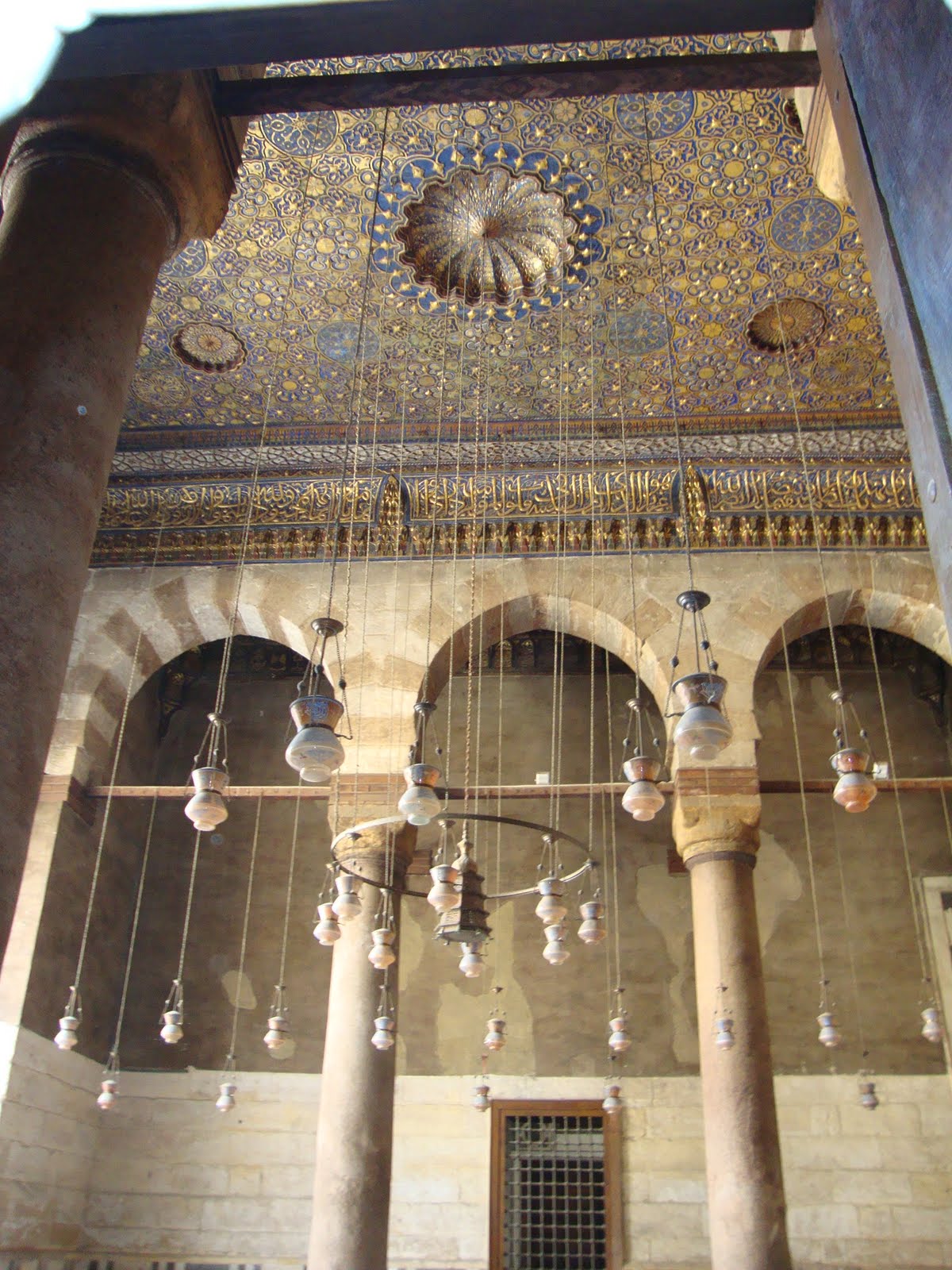
From the street, you can see the interplay of light and form in the recesses which give so much texture to the buildings and the minarets that top the structures are a study in different styles of design and calligraphy. It is a place that constantly affords you a new sight to study and a new treasure at which to marvel.


copyright 2010 Maryanne Stroud Gabbani

Sunday, July 27, 2008

Not Only In Egypt


About a week ago the net flickered and died out here in Abu Sir. We had to haul in our telephone company to check the lines (Gee! There are about 6 breaks in this section!) and our internet company to check the lines afterwards, and now we are back in the cybersphere. While my connection was down, I would go to a friend's place every couple of days to check my email. I'd delete anything not essential, not having much time to waste on things that I could usually meander through. One of the things that I did do, however, was to read my online New York Times. There was an article in it on the 23rd about how Philadelphia was in the grip of manhole mania... with the price of iron on the rise, they are being stolen.

Now this is a story I can identify with! Disappearing manhole covers are a fact of life in Egypt too. In the US they are trying to come up with a way of locking them so that they can't be stolen, but we deal with the problem in another way. Road Sculpture is the Egyptian solution to open manholes, as it is often also the solution to things like broken down buses on the side (or even middle) of the road. Road Sculpture is the artful placement of tree branches, stones, bricks, or even barrels in the road to indicate that there is something, aside from the tree branches, stones, bricks, or barrels that a motorist might wish to avoid.

It can be quite disconcerting to be driving peacefully, or as peacefully as one can drive in Egypt, down a road only to spy some anomalous object right spang in the middle of the thoroughfare. Having come from a basically law-abiding tidy society in Toronto, my initial response was to think "Good grief! Someone could hit that and have a nasty accident!" But after a while I came to understand that leaving large dangerous objects in the middle of the road was an attempt to PREVENT accidents. Of course. It makes all the sense in the world.

So maybe we need to export some of our road sculptors to the US to teach them how to avoid accidents while beautifying the roadways. Just imagine what the Highway Patrol would say.


copyright 2008 Maryanne Stroud Gabbani

Sunday, September 16, 2007

Getting Creative


While my hands were healing from spider bites, it was pretty hard to ride horses, so thoughts turned to other projects that we wanted to pursue. One of the things that I'm wanting to get for the farm is a donkey cart that is built for driving with just two passengers. It would be so much more practical for local trips in the neighbourhood, along with being, most importantly, a lot of fun. I'd been told that an ironworker at a local art centre could probably help me make a cart based on a photo of one that I'd downloaded from the net, so I set off with my trusty Mohamed Said to make his acquaintance.

Not far from the farm on the Mariouteya Road is a place commonly called Fagnoon, after two Arabic words: Fanan or artist, and Magnoon or crazy. The crazy artist who established this wonderful place is otherwise known as Mohamed Allam. He decided that the children of Cairo needed a place where they could let their imaginations run riot...and in the process created a marvelous space where their bodies could be free as well.

The centre itself is a creature of constant growth. Platforms, balconies, walkways, and bridges connect spaces where children of all ages can paint, draw, work in wood or fabric in shade and sunlight. The meandering walkways invite exploration and an obviously handmade bridge curves over the canal to a garden where pottery wheels stand under shades and a pen of goats watch the activities with interest. Papyrus has been planted in the canal so that papermaking activities can also be pursued. This is one of the few places that you will see the plant that was so much a part of Egypt's history growing. The day we came, workers were constructing a third level to some of the centre, giving visiting chilren many metres of wall to paint and decorate.

With so many of Cairo's children living in apartments, a space where not just spirits but bodies can run free is a joy. In one area a net of multicolored fabric hangs from the ceiling ending in a slide down which children can slither onto a pad of mattress springs also wound in fabric. The center is full of objects that can be climbed over, into and under.

Adult art activities are also encouraged here. The hadad, or iron worker, that I'd come to see has created animal statues that are found randomly around the centre. A goat stands in a teepee framed in wood and woven from dried bullrushes from the canal. A vividly imagined pair of ducks and some ducklings gather in a shady corner near a column that is constructed of natural wood in the shape of a tree. While we were chatting with the hadad and the centre's owner, a group of college aged students ran about on an upper level pelting each other with water balloons. Paint streaks on tshirts and jeans showed that having a water balloon fight wasn't the only activity of the day. These young adults have been coming here since the time that they were school children being brought on excursions from the classroom. My grad student daughter is one of Fagnoon's biggest fans and was fond of spending an afternoon out there.

Mohamed Allam is a good director for such a centre, being an artist himself who creates beautiful and interesting work. A gallery for his work is part of the complex and his handiwork is everywhere, in statues scattered about, iron wall hangings and beautiful and innovative furniture created in wrought iron and wood,fabric or other materials.

A trip to Fagnoon should be compulsory for Cairo residents. Parents can relax under a tree if an artistic endeavour is not on the menu, kids can run amok happily, and resident bakers offer refreshments such as fateer, a flaky bread eaten with sweet toppings such as clotted cream, nuts and honey or with savoury such as cheese. There are even outdoor taps and showers to clean off all the grubby little Van Goghs after a day creating. Just recently another branch of the centre, Fagnoon Fellah, has been opened even closer to the farm. This centre offers space for camping overnight near the village of Abu Sir on the Mansoureya Road, within hiking distance of the original centre. The centerpiece of the new establishment is an enormous net hung from the trees, providing enticing spaces for climbing or just settling in with a good book. More information can be had by contacting them at fagnoon@fagnoon.net or phoning 3815-1633.

copyright 2007 Maryanne Stroud Gabbani