I've been writing this blog for about eight years now and right from Day One I've been getting emails, mostly from women, about moving to Egypt to pursue a relationship with someone. Many of these inquiries stem from holiday romances, some from people met at univerisity abroad, some from internet romances that someone wants to pursue. Our revolution hasn't changed the incoming traffic one bit, other than my correspondents report even more nervousness from their friends and relatives who worry that a move to Egypt will automatically end in disaster. I finally decided that it was time to put out a list of things to think about before marrying into Egypt.
I spent 25 very interesting years married to an Egyptian man whom I met in Canada while in grad school. We married and had our kids in Canada but we were visiting Egypt very regularly before we moved to Egypt. Some years while the kids were still very young, I spent a month or two staying with my in-laws while my husband would travel back and forth between Cairo, Khartoum and Toronto. When I finally moved to Egypt, I'd been visiting it since 1976 and had spent a fair bit of time exploring and learning my rudimentary Arabic. I had decided that I loved Egypt's chaos, its happy loopiness and randomness, and it was actually my idea to move here against all of my husband's objections. We had a good life, our children had a varied and rich childhood, and while there were some ups and downs, I wouldn't have missed a minute. I did NOT move here cold without having visited quite a bit, nor without knowing some Arabic (enough to do daily tasks fairly independent), and I knew (or at least thought that I did) my husband's family quite well. In other words, I probably made the transition from Canada to Egypt under the best of circumstances. I'm not sure that most other people will be so blessed. So here is my open letter:
Dear Whoever is thinking of moving to Egypt for a partner,
I really should have a sort of form letter for this because I don't know how many emails I've sent to people who are thinking of following a friend to Egypt. First, the reality of life here is not seen anywhere in the western media. Life here is nothing like what they show on the news or in magazines. It is not especially dangerous, but it is not a life for someone who is unaware of his/her surroundings. Tell all your friends and relatives that you are not moving to the moon or to the 2nd circle of hell. That said, there are some serious questions that you need to ask and answer for yourself before making any kind of permanent or even semi-permanent commitments to a life here.
1. Do you like living in Egypt? Is this a country that fits well with your lifestyle and personality?
This must be decided for you and you alone. Life is impermanent and people come and go in it. So if you think about living in Egypt, it's important to know that you would like living here with or without your partner. I suggest coming on a visit to see if you can cope with the life in Egypt, whether it is in the pollution, crowding, and excitement of Cairo or in the much slower life of the villages or smaller cities. Don't just visit the pyramids and museums. Go everywhere. Check out shopping centers and souqs. Talk to other people living here. Go grocery shopping. Try cooking. Look for a job ...if only to see if you would be happy working here.
2. Are you willing to learn Arabic?
It is possible in some places to live in Egypt without knowing Arabic, but to be honest, you will be missing out on most of the life here if you can't simply carry on a conversation with the people around you. Even a simple task like grocery shopping can be much more effective and interesting if you can ask what new foods are and how to prepare them. Getting lost is less of an issue and Surprise! many of the things that people say around you are not cause for concern. Written Arabic and spoken Arabic are almost different languages, but there are many language schools here in Egypt and abroad that will help you to learn the language.
3. Do you know what you are getting into? Relationships are complicated and more so across cultures.
If you are considering an alliance with an Egyptian partner, you need to meet his/her family. You never marry a person, no matter where you live, you always marry his/her family and their history. This is true of marriage within your culture and religion and even more true if you are moving outside of your culture or religion. Your partner's unconscious assumptions about the role of wife and mother or husband and father are determined largely by what existed within his/her family, just as yours have, and it's a very good idea to meet the role models, to say the least. As well, although it is totall unPC to say anything about social class or anything like that, if your family backgrounds are too different, the adjustment can be very difficult. With a new geography, new culture, and new language, why make things harder than necessary? The more you know, the better you are prepared.
4. Do you realise that every country has a different family law? What you are accustomed to is not necessarily what is going to be what you have to deal with here.
Learn about family law in Egypt and get a good lawyer to explain and protect your rights if you choose to marry and live within Egypt. Egyptian family law is currently closely tied to the family's religion and this must be understood and taken into account. As we are currently in the process of reworking the constitution and government (hopefully), much of this is still unclear, but most definitely the family law that you are used to wherever you live now is nothing like the family law in Egypt. Family law is the law that determines marriage, divorce and child custody. For example, a woman's rights to divorce and other things can be specified in her marriage contract...a legal document that is the basis of every Muslim marriage, while divorce is forbidden by the Coptic church. Inheritance is so complex under Islamic law, which will be applied to a Muslim family no matter what anyone might wish otherwise, that it almost is a course of study on its own.
These are the main points. You need to see for yourself. That's the main thing. Egypt is safe to visit, so you should. Think carefully and do what is best for you.
Wishing you all the best,
Maryanne
copyright 2011 Maryanne Stroud Gabbani
Showing posts with label marriage. Show all posts
Showing posts with label marriage. Show all posts
Friday, May 27, 2011


Saturday, February 12, 2011
Thinking About Love
Valentine's Day is and its connection to romantic love is celebrated worldwide in February. It is not a particularly Egyptian tradition, and in fact November 4 is celebrated as well as the Egyptian holiday of love. Rather cynically, one could easily suggest that the cute stuffed animals, the roses, the chocolates, the cards, and the rush on intimate dining spots are all a ploy by the commercial interests to get us all spending more money after we've recovered from the giddy rush of the Christmas season, especially since there is no real historical evidence that either the day or the saint have anything to do with romantic love. But the ease with which many cultures have adopted the day of thinking of one's loved one suggests that this is something important to us all.

If you examine the day and the relationships that it celebrates, it is indeed important to us all, for without the bonds of friendship and love between partners it would truly be difficult for us to renew the human race...a fact any single parent will attest to. It is always a good thing to remind ourselves that we are not alone in our daily struggle to survive. As a widow for ten years, it's been rather a long time since I got a Valentine's Day bouquet or card, and I have friends who are just entering the long period of adjustment to this state. It's hard to lose a partner and Valentine's Day can be especially painful in the first years. Those of us who have survived that first traumatic year take care of our friends who are struggling through. We call, visit, email and try to be there to help keep their heads above the waters of loneliness.

So what is this love we are celebrating? Is it only the feelings of warmth engendered by the sight of a smile, the warmth of physical contact, the wish to spend more time together and perhaps marry? When thought of in this fashion, this love that we celebrate on Valentine's Day is not just romantic love ("Oh my, look at that gorgeous one! Wouldn't I love to be the number one for that!) but it is truly love in general.

We love many things and people. We love our husbands, wives, mothers, fathers, and children. We love our pets, our gardens, our neighbours (hopefully), our friends and so on as well. Are they truly different kinds of love? From the vantage point of my early 60's, I'm not really sure that they are. Truly, I'm not interested in marrying my terrier who might wake me at night with his barking, nor most of my friends. At the same time, my husband was both loved by me and was my best friend. I knew I could count on him when the chips were down and we shared many secrets that were known only to us. But just as chocolate comes in many flavours that appeal to many sorts of people, or even to any one person at different times, love also comes in many flavours.

Too often we look for love as if it were a beacon or spotlight that might shine on us through the eyes of a loved one. We think of it as a gift that another person or being might bestow upon us if we are worthy, and far too many people feel that they have no hope of being worthy of such a gift. Does love sail out of the moonlit sky like a flying saucer, does it suddenly drench us like an unforseen rainstorm, or fall splat on our forehead like the gift of a passing bird? It certainly feels like that sometimes.

When my husband died, I was devastated, bereft, lost in a number of worlds that seemed completely unfriendly to me. I went through my days in a haze, expecting to see him walk through the door just returned from a business trip that took too long, listening for the sound of him sneezing as he got up in the morning. It was a terrible period for me. One evening, I went out to the farm where I was boarding my horses and took my old mare out for a walk in the summer night. We were alone in the darkness listening to sleepy birds, hearing snatches of music from distant village weddings, noting our time by the call to prayer in the night. My mare walked along the darkened paths calmly, responding to my random comments with a flick of her ear, and I thought to myself how good it was to be alone with someone who cared about me and not about my late husband's businesses. I realised just how much I loved this creature who trusted me to guide her and who offered to guide me when the way was too dark for my feeble human vision. With this realisation, an extraordinary sense flooded through me of the warmth of my mare, the beauty of the trees against the night sky, the softness of the air moving slowly across the fields.

With the loss of my husband, I thought that I had also lost the love that we had shared and that lit our world and warmed our children. Alone with my mare in the night, I realised that nothing outside of us can either take or give us love. The love is within us waiting to come out to touch other living things, whether human, animal, or vegetable. As I passed a village home, a woman called out to me inviting me to tea. I wasn't willing to stop or break the spell, but I found myself able to smile with real warmth at her to thank her. Her answering smile washed over me, leaving me comforted again to the center of my soul. That night, I knew that I would survive my loss and that I would in fact thrive.
When we think of the holiday of love, we must remember this fact. Love is not given to us; we give it and then receive the warmth of our gift. When we cook with love, the food is more delicious and nourishing; when we care for our plants with love, they flourish; when we spread our love and joy among our friends and family, it shines back at us as the sun is reflected in the moonlight. And the more you give, the more you get.
copyright 2010 Maryanne Stroud Gabbani
Thursday, July 12, 2007
A Summer Blessing?
Christian Science Monitor is not a newspaper that most people who know me would assume that I'd read right off the bat. It is, however, a very good one with articles that are not simply rehashes of various wire service stories. The one that will come up if you click on the title here is one of the good ones about the mixed blessing of Arab tourism.
Long before we moved to Egypt I would accompany my husband on business trips with the children until they got old enough for real school...as opposed to nursery school. One of my strongest, and least favourite memories of these trips was the frequency with which I would be sharing an empty restaurant at the Marriott in Zamalek at some ungodly early hour when small children wanted breakfast RIGHT NOW with Saudi and Gulf Arab men who would stagger in blind drunk for coffee at 7 am. I'm not particularly opposed to people on holiday going out on a bender. What would drive me nuts was the hypocrisy of the the whole scene. These are people who take a lot of pride in being the bastion of "real Islam" and keepers of the faith. That's the sort of behaviour that truly gives Islam a bad name, and it is unfortunately not particularly seen as a problem by the tourists from the peninsula and gulf.
There are villages out here in Giza that are well known for the fact that basically every summer young girls are sold into a temporary marriage for a sum of money that is then used to arrange another marriage later after the wealthy client has departed, often leaving the girl in a family way. It's essentially long term prostitution and it has become a way of life, but it wouldn't be one if people who have a LOT of money didn't feel that gave them the right to offer to buy. One of my neighbours told me that once it was accepted in a village, it became a way for the girls to be able to afford nicer houses when they married whoever it was that they were actually planning to marry. Funny how money can change morals, isn't it?
copyright 2007 Maryanne Stroud Gabbani
Wednesday, June 20, 2007
The Importance of Remembering

Anniversaries are sneaky. They lie low in the bushes of our lives pretending to be asleep or not even there until we walk by, and then they smack us from behind. Sometimes we don't even recognise the smack as coming from where it did until a bit later. I learned a new lesson about the power of emotion over body during the past 10 days.
On June 10, I spent the day pottering around the farm. I noticed the date and thought with a certain amount of pride (watch out for that stuff...always caused the Greeks problems) that this year I was taking it pretty well. June 10 is the anniversary of my husband's death, an occasion that changed my life and my children's lives irrevocably and with the impact of having a building fall on us. So to just be doing some gardening, go out for a ride, things like that on June 10 felt good. Foolishly, I thought to myself that I was really "getting over it".

Losing your partner isn't the sort of thing that you get over. You do get used to it. As a friend of mine told me not long ago, it never hurts less...it only hurts less often. I've gone through the anger, through the expectation of him walking in the door surprised that we weren't expecting him home from a trip unepectedly, through the sadness...well, some of the sadness. Now the loss is more like an old friend.
So how did I get smacked? About the 12th I noticed an itchy eye which on closer examination was a stye, an inflammation on my eyelid. A stye? I haven't had one of those in years. Styes are a sign that your immune system is on the blink and for the life of me I couldn't imagine why. Then all of a sudden I had a sore throat and fuzzy tongue. Thrush? Another immune system warning bell. Neither of these things have been life threatening, just unbelievably irritating, and easily treated. I found myself extremely tired as well, to the point of taking an unplanned 6 hour nap one day.

It was only around dawn today that I suddenly woke up and made the connection. Sure, consciously I'd slid by June 10, but that didn't mean that my unconscious didn't notice. For many years I used to get incredibly cranky and argumentative right after New Year's Day and each year I had to remember consciously that this was the anniversary of my father's death. My mother died slowly and there never really was a particular date associated with her passing, so I never noticed the phenomenon with her death. At any rate, having realised that not taking the time consciously to recognise the day ended up with me paying for a week or so, I've decided to pay more attention to these things from now on. This is probably the reason for many of the ceremonial anniversary observances. It keeps things out of the bushes.
copyright 2007 Maryanne Stroud Gabbani
Monday, March 05, 2007
The Complaints Department
So I live in a place that is sunny almost every day and I can ride my horses out my gate into the Sahara Desert to visit pyramids and the food is wonderful because it's fresh all year round. So what can I possibly complain about? Today, I can complain about plenty, most of which I can't do a bloody thing to solve.
I have a Daily City Photo blog for Cairo that hasn't had a photo for days because my internet connection is so erratic that I can't upload any photos. Vodafone Mobile Connect is not my friend these days. I sit for hours trying to open one email while the network goes from strong to weak to nothing over the course of seconds. Since most of my email time is spent at night, I'm hitting the pillow one frustrated sleeper and I believe that my dreams are beginning to reflect the situation. I tried to call Vodafone last night but their customer service department wasn't answering. Sweet.
On the other hand, maybe my photo problem is originating from Blogger as well, since every time I click on the little picture icon the magic swirling button on my Mac starts and then stops as if it's forgotten what I'm asking it. At this point, since I need my internet connection to reach Blogger, it's sort of a chicken and egg issue. First thing, I'm going to go after Vodafone since they are theoretically at least at the end of a phone line. If I have to I'll go to their offices as well.
Then there is a more existential problem that has been bothering me lately. I'm concerned over the women (mostly seem to be in their 40's or so) who are falling for some smooth chat on the internet with some of our charming Egyptian males (mostly in their 20's or so) and they contact me with ideas of coming to Egypt and marrying this adoring young Adonis. First, I'm not happy that there are so many women who are so unsure of themselves, so unpleased with their lives, and feeling the need to be loved that they fall for these characters that they are meeting in chat rooms. I also am concerned about the real lack of information on cultural differences and so on which prompts the emails that I get in the wake of some new internet romance.
I have always felt that there was a a basic inequity in the way that society has usually felt that men just grow more powerful and distinguished with age while women get old. Old, my ass. I'm sorry but maybe the packaging is getting a bit tatty, but I swear that at pushing 60 I can outride, outdream, outplan, and probably outtalk (they'll agree to that one!) most of the men I know in my age group. On the other hand, I also don't feel the need to find some adoring male to prove to myself that I'm "still a woman". You can't stop being a women, girls. You are stuck with being a woman. However, the aspect does change and we aren't going to be Angelina Jolie all of our lives...for that matter, neither is she. No matter how many times we snip, nip, pull, shrink, whatever, our bodies and faces, we age. It is really sad that especially in Europe and North America, aging is now looked on like a disease...to be cured with diet, exercise and cosmetic surgery.
I have wrinkles in places where I didn't have them at thirty and there are parts of me that are there in places where they weren't when I was thirty, and there are parts of me that simply hurt more than they did when I was thirty. That's because I'm not thirty and I never will be again, thank heaven. Maybe those extra spots are where I've been tucking the wisdom that one has the chance to accumulate in thirty years. I like to think that. I tell these women who email me about this young man who "truly loves" them to think about the future, to think about the fact that nothing in Egyptian society supports older woman/younger man marriages other than the economic reality that a foreign wife is often an asset in that she is likely to be less demanding than an Egyptian wife and more likely to have marketable skills to bring in income. However, the real tragedy isn't in the fact that these alliances are formed based on false pretexts, but in the fact that the need is there to form them.
Living alone isn't the greatest thing in the world. There are times when I miss being able to laugh over private jokes with Diaa, times when I miss being able to argue with him over something. But you can't change what you have before you as you might wish to, so learning to find the joy and beauty that is also there is a skill to be encouraged. I've learned to appreciate my friends so much more, to make the effort to try to see them and to have them out or over for coffee or a barbecue. So it isn't the best thing in the world, but it sure as hell isn't the worst thing either.
The worst thing is when your internet doesn't work right.
copyright 2007 Maryanne Stroud Gabbani
Monday, March 06, 2006
Mothers Of The Bride
 There are people who have commented that I candy coat Egypt, a country with lots of problems where people have very hard lives, when I talk about the happier moments in our lives here. Well, I don't think so. The fact is that at my age I don't have so many illusions about living happily ever after in any sense. I've lived long enough to have seen that most of us spend our days in fairly stressful yet often tedious tasks that never seem to end. We spend years worrying about jobs, taking children to schools, running late to dental appointments, shuffling our money to meet bills and obligations, and then to relieve the boredom, something really horrible happens to us and we lose loved ones or find a dream shattered. I don't believe that human beings anywhere lead lives that are particularly calm or unnaturally joyous. But I do believe that most of us are granted brief moments of happiness, love, and comfort in the company of our friends, family and neighbours or by the beauty of the world in which we live, and all too many of us forget these blessings in the daily grind of living. In one sense, the events that I describe in my life here are not really about Egypt but about the common human joys that we all share, just as we share the common human sorrows. When I began writing my blog, I was concerned about the fact that somehow there was an "us vs them" attitude about people in the Middle East, that the journalists had managed to let people forget that the people with whom I'd chosen to live, the Egyptians, were really not so different from the Americans, the French, the Taiwanese in their daily lives. Sure, we all live in pyramids and drive our camels to work and go grocery shopping in belly dancers' outfits, but other than that we are just plain folks. So I decided to record some of the experiences of my daily life, and being a fairly easy-going, patient, and friendly person myself, most of those experiences are positive. I've had my share of horror but I'm not sure that the bad parts of my life have anything really do with being in Egypt as much as they have to do with human weakness in general...not my favourite topic and one that can be covered by many news sources.
 Last week my young housekeeper got married to my neighbours' head groom. I could be concerned that she was too young to marry at seventeen, but she'd been orphaned a few years ago and that is a rather maturing experience. She's been working since she was about fifteen to provide the money for her household effects. It wasn't an arranged marriage. Gaber had been interested in Sabrine for some time and only recently convinced her to marry him. Sabrine worked for me up until a month before her marriage when she quit to have time to arrange all the things that were required for her new home and she found me an new housekeeper, a young single mother with two daughters who is really in need of the income. Tradition dictates that a new bride does not work outside the home in the villages, but a divorced mother has to do something to support her children if the father is not ready to help (as is too often the case both here and elsewhere). I've seen the procedure for weddings in the city, but this was the first time that I was intimately involved with the events in the village. Tracy and I found ourselves in the odd positions of being sort of adoptive mothers of the bride, having helped her to assemble some of her household needs for the wedding and having offered moral support during the whole procedure of the engagement.
 A wedding in the villages isn't a one day affair. After the party to announce the engagement, the couple may wait a few months or years before marrying, depending on the ability of the groom to provide a home for the bride. Gaber's family is from a neighbouring village and he had an apartment in a building in the village that housed the rest of his family, so this wasn't an issue for them. Their engagement was only a few months. The first event of the marriage was the furnishing party when the families assembled the furniture that Gaber had bought and the linens, dishes and appliances that Sabrine had bought. I was invited to Sabrine's home where her purchases were assembled outside waiting the arrival of the trucks to carry them all over. I'd foolishly put my camera battery charger into a plastic bag with a box of salad the week before, shorting out the charger, so I don't have any photos of the collection, but it was most impressive. The women sat in the courtyard chanting rhymes in praise of the bride while the men sat in the living room. When the trucks arrived, everyone loaded the furnishings on board to move to the new apartment, leaving Sabrine at her home. The bride doesn't get to see her new home until her wedding night.
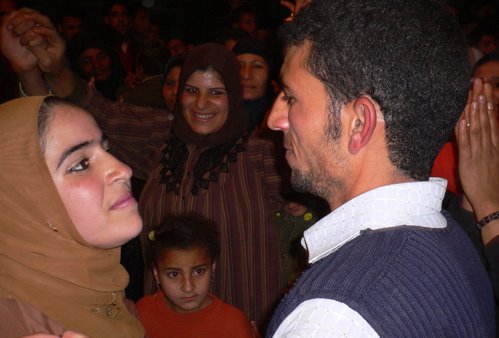 A few days later, the henna party is held at the bride's home. Henna is an herb that mixed with water provides a fairly strong dye and is used to colour hair or skin on important occasions. The henna party is a sort of bachelor party without the cake or the other festivities that we might associate with the night before the wedding. It gives the chance for the families and friends to celebrate the upcoming nuptuals while at the same time, provides a place for a very important economic event, the "nota". The "nota" is a system whereby local people pay a small amount of money to the bride and groom on the event of the marriage with the understanding that they will receive a similar payment when they have a wedding. The amounts contributed by each person are carefully noted in a large book under the supervision of a group of the older women, so that someone who contributes a lot will in turn receive the same amount. The contributions will provide the young couple with a financial boost at a time when it is direly needed.
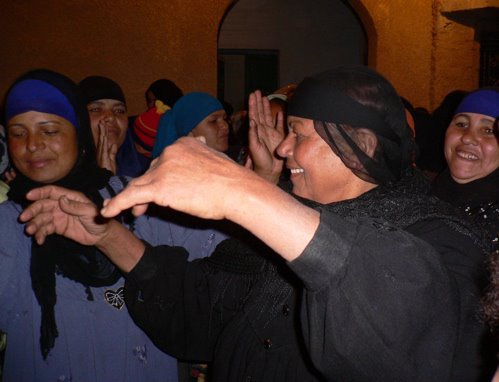 Meanwhile, the festivities going on outside the bride's house while the financial crew works inside are loud and happy, and they span the generations from the grandmothers to the infants.
 Younger boys and girls crowded around Tracy and I begging to have their pictures taken. I obliged, but tried to point out that Sabrine was the star of the party without a great degree of success. The noise was deafening with music blaring from a DJ's stand outside Sabrine's family home as buses and cars drew up depositing well-wishers from surrounding villages. The women formed a knot around Sabrine where they took turns dancing together. I've seen plenty of belly dancers in hotels over the years but none of them can match the women who dance at family occasions for sheer joy in performance.
 Inevitably, Tracy and I got pulled into the circle to dance, something that Tracy did much better than I did. I actually took lessons in this sort of dancing many, many years ago, but over the years my knees have suffered greatly and no longer can stand the twists required to do it properly. Sabrine danced for hours that night, the power of the young, and Gaber arrived about halfway through to spend a couple of hours dancing with his bride to be. Perhaps this exercise helps to reduce the natural anxiety of the bride and groom. When I arrived at the party, I made my way through a thickening crowd of young men on the fringes of the women's group.
As the evening wore on, this group grew larger and more boisterous in their celebrations with young men dancing together in traditional dances using staffs and rather untraditional dances in which they waved cans of insect spray whose propellent had been lit, providing the boys with mini-blowtorches.
 Safety is not Egypt's middle name, but happily no one was hurt during the evening. After a couple of hours of the music and dancing, I made my way home, a bit deaf for the time being, but I had clients for riding early the next morning and a lot of preparation to do yet. The next day was the wedding celebration which was held outside of Gaber and Sabrine's new home.
The wedding itself is actually just the signing of the register to show that the bride and groom are married. The ceremony is small, with only a few witnesses, is called "the signing of the book" appropriately, and is usually held in the afternoon, after which the bride goes off to the hair dresser and prepares for the party in the evening. Tracy had arranged for her car to be decorated to carry the bride to her new home, but some workers arrived rather late to install kitchen cabinets at her new house, making us late for the task which fell to one of our neighbours. She and I dashed about getting ready to go and went over to Zawya, Gaber's village, in my jeep.

We found lights strung over an alley in the village and crowds of people standing before a stage on which Sabrine and Gaber were greeting their guests. Most of the grooms in our area were at the wedding, so I wasn't surprised to find some of mine waiting for us to take us to the stage to congratulate the bride and groom. We inched our way through the crowd to the stage where Sabrine greeted us with hugs. The change in her appearance was fairly astonishing. A beautiful girl in her natural state, she had been made up for the video tape that is made for every wedding. Like the old tomb paintings that I've seen all over Egypt, I found a groom with dark skin and a bride who was made up to be much paler. Interesting.
 Her long hair had been wound up in curls on top of her head and her hands decorated with henna drawings. She was dressed in a long white wedding gown of western design, which I very much suspect was rented for the occasion. A wedding dress is not really a very practical investment for the new wife of a stablehand. Sabrine insisted that Tracy and I join her and Gaber on the stage while people climbed the stairs to congratulate them. There we met members of both families, including the much-feared mother-in-law. Rumour has it that Gaber's mother is a very strong woman and that Sabrine will have some adjusting to do in learning to live downstairs from her. Egyptian mothers-in-law are not known for their love of their sons' wives.
 I had my problems with my mother-in-law and chats with Egyptian friends assured me that the problems were not necessarily concerned with my being foreign. Egyptian wives also have problems in the same area. To be honest, Gaber's mother didn't really look like someone I would want to cross.
 The wedding celebration was a bit of an anticlimax after the henna party. Lasting only a couple of hours, the party broke up with the announcement that the bride and groom would be accompanied to their new home. As she turned to move down the stairs, Sabrine looked at Tracy and I with huge worried eyes and gave us a small smile. We didn't join the crowd escorting the couple to the apartment and went back to our cars. Sabrine had told me earlier that this was a moment that every girl fears as much as she might look forward to it. The day following the wedding, the bloodstained sheet of the marriage bed would be on display to prove that the bride was, in fact, a virgin at her marriage. If for some reason the sheet had no blood, which could conceivably happen even to a virgin bride, there could be serious repercussions including an immediate divorce. Happily, this was not the case for Sabrine, as I heard from her friends later.
Sabrine's life hasn't been easy. She is not from a wealthy family, quite the contrary, and it is large, her father having married three women, although not all at once. She's had pretty much to fend for herself since her father died a few years after her mother, but she's a smart girl who thinks carefully about her choices. Having talked with her a lot about what she was deciding to do in marrying Gaber, I have a lot of respect for her good sense and intelligence. We've seen her through a major step in her life, her wedding, and now since Gaber is working in the same field as I am, with horses, we will be in contact through subsequent events. In all probability we will see her a new mother within a year. I don't plan on losing touch with her because she is a girl who sang as she worked in my home, who loved to play with my dogs and laughed with us at silly Egyptian television shows that we would watch together in the afternoons to help our Arabic. Somehow Tracy and I adopted a daughter and we plan on being there for her. Mabrouk, habibti
Subscribe to:
Posts (Atom)