Showing posts with label village. Show all posts

Sunday, May 31, 2009

Shutting Out the Neighbourhood


I've been a little less than thrilled with the Supreme Council for Antiquities for a while, and last night I got even more reason not to be impressed. I heard from a fairly reliable source that they'd decided to go forward with the wall that they've been talking about for a while in this part of the desert and are starting out with building it in the Abu Sir area, specifically from the pyramids of Abu Sir to just a bit beyond the Sun Temple. I actually understand the building of the wall in Giza, although they didn't have to make it so ugly. There is a densely populated area surrounding the plateau there, but down here the desert is bordered by large houses and gardens belonging to people who are keeping people out of the desert quite effectively. We've had to negotiate a close by access, which if the story is true, will no longer be available after the summer.

So what's the problem other than the fact that I wll probably be inconvenienced? One of the problems is the fact that the edge of the desert that will be closed off by the wall is where the local kids play football (soccer to you, Mericans)in the afternoons. There aren't any open spaces for a football field for these kids. Sure, they are better off than city kids in many ways having much, much more space and less pollution, but it seems pretty raw that a government that can't seem to upgrade the electric power, provide enough telephone lines, provide running water, sewage and trash collection to the people out here has money to toss away on a wall that isn't really going to do anything but make life difficult.

But if the point of the wall is to protect the antiquities in our area from unauthorised digging, how is it going to do this with an open area of sand and gravel mining immediately to the west? Sure the farmers live in the valley, but the Sahara extends all the way to the Atlantic Ocean and they can't possibly wall off all the the area...it's huge! When I first began riding out here about 16 years ago there was a large sandy plateau just west of Sakkara Country Club. Over the years the mining families have dug up that plateau creating a moonscape that is even beginning to spill over the edge into the desert leading down to the pyramids. Naturally, the SCA has been aware of this activity just as they are aware of the Giza dump that is also on the plateau and crawling towards the wadis that lead down to the pyramids of Abu Sir and Sakkara, the same dump that so graciously sends us all the extra plastic bags every time we get a strong northwest wind.

Now THAT'S something that they could wall off. But, no, it's much more important to wall off the homes and farms bordering the desert, places that have a vested interest in keeping the desert clean and enjoyable. It's also interesting that while they could be building their wall between the cliff face housing the archaic tombs and the very crowded village of Abu Sir, they did not move on that option. They've also chosen to leave the Sakkara Country Club an access to the desert so that they can send out their marvelous, noisy and intrusive dune buggies into the desert to be driven by teenage Cairenes through the antiquities areas. Those things do more harm to the desert than any of our horses and football players.

So not only are they dumping the trash from the archaeologists (at least I assume that it is dig trash) out in the desert just west of Sakkara, but they want to keep the people who have been noticing this and commenting on it out of the desert. I don't get it. These are supposed to be people who care about the area, not people who want to trash it. But I guess that one can be mistaken about the responsibilities of government.

So for now, the village kids and I will be enjoying our summer evenings in the desert waiting for the concrete to be poured walling us off from our desert neighbourhood. The wall won't stop people from going out in the desert. There are too many ways to go in even if they do build the wall here blocking all the homes off. And the dune buggies from the Club will still be running all over the pyramids as they wish since they seem to have been considered less harmful than a few football playing children and some riders.

copyright 2009 Maryanne Stroud Gabbani

Tuesday, November 18, 2008

Islanders Win For Now

An article in the Daily Star today revealed that the courts had ruled in favour of the islanders on Qorsaya
who had been fighting off military dredges on their island and eviction orders. A previous suit by the islanders against the Potable Water Company asking for service to provide water had been denied because the courts ruled that as a protectorate the island wasn't entitled to civic services. This worked against the encroachers when again the island was declared to be a protectorate and immune from industrial or commercial building.

This is hardly the last word on the subject, but it is heartening.


copyright 2008 Maryanne Stroud Gabbani

Friday, October 24, 2008

Going Out With A Bang


Although they are illegal and quite dangerous, Egypt has a thriving fireworks industry at a cottage level. Small factories make what we used to call cherry bombs (wads of paper with explosive powder and a bit of grit in them that explode when thrown against something), rockets and firecrackers, all of which are part of traditional festivities on the feasts and at weddings in the rural areas. The people who work in these industries suffer injuries fairly constantly and the users of the noisemakers also are injured with great regularity. So when the police get the chance to impound fireworks they do...but one could truly wish that they'd do a better job.

A couple of days ago one or two truckloads (depending on to whom one is speaking) were seized by the police in the area near Shubramant. Concerned that they might be explosive...I would imagine that they would be...the police rather haphazardly hosed down the cargo with water and then dumped it. Where was it disposed of? In the desert, most likely near the Giza Municipal Dump just up the road from us. Day before yesterday, innumerable grain bags of illegal fireworks were appearing all over the area between Abu Sir and Zawia/Shubramant to the delight of the children of the area. After all, most of the garbage in the dump is checked over for recycling, so why not recycle it, right? From about 4 pm on Wednesday to the present the air has crackled with explosions fairly constantly. The first night it went on all night, with a lot of very crabby adults wandering around the next day.

Of my ridiculously high dog population, probably 90% are terrified of the noise of fireworks, so I have about a dozen dogs running in circles all day barking at the unseen threat or running for shelter under my legs, in my bedroom, in the shower, in the kitchen...wherever. After two days of this nonsense, they are no longer barking at explosions more than about 300 metres away, thank heaven, but a neighbour estimates the supplies at sufficient for about two more days of this lunacy. Who knows, maybe this will get them so overloaded with fear that they will stop being frightened? I'd rather not be using the technique however.

Of even more concern with the vast quantities of these fireworks being used is the fact that children are being injured by them in the villages. I saw one boy not more than about seven years old clutching a round cluster of rockets in his fist and showing them to friends with delight. Heart-stopping. My housekeeper confirmed that there had been injuries to children in the Abu Sir area and the local omda did try, although unsuccessfully, to stop the spread of the illegal bounty at the beginning of the siege. But there were simply too many to collect and they were already too widespread. One would truly wish that when the police do something for the public good, it really would be for the public good. Frankly, it would have been better to send those trucks on their way than to spread these things around the villages the way they did. Unfortunately, until a child is injured, the fireworks are seen as being relatively harmless by most parents who grew up with their use.

copyright 2008 Maryanne Stroud Gabbani

Tuesday, March 11, 2008

The Second Day on the River


The next morning we had breakfast at Kom Ombo and then set sail for Edu. This was my favourite part of the trip, heading down the Nile with the northwind in our faces. We passed farms much like those of my area, and fishermen working their boats in the river while their children played on sandbars nearby. Mango, orange, and banana orchards lined the river, but the date palms here in the south were not as well-trimmed as those in our neighourhood.

We weren't the only ship on the river. In addition to the fishing skiffs, there were some smaller motor craft for travel or cargo and, of course, other cruise boats. Since we were all supposed to be going through the locks at Esna that evening, sometimes things looked like an old fashioned river boat race. The weather had warmed up quite a bit, but most of us were looking abit askance at some of the travelers on other boats who were sunbathing on the top deck. Maybe our boat was colder on the topdeck or something but we were quite happy in tshirts.

When we got to Edfu we were told that we would take a horse-drawn carriage to the temple and back. To my delight, the majority of the horses presenting themselves to us at the riverside were in excellent condition. As a horse owner and someone who works with horses, I really can't tolerate working abused horses. The Brooke Hospital group have been working really hard in Upper Egypt constructing shades where the horses can rest and visiting veterinary services.

The temple at Edfu is amazing. It is wonderfully preserved temple that was constructed for the most part during Greco-Roman times and was buried in sand until the 1800's. I remember being incredibly impressed with its halls and decoration years ago. Many of the halls are stained with soot near the ceilings from people taking shelter in them many centuries ago.

After Edfu, we set sail once again, heading for the locks at Esna. At times we could see desert on one side or another, and there were some beautiful buildings along the river. One sand coloured house in the traditional Nubian style particularly caught my eye. The way that it blended into the surrounding desert hills was lovely.

Finally, as the sun was setting, we came to Esna where we moored with a number of other boats while waiting our turn to pass through the locks. South of Esna the river is significantly higher than it is below Esna. Nile cruisers traveling south from Luxor wait in pairs to enter the lock, have about 4 metres of water pumped in to raise them to the southern level, and then after the southbound boats leave the lock, the northbound boats, like ours, enter to have the lock pumped out to lower us to the northern level. From Esna we traveled north to Luxor to find ourselves moored at the corniche in Luxor the next morning.
copyright 2008 Maryanne Stroud Gabbani

Monday, January 21, 2008

Seasonal Renewals


You would think that after over fifty Januaries, they would get to be a bit routine...but one of the things that keeps us alive is the fact that life changes all the time and you never know what you will find. This winter has been a good example. On the plus side of the register, I've had many more visitors this year than in years before. Over New Years I had two interesting Sue's visiting, one from Spain and the other from Kenya. I love listening to my guests' impressions of Egypt and the ways that life here differs from life in other places. Unfortunately for one of the Sue's, Kenya's elections did not lead to a peaceful New Year and she flew home early to check on her home and pets.

Riding with another visitor in the desert, we happened to go up a trail from a village to the sands that I'd never taken before and we found ourselves amidst pharaonic ruins on top of a hill. I'm used to seeing a stone wall or a pyramid, but these ruins were hallways and courtyards of a complexity that I haven't see before outside of some of the huge temples in Luxor. It's always so delightful to find something new in an area that you think is so familiar to you that you know it all. You never do know everything even about a patch of sand, and now I have the fun of sharing it with some of my local riding partners.

The winter weather that has us all shivering has been fairly unique in my experience here. I woke early one morning to find frost on my grass, a clean white carpet of real cold frost. The dogs were seriously unimpressed with it and in fact did everything they could to avoid walking on it. As far as they've ever known, the ground in the garden simply isn't white and cold. The lawn as well hasn't been too impressed with the frost and has turned a rather sad beige as a result, but I suspect that it will recover, since the frost only burned the green stems and not the roots. Canadian grass has to be much hardier to withstand the snow that they get in Alberta.

For my current batch of Canadian guests the contrast is pretty strong and they snicker a bit at our shivering in our rather feeble cold, but the wind whipping off the desert has had them zipping fleece jackets as well. Still, taking a good look at the desert and countryside through their eyes lets me see my surroundings anew. The children are on midyear holiday right now and not in school, which means that where ever we ride in the farming area we ride, we are surrounded by crowds of kids.

The children are ever hopeful that one of these days I will strike it rich and start distributing cash to them all, but there being far more of the children than there is money in my pocket, restricting my gifts to the odd photo printed in the study or a laugh and a chat seems to be the plan. They are good kids for the most part, with lovely dark brown or hazel eyes and big smiles.
Happily, Paddi and Linda enjoy the interactions and they've gotten some great photos. Guess it's time to warm up the printer.
copyright 2008 Maryanne Stroud Gabbani

Sunday, December 30, 2007

No Man Is An Island

Funny things happen to islands in the Nile near Cairo. A couple of years ago residents of Maadi noticed dredging equipment working on a small unoccupied island just off the Military Hospital on the Maadi corniche. Rocks were piled against the banks of the little island, palm trees brought and planted...all very intriguing. Oddly enough, no one could find out who was doing the work or why or to what end. Now as you drive by there is a very manicured island with a picture of the President of Egypt on it. Did he change the island? No one knows. But there was quite a loud fuss made over the process because changing the shape or size of an island changes the way that the river flows and the River Nile is not just an Egyptian river but it is a major world river. When the Aswan dam was constructed and the silt that used to travel down the Nile to the Mediterranean Sea became blocked behind the dam, the farmers of Egypt weren't the only people affected by the change. The sardine industry was devastated because the sardines relied on the nutrients that had been reaching the sea through the Delta...except now their food source had vanished. Changing a river in any way affects much more than the people who are living on its banks.

Not long ago news reports mentioned that another island was having problems of a similar sort, but this was a larger island and one with quite a few people who have been living there for a number of generations. The islanders found some dredges parked alongside their island and some military personnel standing about on the shore. Having both military personnel and dredges is a very awkward situation. The military have fairly remarkable powers in Egypt... one doesn't want them as an enemy.

The situation became quite tense in fairly short order. The inhabitants of the island are, for the most part, farmers and as such very dependent on their land. At the rate that farmland is being developed in Egypt, to have to pull up stakes and move to another plot of land would not be an easy thing at all. Starting over on reclamation land is a massive enterprise in terms of installing infrastructure and building a new life...plus, Egyptians in general really don't like moving. They like living near their families and friends from generations back.

I've been watching the news to see what is happening with this island and for the past week or so there's been no news. The islanders are fighting the incursion of the army in the courts, but in a country where the military have extraordinary powers, that's not an encouraging activity. There's been no indication of who it is who wants the island or who claims to own it and no indication of the intended outcome. Hopefully, at some level of planning in this issue, people will realise that this isn't just a corner lot somewhere that might make a good grocery store. Islands are part of a river and the Nile isn't just any river.

copyright 2007 Maryanne Stroud Gabbani

Monday, August 20, 2007

Please Contact Them

The story as I understand it is that some of the villagers in Menawet decided that the Mobinil relay tower there was causing cancer or some such thing. Or maybe they decided that the steel and concrete could be put to better use...who knows? At any rate, from what I understand, and this hasn't been published in any papers that I am aware of, they dismantled the relay tower last week and the area roughly from Shubramant to Abu Sir in Giza has been left with no Mobinil service at all.

To understand what a disaster this is it helps to realise that there are about forty thousand people living in the area, of whom probably less than 10 or 20% have land lines. The rest of us, including myself, make do with mobile phones. Some of us use Mobinil, some Vodafone, and a few adventurous ones the new carrier. To be honest, Mobinil, until recently, had the best reception out here and was the most reliable. Vodafone has improved a lot lately after calls to technical support brought engineering staff out here to check out and improve the situation. Because I do a lot of distance riding and the mobile reception in the desert is spotty...sometimes Vodafone working better than Mobinil, sometimes the opposite...I've had lines with both carriers. Right now I have my Mobinil line forwarded to Vodafone so that people can reach me at home.

Today one of my neighbours called me with the news that Mobinil has apparently decided not to replace the missing relay tower for at least a year, leaving the area completely without service for residents and visitors alike. Bloody brilliant. By the time they do replace the tower there will be no Mobinil customers to need it. As someone who depends on my mobile phone and who has been a Mobinil customer almost since the company opened, I am seriously ticked off. Probably someone in the higher echelons of the company decided that a bunch of ignorant farmers don't need a relay...so who is really the ignorant one?

The link in the title will reach the customer support page at Mobinil. If you are a Mobinil customer and find the idea of leaving 40 thousand residents and who knows how many visitors to the area with all of its antiquities, hotels, clubs, restaurants and so on without Mobinil service, do use the link to let Mobinil know.

We would appreciate it.

copyright 2007 Maryanne Stroud Gabbani

Sunday, January 14, 2007

To Market To Market


A while back we built a woodburning oven behind my barbecue for baking bread. We brought in a skilled bricklayer, bought a special heavy ceramic plate to serve as the base in the baking section, and finally in that classic countryside style, plastered it over with mud. But an oven without any equipment isn't going to produce any bread, so today we did what any normal person would do under the circumstances. We went to the Menawet souq. Menawet is a village not far from the farm, somewhere near Badrishin. I don't believe that it has anything at all to recommend it other than the market that takes place there on Sunday, but from my point of view the Sunday market is pretty much worth the trip.

What we were going for was a selection of paddles made from palm wood that would be used to move the bread in and out of the oven. As well we bought a large shallow box into which the bread would be placed after baking. But, as so often happens on shopping trips, we found a number of other things to interest us. The first thing for me was a donkey barber shop that happened to be right where we were trying to park. Parking in the immediate area of the market is quite out of the question, as my trusty Mohamed Said kept reminding Farag and me. He and Farag had come once before to the market to get a harness for George, our donkey, and in order to fit him properly they had come with the donkey cart. In order to have the donkey, the cart and the harnesses all in the same place, they had driven right into the market area, a feat they had no wish to copy today. So while Mohamed was working the jeep into a tiny slot between a palm tree and a building, I watched the donkey barber shaving donkeys with his hand clippers. This guy must have a grip of steel, as he works these manual clippers all day long. Because all of my animals live out of doors, I don't clip my horses or donkeys in the winter. I figure that the longer hair has a very good use and just leave it, so the barber has never visited us.

Once we got into the market area, we immediately found something that we needed but had not thought of. A woman was selling various types of ropes and cords, so we bought about 40 metres of a medium weight pseudo yacht braid to make rope halters and horse leads with. The rope was soft enough to be comfortable in the hand, had a nice colour combination of black, brown and beige, but the fiber looks for all the world as though this cord is made of recycled plastic bags. All the better actually. Right next to the rope seller was a mat with handmade iron tools displayed on it for people looking for axe blades, chains, and the like. Business was pretty brisk and while Farag and Mohamed took care of the bargaining, I took pictures.

I had to watch myself as the street which would usually accommodate at least two trucks abreast was now so crowded with pedestrians that only one car at a time could manage to squeeze through. And what cars. I found myself nose to nose with truckloads of calves, donkeys, and poultry. At one point, a carter drove by with a young stallion of about four years or so tied to the back of his cart. No one was watching or monitoring the young horse who simply stood quietly when the traffic came to a standstill. Arab stallions have such a reputation for hijinks that I found myself chuckling at the sight of this steady young horse.

Down the road and across the street a group of men with donkeys stood around a doorway where a farrier was pulling shoes, trimming feet and shoeing donkeys on the side of the road. I have a pretty good blacksmith who comes to the farm to trim and shoe my horses and donkeys. We arranged with visiting farriers to have Omar trained to increase his skill level. After watching the farrier working on this poor donkeys, I was very happy to have Omar available to us. The tools were quite medieval and the skill level was best not discussed. A number of the donkeys gingerly made their ways down the road after having the hoof improperly trimmed. When I first took some photos, one of the men objected and asked me for money. I shrugged and told him that if he really didn't want me to take a picture I would delete it, but that I didn't have any money to give him. I explained that I own a farm with horses and have friends abroad who work as farriers who would be interested in his work and tools. Assured that I wasn't a tourist, he was all smiles at this point. It's ok to be a nosy neighbour. But it's hard to concentrate on one spot when people are walking past you with baskets of ducks on their heads.

Right across the street there is a wall and an entrance to a large piece of (probably usually) empty land which is currently wall to wall livestock, foodstuffs, and equipment. To the right are clusters of goats and sheep being offered for sale. Farag's family raise sheep, goats, and cattle so his attention is drawn to this area every ten seconds. Further back and to the left, cart horses are being sold and tried out. Some of these horses are beautiful and as the men buying and trying to sell them put them through their paces, a dust cloud is stirred up that just lingers over that quarter of the yard. I spot a dark bay mule and go over to take a look. A friend of mine has asked me to find him a riding mule, but unfortunately most of the mules in this area are actually hinnies. A mule's mother is a horse and father a donkey, while a hinny is the opposite and hinnies are smaller than mules. A casual question revealed that mom in this case was a donkey, but when I say "That's too bad. I was looking for one whose mother was a horse." I'm almost knocked over by the earnest assurances that that was the case. Well, thanks for the compliment, but just how young do you think I am anyway? With boundless enthusiasm, the handlers tell me that the hinny is very calm and trained to riding. Do I want to see? Well, whether I do or not, they are going to show me and they toss one of their number on to the back of the young male (I'm looking for a female mule) hinny. There follows one of the best bucking exhibitions through flocks of goats that I've ever seen in my life and we make our way back to the car hauling our boxes, paddles, and rope chuckling.

Monday, March 06, 2006

Mothers Of The Bride

There are people who have commented that I candy coat Egypt, a country with lots of problems where people have very hard lives, when I talk about the happier moments in our lives here. Well, I don't think so. The fact is that at my age I don't have so many illusions about living happily ever after in any sense. I've lived long enough to have seen that most of us spend our days in fairly stressful yet often tedious tasks that never seem to end. We spend years worrying about jobs, taking children to schools, running late to dental appointments, shuffling our money to meet bills and obligations, and then to relieve the boredom, something really horrible happens to us and we lose loved ones or find a dream shattered. I don't believe that human beings anywhere lead lives that are particularly calm or unnaturally joyous. But I do believe that most of us are granted brief moments of happiness, love, and comfort in the company of our friends, family and neighbours or by the beauty of the world in which we live, and all too many of us forget these blessings in the daily grind of living. In one sense, the events that I describe in my life here are not really about Egypt but about the common human joys that we all share, just as we share the common human sorrows. When I began writing my blog, I was concerned about the fact that somehow there was an "us vs them" attitude about people in the Middle East, that the journalists had managed to let people forget that the people with whom I'd chosen to live, the Egyptians, were really not so different from the Americans, the French, the Taiwanese in their daily lives. Sure, we all live in pyramids and drive our camels to work and go grocery shopping in belly dancers' outfits, but other than that we are just plain folks. So I decided to record some of the experiences of my daily life, and being a fairly easy-going, patient, and friendly person myself, most of those experiences are positive. I've had my share of horror but I'm not sure that the bad parts of my life have anything really do with being in Egypt as much as they have to do with human weakness in general...not my favourite topic and one that can be covered by many news sources.

Last week my young housekeeper got married to my neighbours' head groom. I could be concerned that she was too young to marry at seventeen, but she'd been orphaned a few years ago and that is a rather maturing experience. She's been working since she was about fifteen to provide the money for her household effects. It wasn't an arranged marriage. Gaber had been interested in Sabrine for some time and only recently convinced her to marry him. Sabrine worked for me up until a month before her marriage when she quit to have time to arrange all the things that were required for her new home and she found me an new housekeeper, a young single mother with two daughters who is really in need of the income. Tradition dictates that a new bride does not work outside the home in the villages, but a divorced mother has to do something to support her children if the father is not ready to help (as is too often the case both here and elsewhere). I've seen the procedure for weddings in the city, but this was the first time that I was intimately involved with the events in the village. Tracy and I found ourselves in the odd positions of being sort of adoptive mothers of the bride, having helped her to assemble some of her household needs for the wedding and having offered moral support during the whole procedure of the engagement.

A wedding in the villages isn't a one day affair. After the party to announce the engagement, the couple may wait a few months or years before marrying, depending on the ability of the groom to provide a home for the bride. Gaber's family is from a neighbouring village and he had an apartment in a building in the village that housed the rest of his family, so this wasn't an issue for them. Their engagement was only a few months. The first event of the marriage was the furnishing party when the families assembled the furniture that Gaber had bought and the linens, dishes and appliances that Sabrine had bought. I was invited to Sabrine's home where her purchases were assembled outside waiting the arrival of the trucks to carry them all over. I'd foolishly put my camera battery charger into a plastic bag with a box of salad the week before, shorting out the charger, so I don't have any photos of the collection, but it was most impressive. The women sat in the courtyard chanting rhymes in praise of the bride while the men sat in the living room. When the trucks arrived, everyone loaded the furnishings on board to move to the new apartment, leaving Sabrine at her home. The bride doesn't get to see her new home until her wedding night.

A few days later, the henna party is held at the bride's home. Henna is an herb that mixed with water provides a fairly strong dye and is used to colour hair or skin on important occasions. The henna party is a sort of bachelor party without the cake or the other festivities that we might associate with the night before the wedding. It gives the chance for the families and friends to celebrate the upcoming nuptuals while at the same time, provides a place for a very important economic event, the "nota". The "nota" is a system whereby local people pay a small amount of money to the bride and groom on the event of the marriage with the understanding that they will receive a similar payment when they have a wedding. The amounts contributed by each person are carefully noted in a large book under the supervision of a group of the older women, so that someone who contributes a lot will in turn receive the same amount. The contributions will provide the young couple with a financial boost at a time when it is direly needed.

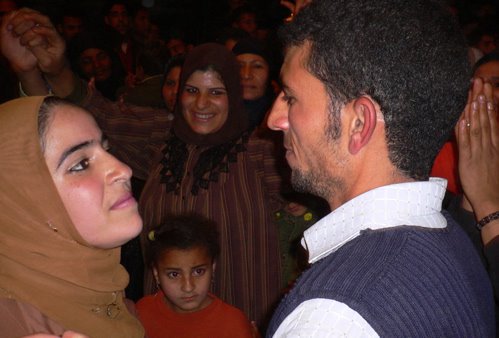
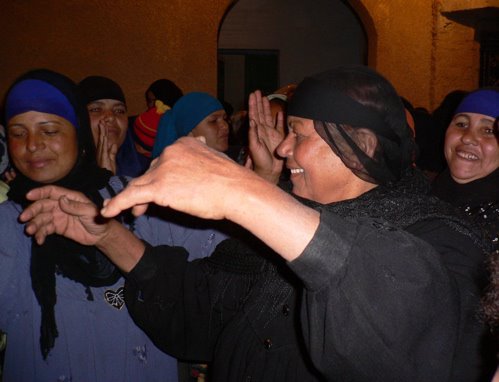
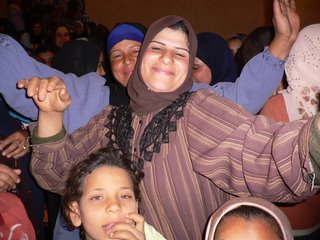
Meanwhile, the festivities going on outside the bride's house while the financial crew works inside are loud and happy, and they span the generations from the grandmothers to the infants. Younger boys and girls crowded around Tracy and I begging to have their pictures taken. I obliged, but tried to point out that Sabrine was the star of the party without a great degree of success. The noise was deafening with music blaring from a DJ's stand outside Sabrine's family home as buses and cars drew up depositing well-wishers from surrounding villages. The women formed a knot around Sabrine where they took turns dancing together. I've seen plenty of belly dancers in hotels over the years but none of them can match the women who dance at family occasions for sheer joy in performance. Inevitably, Tracy and I got pulled into the circle to dance, something that Tracy did much better than I did. I actually took lessons in this sort of dancing many, many years ago, but over the years my knees have suffered greatly and no longer can stand the twists required to do it properly. Sabrine danced for hours that night, the power of the young, and Gaber arrived about halfway through to spend a couple of hours dancing with his bride to be. Perhaps this exercise helps to reduce the natural anxiety of the bride and groom. When I arrived at the party, I made my way through a thickening crowd of young men on the fringes of the women's group.
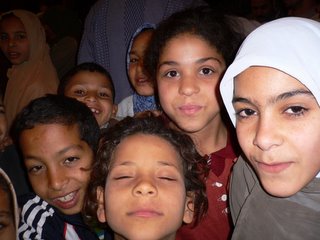
As the evening wore on, this group grew larger and more boisterous in their celebrations with young men dancing together in traditional dances using staffs and rather untraditional dances in which they waved cans of insect spray whose propellent had been lit, providing the boys with mini-blowtorches. Safety is not Egypt's middle name, but happily no one was hurt during the evening. After a couple of hours of the music and dancing, I made my way home, a bit deaf for the time being, but I had clients for riding early the next morning and a lot of preparation to do yet. The next day was the wedding celebration which was held outside of Gaber and Sabrine's new home.

The wedding itself is actually just the signing of the register to show that the bride and groom are married. The ceremony is small, with only a few witnesses, is called "the signing of the book" appropriately, and is usually held in the afternoon, after which the bride goes off to the hair dresser and prepares for the party in the evening. Tracy had arranged for her car to be decorated to carry the bride to her new home, but some workers arrived rather late to install kitchen cabinets at her new house, making us late for the task which fell to one of our neighbours. She and I dashed about getting ready to go and went over to Zawya, Gaber's village, in my jeep.

We found lights strung over an alley in the village and crowds of people standing before a stage on which Sabrine and Gaber were greeting their guests. Most of the grooms in our area were at the wedding, so I wasn't surprised to find some of mine waiting for us to take us to the stage to congratulate the bride and groom. We inched our way through the crowd to the stage where Sabrine greeted us with hugs. The change in her appearance was fairly astonishing. A beautiful girl in her natural state, she had been made up for the video tape that is made for every wedding. Like the old tomb paintings that I've seen all over Egypt, I found a groom with dark skin and a bride who was made up to be much paler. Interesting. Her long hair had been wound up in curls on top of her head and her hands decorated with henna drawings. She was dressed in a long white wedding gown of western design, which I very much suspect was rented for the occasion. A wedding dress is not really a very practical investment for the new wife of a stablehand. Sabrine insisted that Tracy and I join her and Gaber on the stage while people climbed the stairs to congratulate them. There we met members of both families, including the much-feared mother-in-law. Rumour has it that Gaber's mother is a very strong woman and that Sabrine will have some adjusting to do in learning to live downstairs from her. Egyptian mothers-in-law are not known for their love of their sons' wives. I had my problems with my mother-in-law and chats with Egyptian friends assured me that the problems were not necessarily concerned with my being foreign. Egyptian wives also have problems in the same area. To be honest, Gaber's mother didn't really look like someone I would want to cross.

The wedding celebration was a bit of an anticlimax after the henna party. Lasting only a couple of hours, the party broke up with the announcement that the bride and groom would be accompanied to their new home. As she turned to move down the stairs, Sabrine looked at Tracy and I with huge worried eyes and gave us a small smile. We didn't join the crowd escorting the couple to the apartment and went back to our cars. Sabrine had told me earlier that this was a moment that every girl fears as much as she might look forward to it. The day following the wedding, the bloodstained sheet of the marriage bed would be on display to prove that the bride was, in fact, a virgin at her marriage. If for some reason the sheet had no blood, which could conceivably happen even to a virgin bride, there could be serious repercussions including an immediate divorce. Happily, this was not the case for Sabrine, as I heard from her friends later.

Sabrine's life hasn't been easy. She is not from a wealthy family, quite the contrary, and it is large, her father having married three women, although not all at once. She's had pretty much to fend for herself since her father died a few years after her mother, but she's a smart girl who thinks carefully about her choices. Having talked with her a lot about what she was deciding to do in marrying Gaber, I have a lot of respect for her good sense and intelligence. We've seen her through a major step in her life, her wedding, and now since Gaber is working in the same field as I am, with horses, we will be in contact through subsequent events. In all probability we will see her a new mother within a year. I don't plan on losing touch with her because she is a girl who sang as she worked in my home, who loved to play with my dogs and laughed with us at silly Egyptian television shows that we would watch together in the afternoons to help our Arabic. Somehow Tracy and I adopted a daughter and we plan on being there for her. Mabrouk, habibti