Showing posts with label buildings. Show all posts

Tuesday, December 28, 2010

Living in Colour


When I was building my house I decided that I wanted the house to blend in with the trees and the fields around me, so I asked for a stucco roughly the colour of the cabbages and palms in the fields nearby. After rejecting mint green, sea green, turquoise green, kelly green, forest green, and a dozen other shades, the plasterer finally got the colour right, to his great disgust. "But, madame, this is not a bright colour!", he complained. That's right. It's a grey green that is very easy on the eyes. I love the colour and am happy with it, but the neighbours have decided that this is simply another example of my eccentricity.

Local tastes in house colour are a tad stronger than mine. Sometimes I wonder if the colours are conscious choices or whether someone simply had a sale on a certain shade of paint. I remember a number of years ago when there was a sudden outbreak in lavender painted balconies in certain parts of town. We decided that a huge truckload of lavender paint had been highjacked, but it may have simply become fashionable. Riding through the villages, I notice the house painting fashions change over the years. Just recently it has become popular to paint balconies and houses and then make flower-like prints over the brighter or darker colours of the base.
The interiors of the houses are often equally strongly coloured and bright. I was also scolded for having such subdued tastes as painting my living room a dusty rose rather than a bright yellow or pink. To each his own, I guess. But then I have a collection of prints, photographs and paintings collected over the years that decorate my walls and the village houses are generally more bare of decor. Farmers save their money for schooling for children, new animals, repairs to machinery or buildings or such. Paintings are less practical.

While I choose to live in subdued tones, I really enjoy seeing the bright patterns that people paint on the balconies and walls. Cities are far too much grey cement and red brick in my mind and the colours brighten spirits as well as they brighten the view. Sometimes they are geometric patterns and some of the paint jobs provide optical illusions of texture and space.

I'm sure that in many of our more regulated communities, the local authorities would be having fits at some of these paint jobs. But that is one of the wonderful advantages of a fairly uncontrolled building code.


copyright 2010 Maryanne Stroud Gabbani

Sunday, November 07, 2010

Full Service


They were closed so I couldn't see who was doing what but the concept is brilliant. I just want to know if you do the tatoo after the taxi or after the destination or the internet. Could get busy.

copyright 2010 Maryanne Stroud Gabbani

Sunday, May 23, 2010

A Walk Along A Mameluke Street

A couple of weeks ago a close friend of mine, Patricia Canfield, decided to take one of the walks in Cairo sponsored by ARCE (The American Research Center in Egypt). ARCE offers some amazing tours of Cairo and sites further afield for very reasonable prices. You do have register with ARCE beforehand and to show up on time for the bus as they absolutely depart at the advertised hour, but the tours are some of the best in Egypt. Pat is a freelance writer living here for some twenty odd years and when she showed me the photographs and told me about the places she'd seen, I begged her to write it up for me for my blog. These days my arthritic knees have taken me away from any ideas I have of three hour walks, although knee replacement surgery scheduled for this summer should have me back pounding the pavements, however gingerly, in the fall. Here is her story:

Al Mu’izz Li Din Allah Street

One of the highlights of tours to Cairo is the Khan El Khalili which is an intricate warren of over 1,000 shops, craftsmen and workshops and an astonishing group of Medieval and Islamic monuments which have occupied the same cramped area for well over 1,000 years.
The most spectacular group of these monuments is on Al Mu’izz Street which is part of the main thoroughfare that ran through the Medieval walled city. It is an area called Bayn El Qasrayn (Between the Two Palaces). This was the Mameluke (1250 – 1517 AD) ceremonial parade route which ran between the two palaces of the Royal complex. At that time it was said to be wide enough for 10,000 troops on horseback to pass. These palaces were built on the site of the earlier Fatimid (969 – 1171 AD) era buildings which were the heart of what was then the city of Al Qahira (Cairo).
An extraordinary group of these monuments was painstakingly restored and has recently been reopened to the public. These three adjacent complexes below were built by Mamluke Sultans who traveled extensively during military campaigns and incorporated much of what they saw into their own buildings.
The oldest complex was built by Sultan Al-Mansour Qalawun (1279 – 1290) and is a magnificent grouping of the highest examples of Islamic architecture. It included a Maristan or hospital that handled hundreds of patients each day with a highly specialized medical staff and surrounded the patients with beautiful gardens and soothing musicians. An eye hospital still exists on the site. There was a Madrasa or religious school. However, the most spectacular feature is the Mausoleum which is an absolute treasure trove of marble inlay, intricately carved gilded wood, Islamic calligraphy and stucco that looks like lacework and which houses a cenotaph with several royal burials.
The next building was constructed by Qalawun’s son, Sultan Al-Nasir Mohamed, who was one of the most prolific builders in Cairo’s history. A white marble Gothic style doorway that was brought from Syria opens into the passage which separates the Madrasa from the Mausoleum. The door to the entrance is well-aged silver and marble inlaid floors form a carpet like passage between areas. Colored stained glass windows play with light and color throughout the buildings.
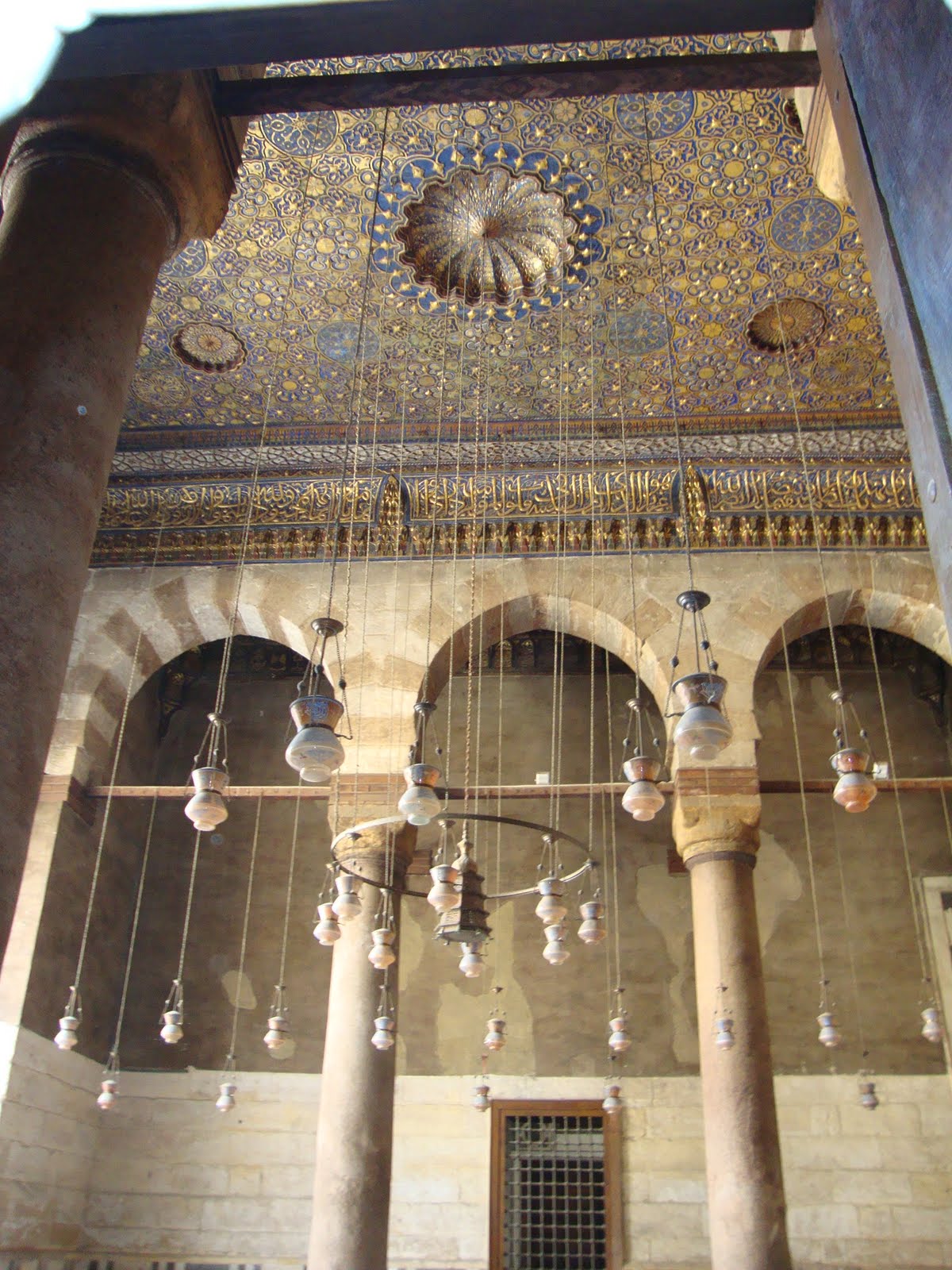
The third building of this contiguous façade is the Khanqah (Sufi monastery) and Madrasa of Sultan Al-Zahir Barquq (1382 – 1399). There are exquisite examples of gilded Arabesque stalactites on the domed ceiling and bands of Koranic inscriptions stretching across the walls of marble inlay and carved Mashrabiyya wood. Colored glass mosque lamps are hung from chains in graceful groupings.
From the street, you can see the interplay of light and form in the recesses which give so much texture to the buildings and the minarets that top the structures are a study in different styles of design and calligraphy. It is a place that constantly affords you a new sight to study and a new treasure at which to marvel.


copyright 2010 Maryanne Stroud Gabbani

Sunday, December 21, 2008

Learning From A Master


My neighbour decided that it was time to finish building his house and put a second story on it to provide a study for his wife and a spare bedroom. The project was complicated by the fact that when his built the first floor, he'd put a dome over the living room to help circulate the air and to evacuate the hot air that we are so good at collecting during the summer. He decided to remove the dome on the first floor and add one to the second floor immediate over the original to do the same job and to create a sort of atrium.

His design was very clever since he planned the stairs to be built outside so that all the work could be done without breaking into the part of the house that he was living in during the construction. The final thing to be done would be to break the original dome and put a railing around the space where it had been. He brought the same master bricklayer who had built the original dome to build the new one and Tuha, the bricklayer, brought his son to help and to learn how to do the work.

Tuha is a marvel. He built my barbecue for me, entire buildings for others and a gorgeous barbecue for a neighbour. You describe what it is that you want and he simply constructs it free hand. After watching ordinary construction workers, you realise that you are watching an artist. The only way to learn to do this is by doing it and his son is learning the family business after spending a number of years in school to learn to read and write. While this may seem strange, it does make some sense since the schools in the countryside are really nothing that marvelous and having a skill like his father's will assure him a good living.

Tuha, having built the main dome, put his son to work on the smaller dome for the stair well. Under his guidance the boy learned how to place the bricks precisely in place to create a slowly decreasing circle of brick that would form the dome. They work from the center of the dome standing on a wooden platform that closes the space beneath them. This platform will be removed when the dome is completed. This method of construction is the traditional architecture of Egypt and is cheaper than the non-traditional forms. A building made with the domes and barrel vaults from brick without concrete columns cannot easily be built upon to make a second floor, however, so many people like my neighbour mix it with the modern construction, making use of the air conditioning features of the dome and vault. And it never hurts that they are beautiful as well.

copyright 2008 Maryanne Stroud Gabbani