Growing up isn't an easy task in any case. I certainly wouldn't want to do it again, and I recently got a new perspective on the process for some of our multicultural kids in Cairo. They say that birds of a feather flock together, so it shouldn't be a surprise to anyone that many of my friends are foreigners married to Egyptians. Likewise, many of my children's friends are the product of such marriages. While I've always been aware of the stresses that I knew could plague such mixed culture families, there are some that I'd never noticed.
Until very recently, it was the law in Egypt that although the children of an Egyptian man and a non-Egyptian woman could be Egyptian, the children of an Egyptian woman and a non-Egyptian man were not. A recent change in the law allowed the children of Egyptian women (especially those married to Sudanese) the Egyptian nationality, enabling them to attend public schools instead of private ones and to take part in Egyptian society. It cannot be said that the legal and social position of men and women in Egyptian society is equal. Boys are granted infinitely more leeway in terms of behaviour than girls are...after all, they are just boys and boys will be boys. As the product of a North American upbringing, I never had that particular prejudice, and my son was stuck with very much the same rules and regulations as my daughter was subjected to.
So it was a bit of a shock to me to be talking with some of the young women here and to discover that many of them felt, as the products of mixed marriages, that they really had no future in Egypt for the next few years. These are well-educated, bright young women. They are the sort that Egypt really needs to provide some of the yeast in the dough, but they are very, very aware of the fact that they don't fit in. The girls spoke of the constant questioning of their "Egyptian-ness", a process that they've gone through for years, many of them not being traditionally Egyptian in their looks. They speak Arabic, but are often answered in English to their extreme annoyance. They have learned to be fiercely independent and self-contained from their trials as children who were not accepted as proper Egyptians....trials that many of their mothers have been unaware of over the years. For myself, my status as a definite and official foreigner was never in any doubt, and it never occurred to me that my children might not be accepted as "real" Egyptians.
Now in university, these young women are questioning the wisdom of coming back to Egypt after graduation to work here. They've been living independent lives in Europe and North America, and are all too aware that in coming home they will be subjected to the questions of relatives, friends, and simply nosy strangers as to why they might want to have an apartment of their own rather than living with their parents, or why they aren't interested in getting married right away. Furthermore, having had the mixed blessing of being raised in two cultures, they are not traditional Egyptian women in any sense of the word, and they do not necessarily see the reason for the traditional assumption that they will marry Egyptian men. This brings us back to the issue addressed by the recent legal changes.
If these half Egyptian young Egyptian women were to marry non-Egyptian men, what would their children be? They would like to be able to live in Egypt and see the possibility of their children being Egyptian as a positive step, but at the same time, they express concern at putting their children through the difficulties that they encountered regarding their own cultural identities. As it is, for the Muslim girls, it would be expected by the entire community and the legal system that their prospective husbands would convert to Islam, since the marriage of a Muslim woman to a non-Muslim man would not be accepted at all, nor would it be a legal union in Egypt. For girls who have been raised to believe that they can be all that their brothers can be, these restrictions are painful.
Most of the girls see a possibility of coming back to Egypt when they are perhaps in their 30's, to come back as adults established in their working fields. They don't want to forget about Egypt as their home, but want only to be accepted as Egyptians who aren't quite the same as other Egyptians.
Monday, January 02, 2006


Monday, December 26, 2005
Christmas in Egypt
 In Canada today would be Boxing Day, the day after the Christmas dinner and gifts, the day that the big sales start. In Abu Sir it's nothing special really, just another beautiful winter day under a clear blue sky after a couple of days of watching the heavy grey clouds of the Mediterranean storms rolling down the valley dropping the occasional load of rain on unsuspecting Cairenes. That's not to say that there is no Christmas celebration here. On the contrary, we celebrate Christmas twice in Egypt, once on the 25th and again January 7th with the Copts and Eastern Orthodox churches. So with two Christmases, the time leading up to the beginning of Christmas on the 25th can be fairly hectic. This year was more so for the people who work at many of the foreign schools that give a Christmas break, because the break usually includes the two holiday dates, bringing students back on January 8th or so. But this year the Greater Bairam, Eid el Adha, starts around the 9th of January, bringing with it an additional week of holiday. So teachers and students were preparing for an extra long Christmas break this year.
 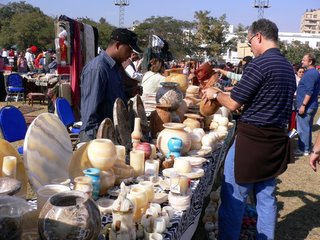 We don't have the massive Christmas shopping push from stores here, however, and you don't find the stores more crowded at this season than any other. Christmas shopping in Cairo has its own flavour. Part of the season has been a series of Christmas bazaars (or bizarres, as you choose) that are held in various places throughout the city. These support local charities from the income of the bazaar and many shoppers prefer to do Christmas shopping that also helps other people. I have been a patron of the Maadi Women's Guild Bazaar since we moved to Cairo. In fact, when we lived in Alexandria, I knew people who would travel to Cairo to attend it as well. The Maadi Bazaar is held at Cairo American College, the school my children attended, and the students and teachers take an active part in fundraising with games for the children attending the bazaar. The football field is usually covered with tables for vendors, part of them commercial vendors and part of them are charitable organisations who raise funds by selling handcrafts and other items. Here you will find bold printed cotton products with Sudanese drawings printed on them, delicate crocheted table cloths, detailed embroidered hangings depicting village life from Upper Egypt, wooden furniture crafted by mentally handicapped students, applique work and quilting from the recycling center for the Zebeleen in Mokattam, a wide array of items that make lovely presents, especially when taken on a visit back to North America and Europe.
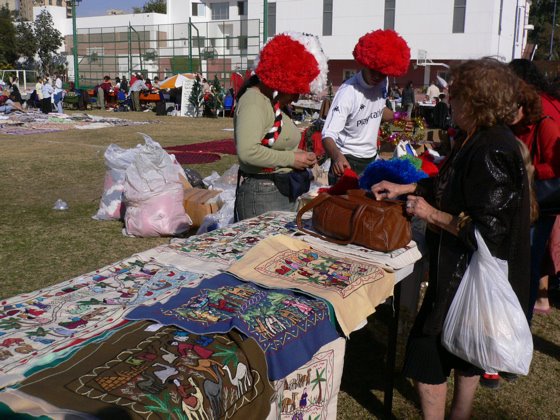 The commercial vendors are worthwhile as well and part of their income goes to the Guild for the donations to charities. Some of the regulars are the old book salesman who carries wonderful old copies of books, some of them published in the past century, for those who are addicted to things readable, or the amber man who sells silver and amber jewelry...hard to resist. The commercial tables are often a chance for someone with a new product to give it a try with the public. In the past I've found a skilled maker of wooden toys selling ingeniously carved objects sturdy enough for children but smooth and beautiful enough for adult tastes. This year I bought some locally prepared chutney that may find its way into the supermarkets later if the response was good enough.
 The European Bazaar is another Christmas bazaar held at the Nile Hilton every year, and the participants there are the embassies of the countries of Europe. They bring in shipments of handcrafts, foods, and beverages from the father/mother land and sell these to expatriates who are longing for German knackwurst, Italian panetone and Chianti, Russian nesting dolls, or English sausages. The proceeds from the bazaar again go to charitable organisations to improve or continue their services. The organisers of these bazaars look through the various organisations working in Egypt to find those who are in need of funding and also really performing a necessary service. Significant amounts of funding go to health services for the poor, orphanages, schools for children with special needs, shelters for women and so on.
 The other place that I like to do some Christmas shopping is in the smaller shops that I know in Maadi that carry interesting pottery, art and jewelry from local artisans. One of my favourite shops is one called Norag run by a close friend of mine, Mai Greis. Mai has an eye for art that is truly gifted and one can often find wonderful gifts there for almost anyone. She's working on a website for her place and hopefully sometime in the future will be online. She carries pottery from the Fayoum school, wooden and stone carvings made by Bedouin sculptors from the oases, handpainted and sewn Egyptian cotton and linen clothing designed by another friend Marie Claire who divides her time among desert safaris and her artistic endeavours, as well as the odd piece of furniture designed by Mai. Every time I go into Mai's shop I find something new and fascinating.
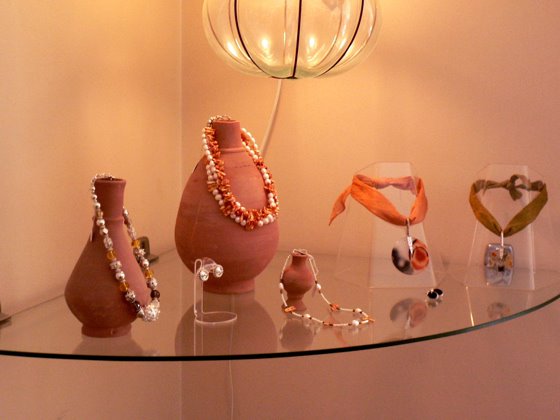 I stopped by a week or so before Christmas because Mai called me to tell me that she was hosting an exhibition of jewelry made by two women we know. Suad Raja has been a friend of mine since the early days in Alexandria when she was a new mother of her daughter Najla and was teaching belly dancing in my living room to a group of other mothers who spent part of the morning working up a good healthy sweat learning to shimmy and twist to the beat of the tabla and the other part of the morning collapsing in hilarious laughter at our own efforts. We are now both much older and less flexible with grown and nearly grown children, but when I see her in my mind's eye I don't see the silver that highlights in her curly black hair (just as it does my own).
 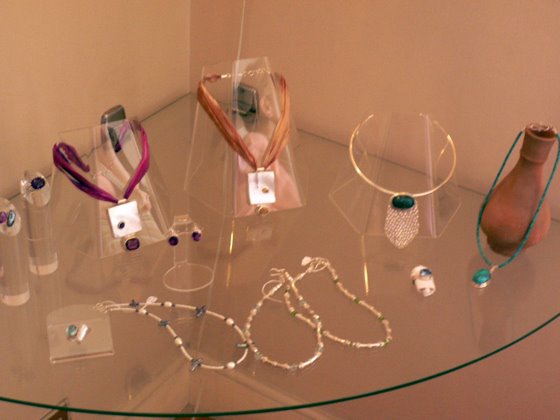 Suad began designing jewelry based on the traditional Yemeni silver of her youth while Najla was still very young and is the owner of a successful company, Sheba Jewelry, www.shebajewelry.com, based in Cairo but establishing a branch in the US as well. She now commutes between the Washington DC area and Cairo. The other artist, Maie Yanni, worked as a doctor before her children were born, but found that being a mother and a doctor at the same time wasn't very easy, so she decided that it was better to do one thing well than two things not so well. Wanting an outlet for her ideas and creativity, she began making jewelry for herself out of common objects such as fine bone and shell buttons, ribbons, and bits of silver wire. It takes a moment to realise that the lovely necklaces are in fact made from such everyday things as buttons. As friends eagerly bought her pieces, Maie has developed a following which now includes the young friend of mine who received a lovely sea green pendant.
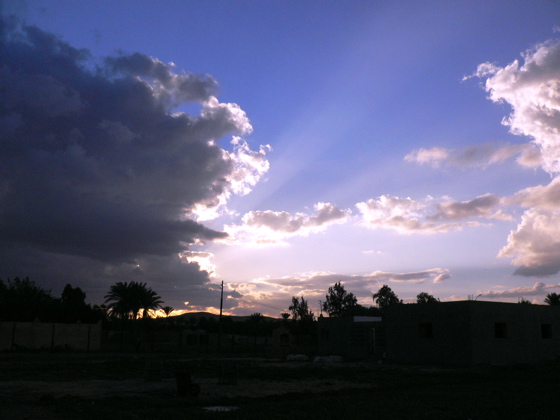
And what did I get for Christmas? My son decided that it was time his mother had a decent set of mini-speakers for her iPod and computer, so he picked up some on a recent business trip, and my daughter arrived yesterday afternoon with a copy of Temple Grandin's book Animals in Translation. But the best present of all was the time spent in the company of my two children in the home of my friend Jo with two of her children (along with a few other people's now grown offspring) enjoying a traditional English dinner of ham, turkey, Christmas pudding and a lot of laughter. For all of you, I wish the best in the holiday season and the new year. Here is a special image of a winter sunset over the desert to remind you of the joy of the intangibles that we are given, the gifts that mean so much more than anything that can be wrapped.
Sunday, December 11, 2005
Definitely Book Of The Month

I stopped by Diwan, a lovely bookstore in Zamalek, the other day when I ventured into town for some reason that I've already forgotten. Stopping at Diwan is like stopping at a chocolate factory for me. I am a serious book addict with a fairly serious library of books by and about Egyptians and Egypt. My visitors love it because they can read to their hearts content about pyramids, Mamelukes, early exploration of the Nile, whatever. Anyway, I found myself poking through the shelves and I ran across a book by Dr. Leila Ahmed, the first professor of Women's Studies at Harvard Divinity School. The book, A Border Passage, is her autobiography and reminiscences of her childhood in Cairo during the change from British rule to Nasser's government. To be quite blunt, it is one of the best books I've read in years.
 Dr. Ahmed has also written Women and Gender in Islam: Historical Roots of a Modern Debate, a book that I haven't read yet, although it is now on my list. A Border Passage is lyrical, with the music of Egyptian life a theme that flows comfortably and seductively throughout her autobiography, which explores many of the issues of growing up female in Egypt. Some of the issues faced in growing up during the 50's and 60's have changed for women in Egypt, but many of them are the same. Watching my own daughter identify and deal with them as she grew up here was both interesting to me and daunting at the same time. With a Canadian mother and an Egyptian father, she had to invent her own culture as she grew up, since the two didn't always synch well. My husband was a product of the same culture as Dr. Ahmed, a culture that did value males over females, and that allowed males more freedom of action than females had. On the other hand, I was raised by a father who felt that it was important for both the boys and girls to know how to cook, sew, change tires on a car, fix a broken toilet, pitch a tent, and catch a fish. Although I made it clear from day one that there would be no difference between the rights of our son and our daughter, this was a point that had to be brought home more than once. Leila Ahmed's family was both ordinary and extraordinary and made it possible for her to study abroad at a time that such a course was not so common for young women.
 I spend a lot of time with women of many backgrounds and social classes. My seventeen year old housekeeper from the village can't read or write, and her mother died about five years ago followed shortly by her father, leaving her an orphan. She's now engaged to be married to a young man from a neighbouring village, a skilled groom working for friends of mine. Before she became engaged to Gaber, she asked my advice as to his suitability. Gaber is a polite, hard-working young man with whom I could see no problems, so my advice was that he would probably make a good husband. Although my heart cringes at the thought of a seventeen year old getting married, she's already been supporting herself for the past three years and is well past the usual age of marriage in the villages. When she marries, she will stop working for me, but has promised to arrange for a friend of hers to come to help out in my house. Her friend is also married but also has children and I suppose has realised the necessity of extra income in her family.
 Every woman has a story. We will recognise ourselves in parts of the story and find new truths in other parts. We will enrich our own lives by learning of the lives of others. A Border Crossing is a double blessing. Not only does it give us an experience of another culture, another country, and another time, but it does so with such beauty and grace that you will dread finishing the book as I do.
Wednesday, December 07, 2005
Just Another Pretty Face
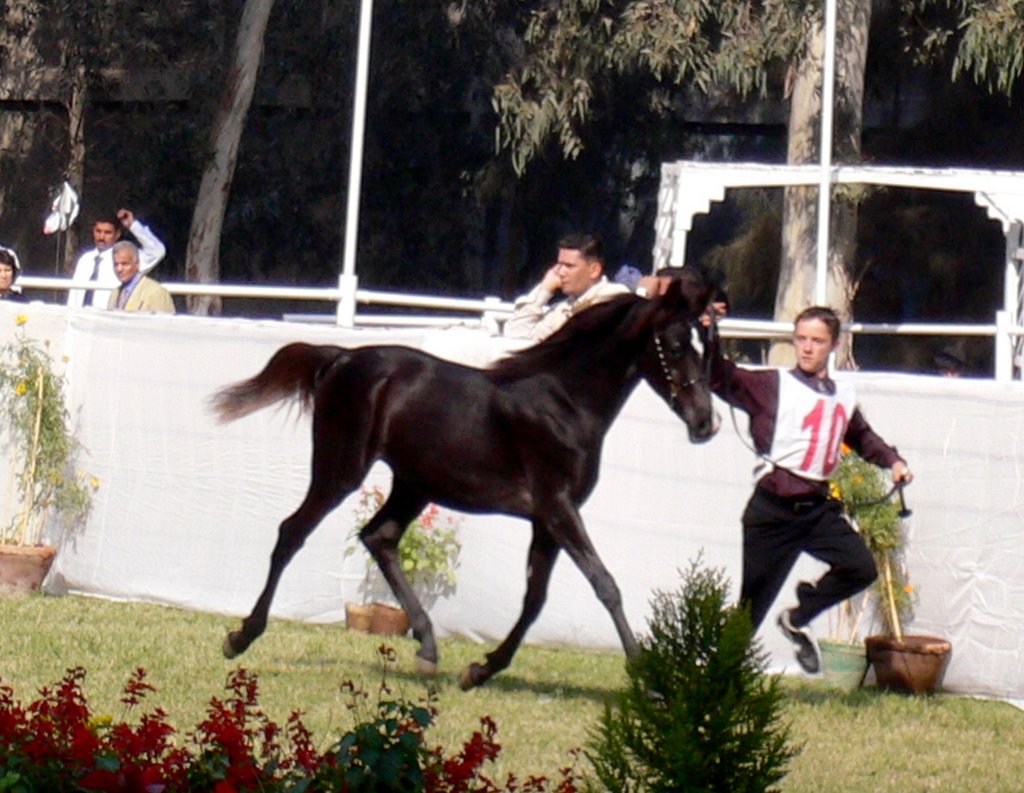
A few weekends ago in November, from the 17th to the 20th, The Egyptian Agricultural Organization, the national Egyptian Arabian stud farm in Zahraa, held the National Egyptian and International horse shows, four days of some of the loveliest horses you could imagine.I went on the first and third days of the show, the days when the mares and fillies were showing because I'm very partial to the girls. The fact that I know many of the breeders who have spent their lives breeding and training some of these horses is a definite plus. It's always good to cheer for the horses of friends.
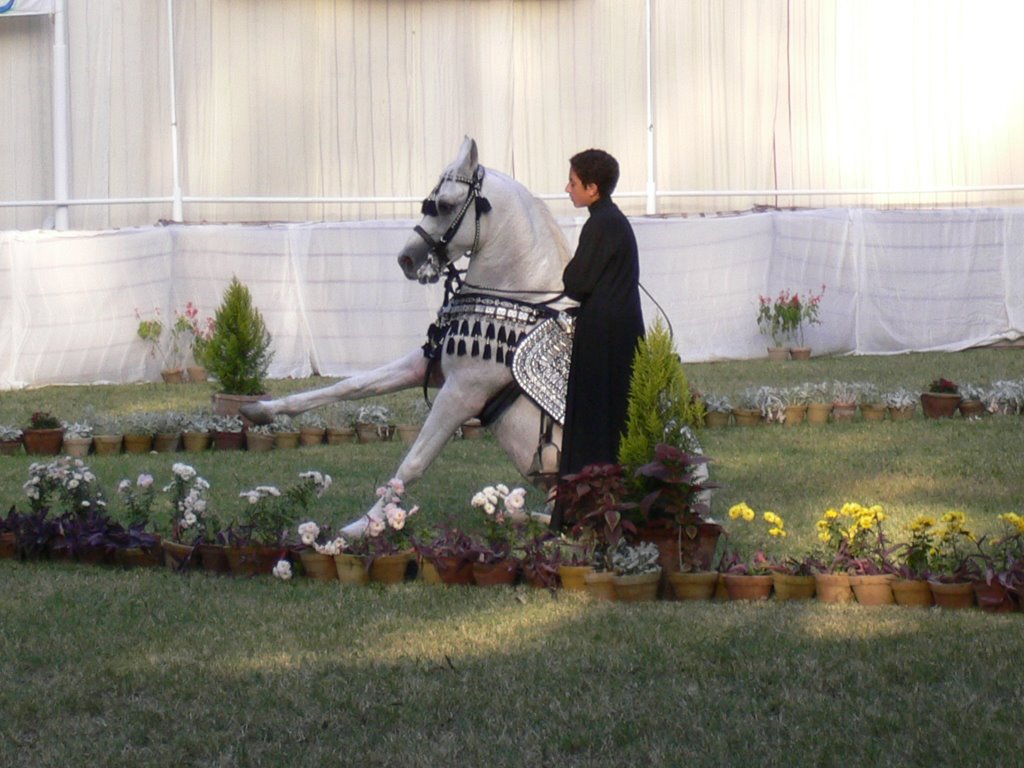 The history of the Arabian horse in Egypt is a long one. When the Arabs moved out of the Arabian peninsula early in their history of conquest that reached all of North Africa and parts of Europe, they moved with their armies on camels leading the horses that were used in the lightning raids on cities and towns along the way. The Arabian horse is one of the primary breeds in existence. They are small, fine boned, thin-skinned, and the originals were tough as nails. They had to survive on whatever fodder was available and, like their owners, on camel milk and dried dates when nothing else was available. One of the interesting characteristics of the Arabian horse is that it has fewer vertebrae than other horses, indication of how long the breed was isolated from the others. The Mameluke cavalry was famous for its horsemanship and the area where I am living now was once the horse farms for the Mamelukes. Like other famous cavalry regiments such as the Cadre Noir of France, or the riders of the Spanish Riding School in Vienna, the riders developed stylised versions of the war moves of the horses into a form of equine ballet. Known as the dancing horses of Egypt, these horses move in time to oriental music with movements similar to those of the high school of dressage. One of the favourite accompaniments of the horse shows in Egypt is a performance of the dancing horses, which often culminates with the horse sitting like a dog and offering a leg in salute. In battle, a horse that could sit or lie down on command could help an injured rider to escape the from the danger of the fight.
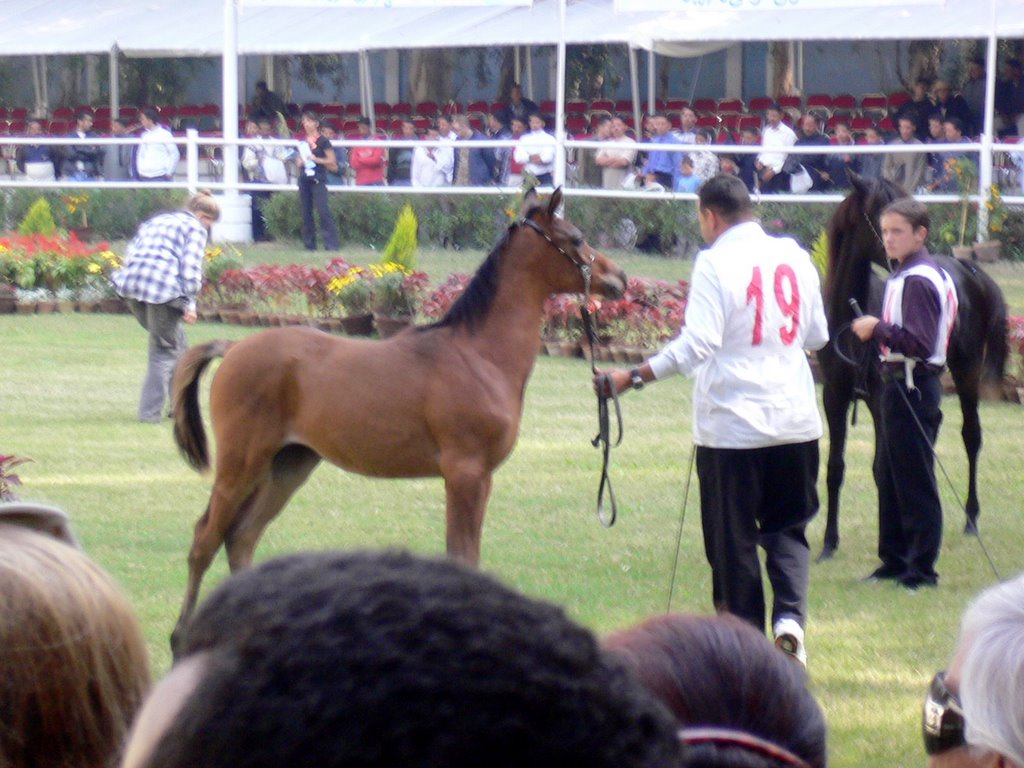 These days most of the Arabian horses in the world are not called on to perform in battle. A very versatile breed, they are used by ranchers to handle cattle, by endurance riders who travel hundreds, sometimes thousands, of miles in competitions, and by people who just want a hardy, intelligent riding horse. Breeders of pedigree horses compete with them in horse shows that rate their beauty, as categorised by head and neck, topline, legs, and movement among other things. Arabs are known for their smooth, almost floating, trot. My own horses are not pedigree Arabs, but baladi, or countrybred, Arab mixes. They share the Arab intelligence and versatility as well as the small size...all the easier to to get back on should one fall off, not that I do that much anymore.
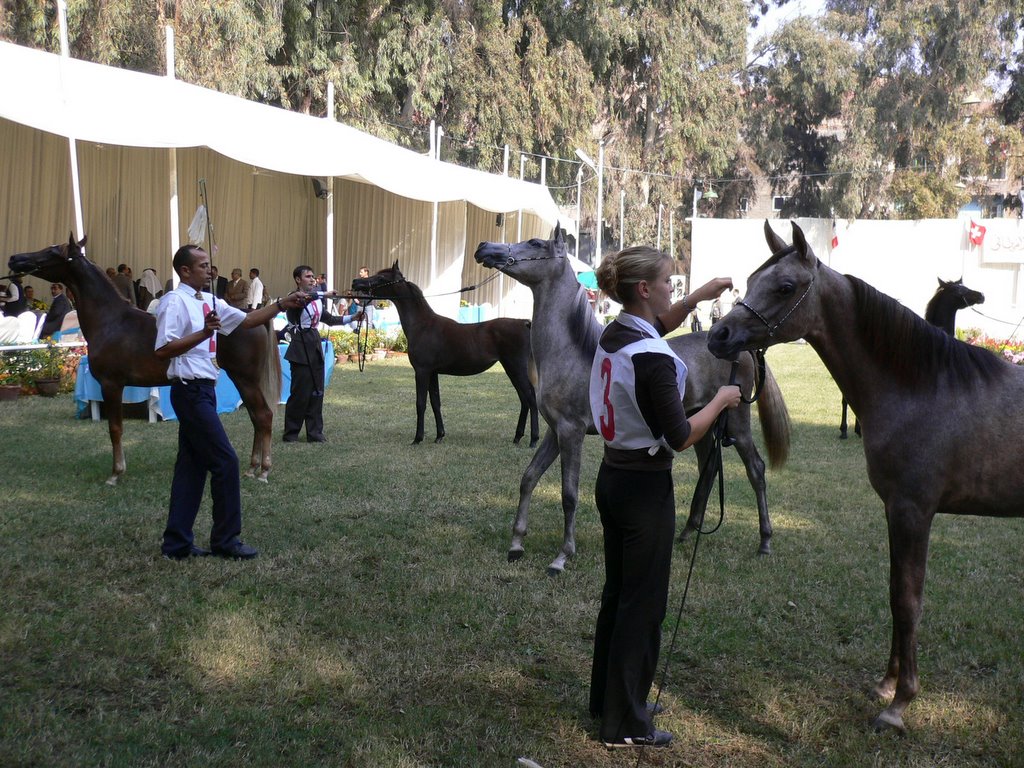 Halter shows such as that at the EAO the other weekend involve some major financial considerations. The mares and stallions that produce prize winning foals in the international shows often have price tags equivalent to the value of an expensive home in a good neighbourhood. I've personally met foals valued at half a million dollars each. Pretty impressive and way, way, way out of my budget. They are works of living art, these extraordinary creatures. They float over the ground and seem never to touch the grass, looking out at the world with wide dark eyes that seem to say to everyone watching them, "Well yes, I am utterly beautiful. Of course you are enthralled."
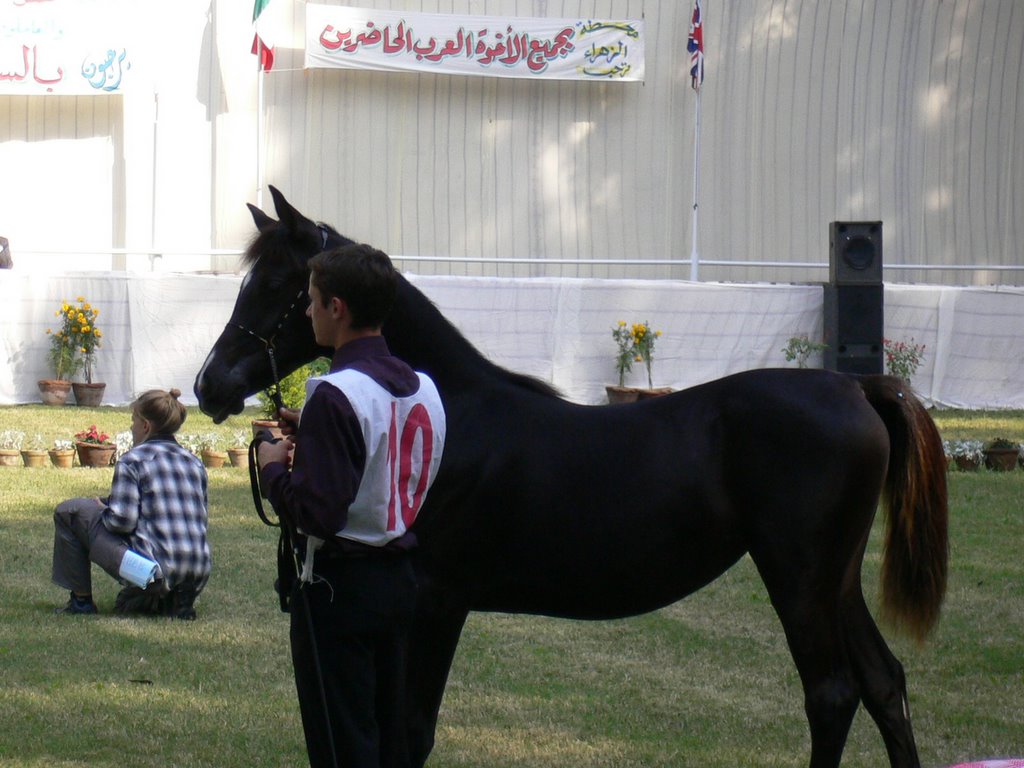 Some people are silly enough to think of horsebreeding as a business. For the very rare breeder, it is a business, but for most people it is an extremely expensive hobby. The investment in the buildings, land, and livestock to start breeding is enormous if you want to compete at the upper levels right away. Many of the successful breeders have been at it for over forty or fifty years now. Meanwhile, if you happen to lose a good broodmare, something that is all too easy, the profits of a year or two can go down the drain in a matter of minutes. Nevertheless I do enjoy watching these people competing with their lovely creatures, though not quite as much as I enjoy riding my own mongrels.
Tuesday, November 15, 2005
Shopping Among the Neighbours
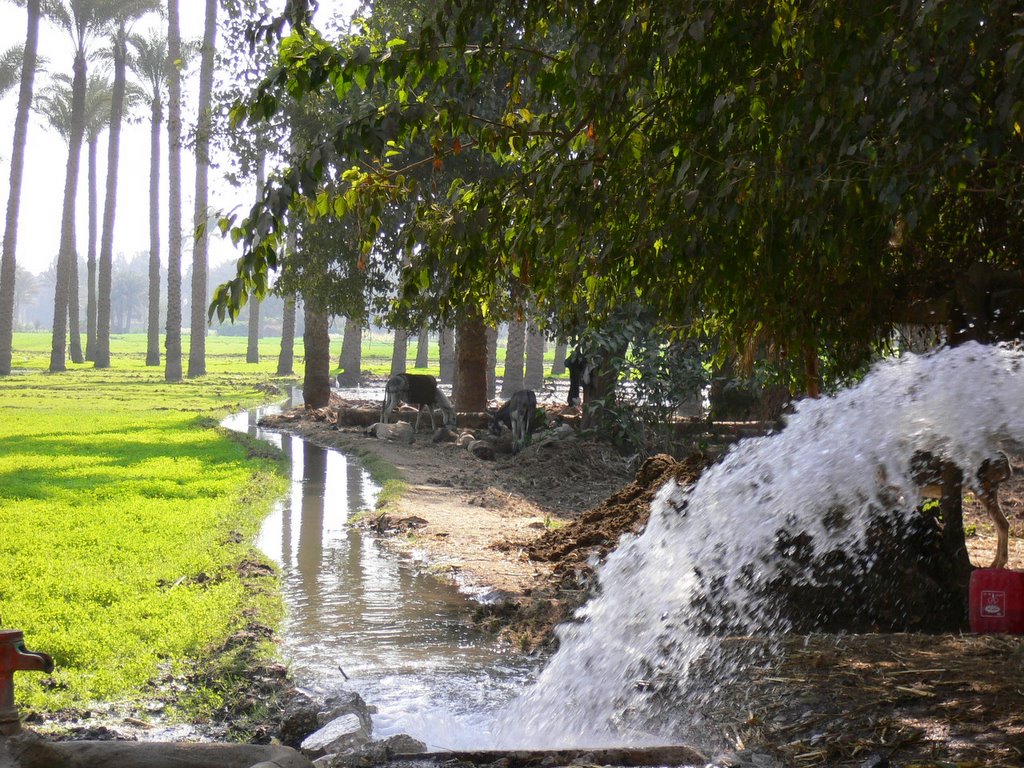
We needed some supplies for the new land, supplies that you can only get in a farming village, so Tracy and I headed over to Hawamdaya with my head groom to buy them. Hawamdaya is not on any tourist map, in fact it's barely on any maps. We get there by going through the village of Abu Sir and continuing on down a narrow asphalt road towards the Nile. The asphalt wears out soon enough and becomes potholed mud more suited to the donkey carts and three wheeled motorcycle tuk-tuks that have been imported from India to serve as taxis in the area. I was very glad to be driving a jeep, aside from the fact that the items we were buying (huge aluminum cooking pots and a three burner camp stove) wouldn't have fit in the trunk of a regular car. The area before entering the village is beautiful, farming land as yet untouched by the spectre of urbanisation.

Last Saturday I explored it a bit on horseback with friends and found it to be just as entrancing as it promised from the road. Lovely palm groves alternated with open fields and on the road we found a palm fiber factory working turning the palm leaf into thin green threads that are used to stuff furniture. Ten years ago it was common to see these factories working under the palm trees, but now they are less and less common. Most people seem to prefer foam rubber now, but I recall driving through Abu Numros on the way to the Club when my horses lived there and plowing through mounds of green fiber piled on the roads to separate from the wheels of cars or carts as they passed over the palm branches.
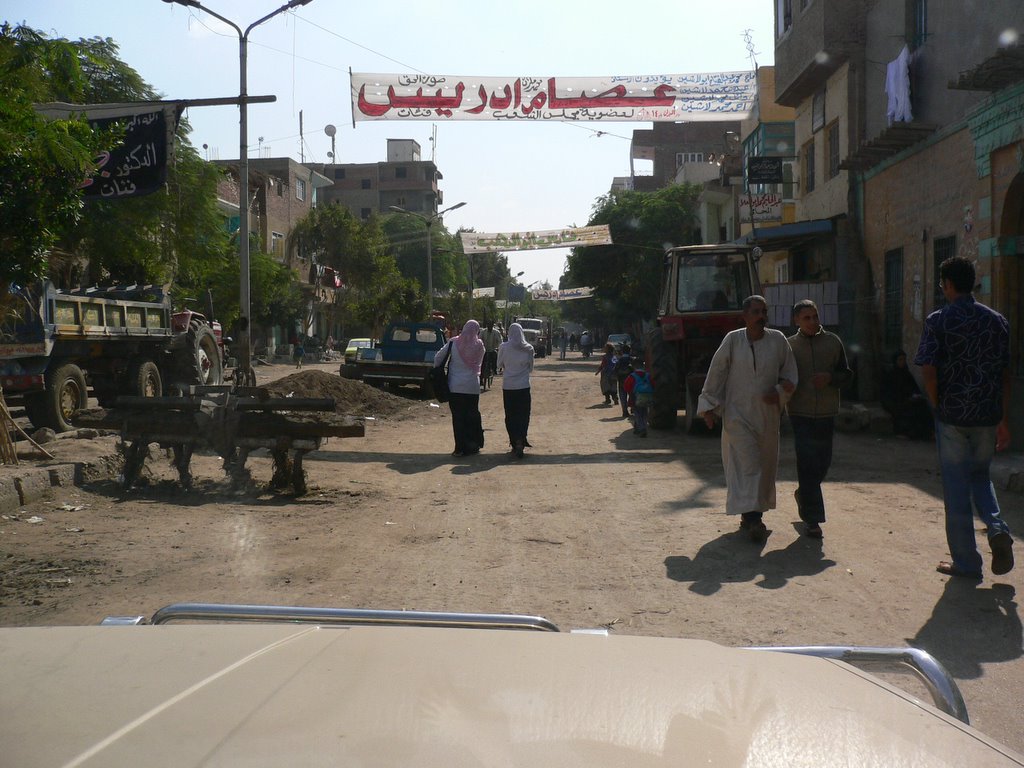 The longer I live in Egypt, the more fond of the villages I become. A lot of my friends think that I'm nuts. The villages are dirty, indeed. There is no attempt at civic services there other than the odd school, phone office and electricity board. The people may in fact be uneducated and have some rather odd ideas, but they usually have the time to chat and exchange these funny thoughts with you. I wouldn't want to live in a village like Hawamdaya for anything, however, and am much happier on my own farm, but a visit there is fascinating. I can't imagine what the village streets are like if it rains since they are composed of that sticky mud that turns to the consistency of concrete during the dry season. These are places that are truly best suited to equestrian travel. Maybe that is the charm for me.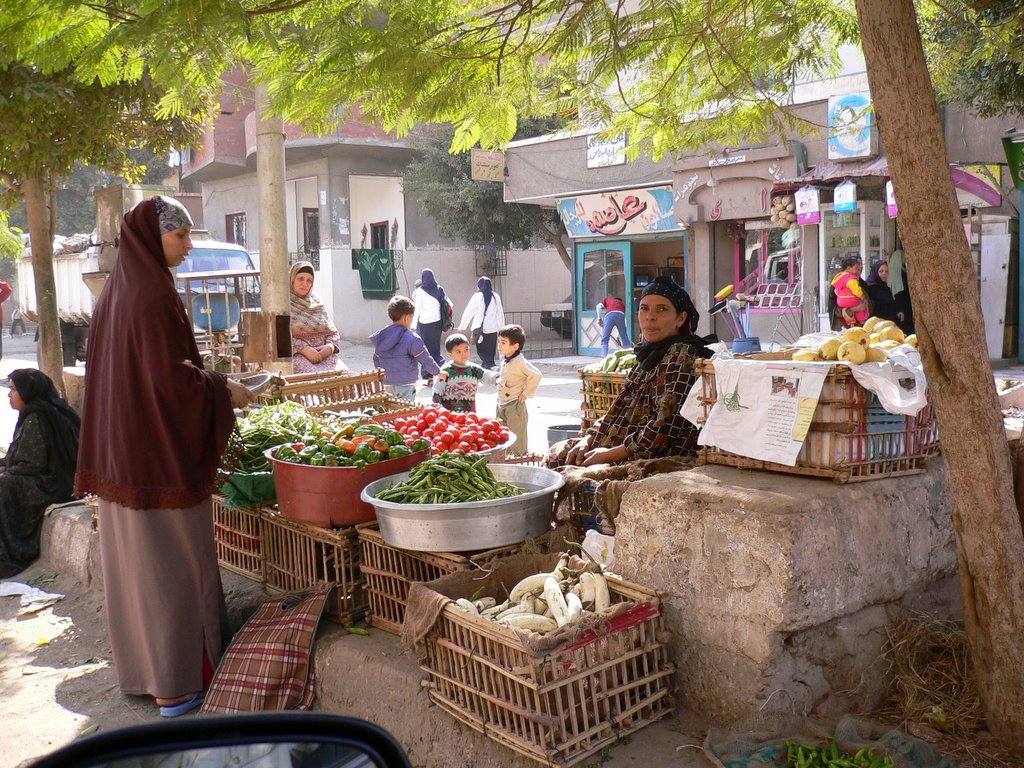
The road into Hawamdaya is oddly enough a divided road with a grassy median on each side of which the dirt potholes are avoided by two independently traveling lanes of traffic. Driving down the right hand side of the median you are just as likely to encounter oncoming traffic as down the left hand side, so it really doesn't matter which side you choose. The trees in the median, however, provide shade for the women selling the fresh produce to the villagers. It's a wonderful example of the randomness of Egyptian country life, as long as you are feeling relaxed and comfortable with the unpredictability. If you expect traffic, cows or even people to be following the rules, you are in the wrong place.
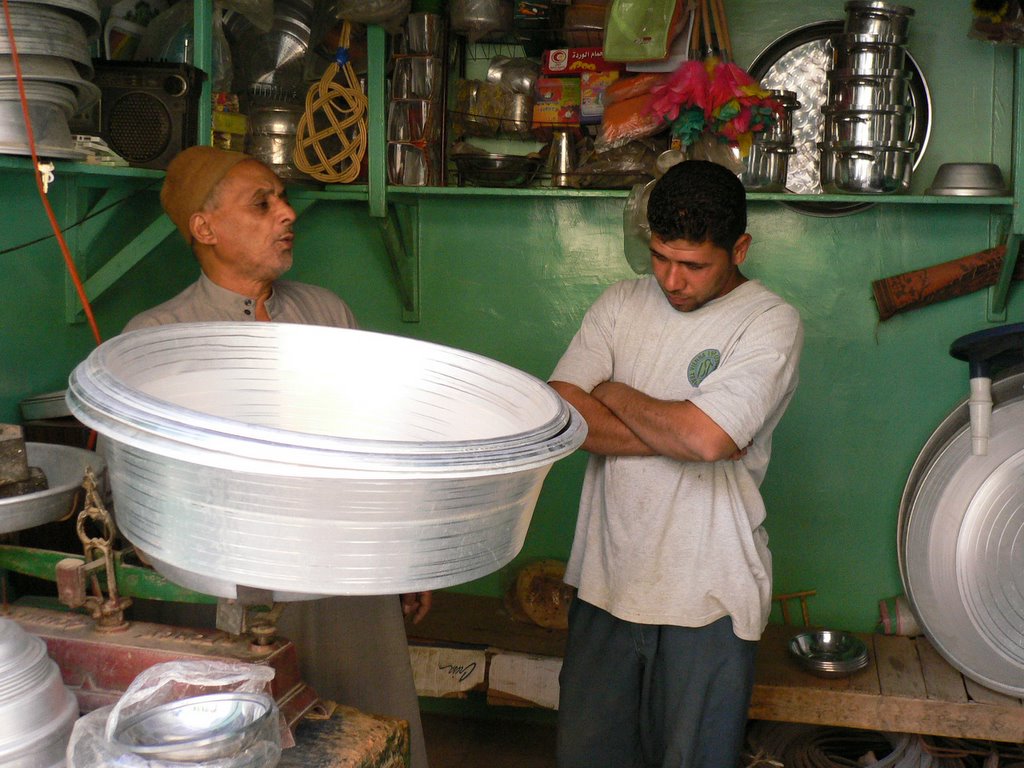 The main items that we needed were some heavy aluminum pans about a metre in diameter to serve as feed bins for horses until we could finish the paddocks. These are sold by the kilo rather than by the piece, so as we selected items, they were weighed and the price of each item or group was added to the mounting total on my mobile phone. Wonderful things, mobile phones, they are like little computers anymore. The shop we picked was owned by an old man who hauled out an assortment of pots and pans to suit our needs and then bargained ferociously over the price. Not too many discounts from that one.
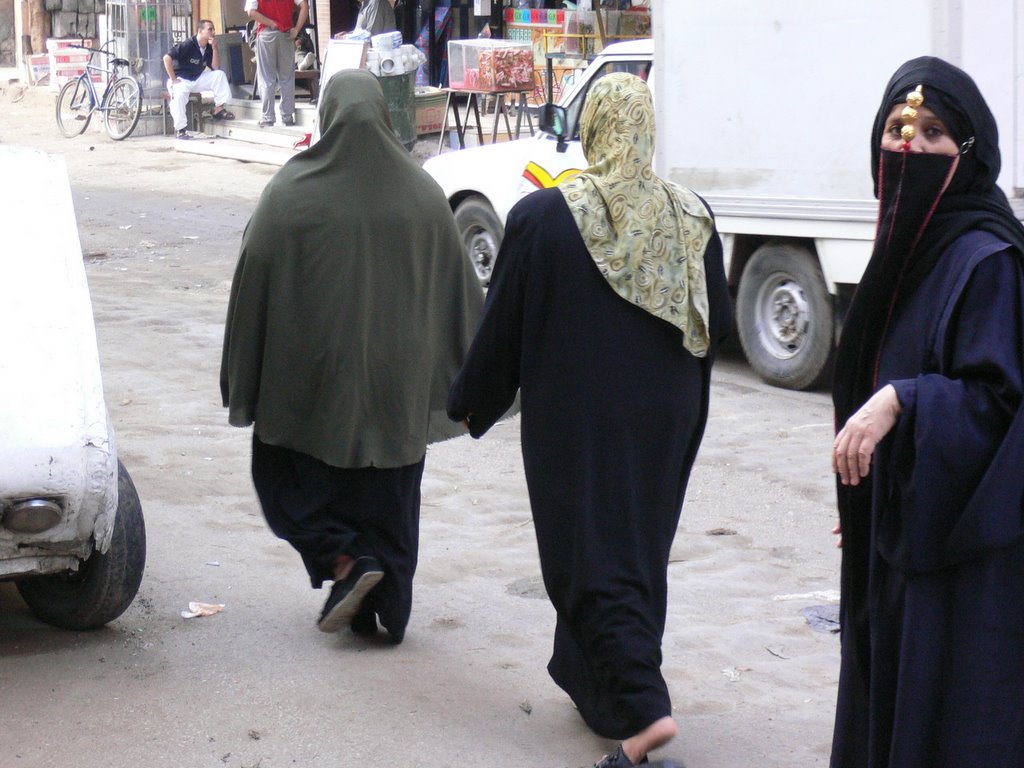 While I chose the pots and pans, Tracy took my camera and had a great time shooting photos of the passersby. Women came to the shop for pots such as those that we were buying, while others seemed to be walking children home from school. Most of them wore the usual head scarves that are so common in the country, while one or two wore the old Bedouin style face coverings. Tracy is the quintessential tall California blonde, the essence of the foreigner, but no one minded her impromptu photography. In fact a number of people offered themselves as subjects. I wish I could post all of the photos, but it just isn't possible.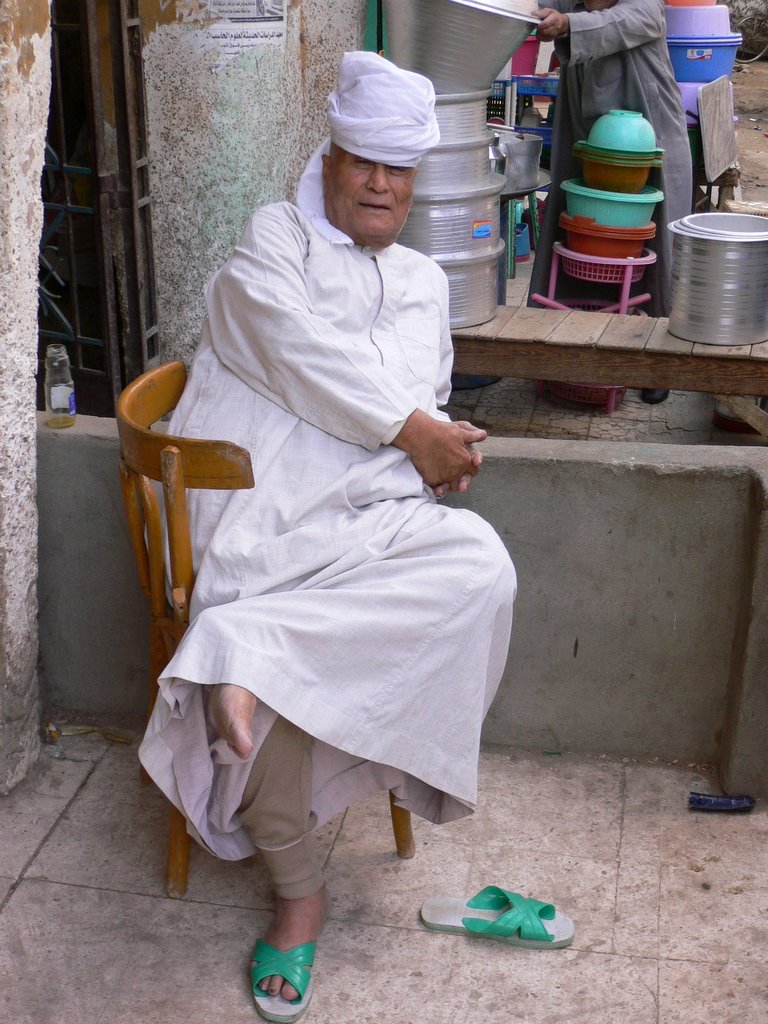
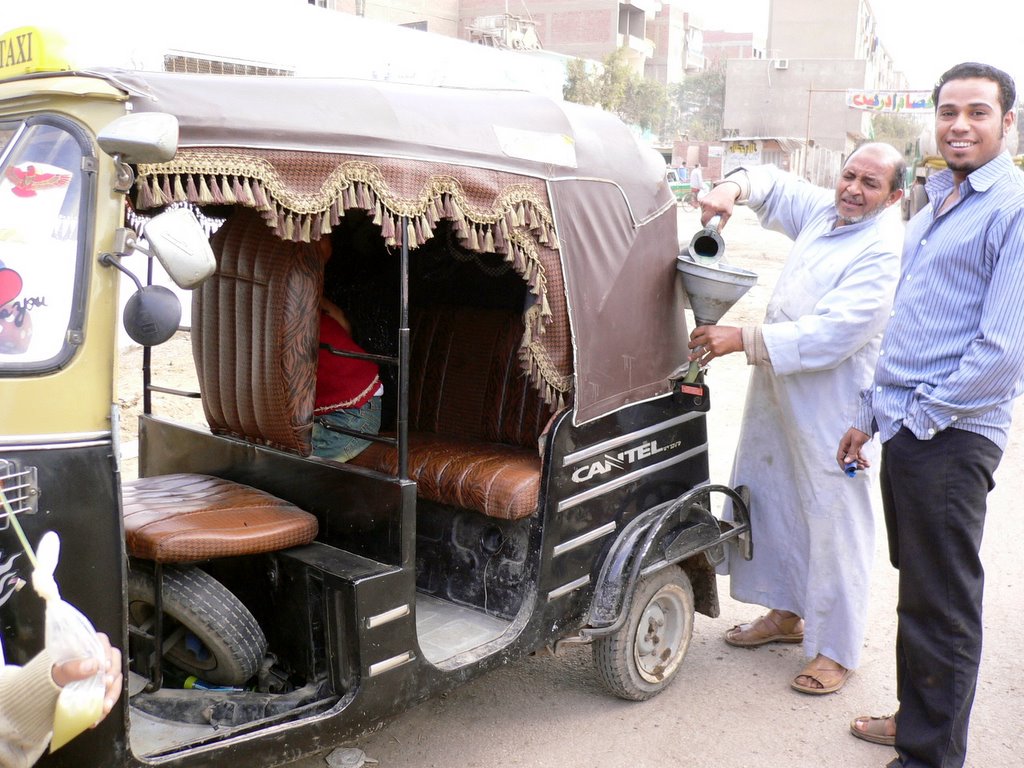 On our way out of town, laden with many kilograms of aluminum pots and a stove for cooking barley for horses and eggs and tea for grooms, we stopped to buy some grains for my parrots and chickens. Right next to the man selling the grains was a small booth filled with plastic jerry cans of gasoline. As we waited for the corn, sorghum, and black-eyed peas to be weighed out, one of the tuk-tuks came to a halt by the booth. The driver ordered some gas for his taxi and we had a chance to ask him about his vehicle. Imported from India, these tricycle taxis only use about 5 litres of gasoline a day. A litre costs LE 1 here, so the outlay for fuel is about LE 5 per day. They carry passengers around the village areas for .5 to 1 LE a trip, so these are profitable little things...Cute too. We left to go home thinking that if we had extra money, one of these would be a nice investment, and probably one that many of our village women would really appreciate. It would sure beat riding in the back of a pickup truck.
Sunday, November 06, 2005
Make a Joyful Noise
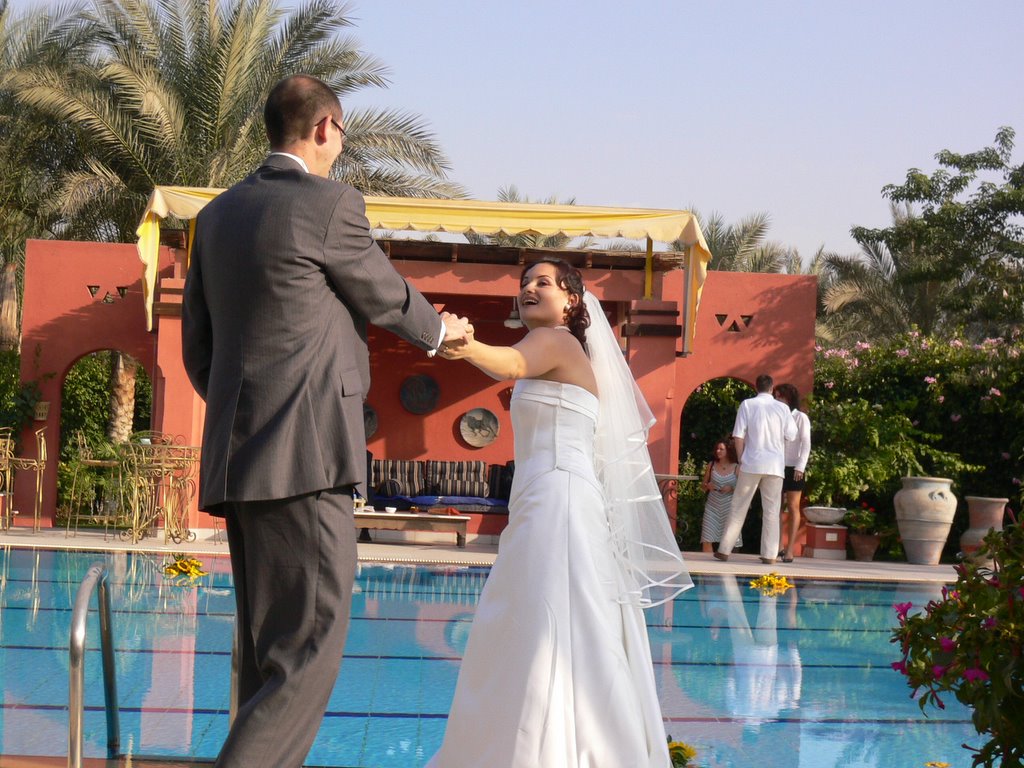 Yesterday was a very special day. It was November 5th, the birthday of my late husband and of a good friend, Erin Munro, but it was also the wedding of Mayan and Arthur. Mayan is the daughter of one of my best friends in Cairo, and the older sister of one of my daughter's best friends. There are a number of us who are close. Some of us are non-Egyptian wives, ex-wives and widows of Egyptians, some of us are Egyptians, but we all have such strong ties to Egypt that we've chosen to live here and make our lives here even if the relationship that brought us here initially is no longer there. Yesterday was utterly beautiful.
Mayan and Arthur met in the UK where Mayan (like her father in Cairo) is working as an architect in London. As they got to know each other, the realisation that they wanted to spend their lives together grew, leading to their wedding yesterday in a church in Heliopolis and a garden party celebrating the union out here in Sakkara. I was taking care of some sick animals and didn't make the noon wedding, but arrived at my neighbours' in time to greet the bride and groom as they arrived in (what else?) a shiny jeep decorated with flowers and ribbons. The crowd waiting for the couple exemplified part of what I love about this country. The bride's Christian Egyptian family was there as was her English family. The hosts were a Muslim family whose head is Egyptian/Moroccan while the wife is Egyptian/German. The groom's family are English and Dutch. The guests were from every possible background and nationality.
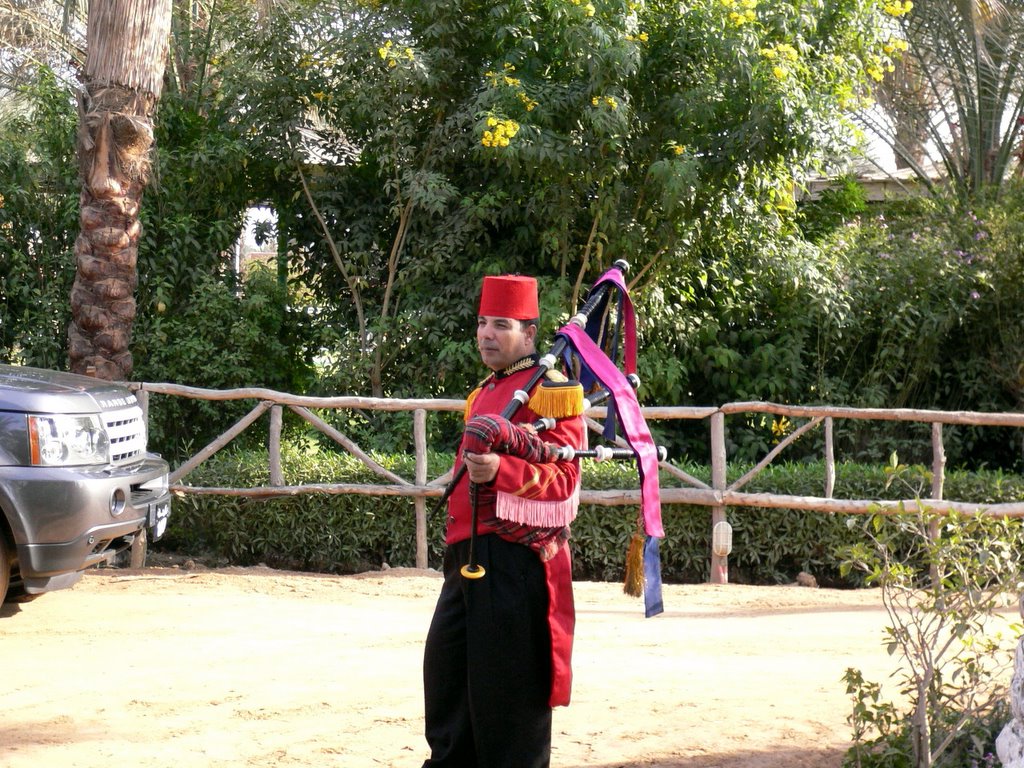
Egyptian weddings are fun. One of the traditions of them is the Zaffa, the procession of the bride and groom into the reception preceded by singers playing tambourines, pipers (you probably thought they were only Celtic), reed players, and dancers. A good Zaffa can wake the dead and make them dance. The tambourines provide a driving rhythm as the women in the audience ululate shrilly. This is a sort of trilling call involving movements of the tongue that I've never learned to do and is traditional at weddings and other joyful occasions. I've seen the processions to last as long as almost an hour when the wedding party was entering a hotel.
 Hotels and their visiting guests love weddings, although not always for the same reasons. The guests love them for the exotic beats and the dancers. The hotels love them because they make a TON of money on weddings. Our zaffa was only about fifteen minutes long since the bride and groom emerged from their sunflower-decked jeep at the end of a garden path between rows of date palms as the guests lined the path to watch, cheer and toss fake coins. About ten singers in pale blue satin waistcoats offered praises of the bride and groom and encouragement for the enjoyment of the festivities.
 A group of six young women in red dresses danced down the path in front of the couple, two of the women wearing headpieces carrying brass candelabras bearing lit candles. The candle dancers didn't dance the entire way down the path, quite understandably. I think that those candelabras must be really heavy.
 The procession led into the garden of the country house and to the deck of the swimming pool where Arthur and Mayan danced before the guests to the old rock and roll song "Happy Together". Old friends who hadn't seen each other for ages found time to catch up on gossip in the afternoon sun as we watched the wonderful fusion of two families from different parts of the world. First time visitors to Egypt sat with archaeologists and asked questions about working here, about archaeology and culture. Young people from at least four different countries compared parties as they mingled over lawns sprinkled with palms and gardenia bushes.
About sunset everyone moved into a currently empty horse paddock where a Cairo restaurant had set up tables of traditional Egyptian dishes such as koshari (a mix of pasta, dark lentils, rice, a spicy tomato sauce, and crispy fried onions), shawerma (slices of meat or chicken skewered on a rod and roasted, then sliced thin and mixed with tomatoes and onions in pita bread) fattah (a mix of crispy bread, meat, and a creamy vinegary sauce..excellent), kofta, kebab and shish tawouk (grilled ground meat, meat chunks and chicken chunks respectively) along with salads and cooked vegetables, some of them stuffed with rice. Local ice cream and desserts such as Om Ali (a sinful concoction of cream, crispy bread, nuts and raisins), fought for room with freshly made sweets cooked before us. I think that our visitors had a chance to sample some of the best of Cairo's cooking.
 And then the dancing started.
Disco, rock, and Arabic music poured out of the speakers set up in the garden and the younger members of the crowd proved that the night belonged to them. English matrons found themselves being pulled onto the makeshift dancefloor under a trellis to try their hips in an Arabic shimmy. Men young and old clapped hands over their heads in encouragement and appreciation of the women's efforts and then found themselves being pulled into the circle.
I watched the festivities until some of the evening's chill began to work its way into my bones. The autumn evenings here are cool these days and once the sun has gone down, leaving a crescent moon kissed by a single star in the velvet sky you'd better be either dancing or wearing a sweater.
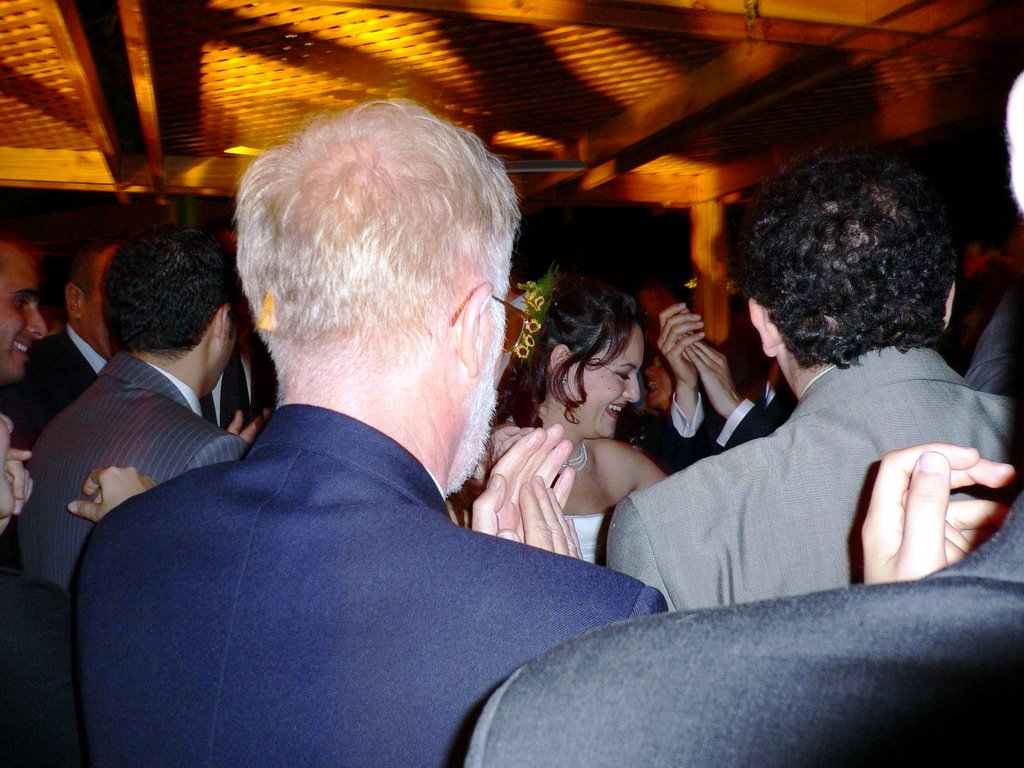 After riding all week, my knees were not up to dancing and my light jacket wasn't up to the chill, so I retired around 8 pm. Most of us fogeys packed it in by around 9 pm, leaving the dance floor and the garden to the younger generation.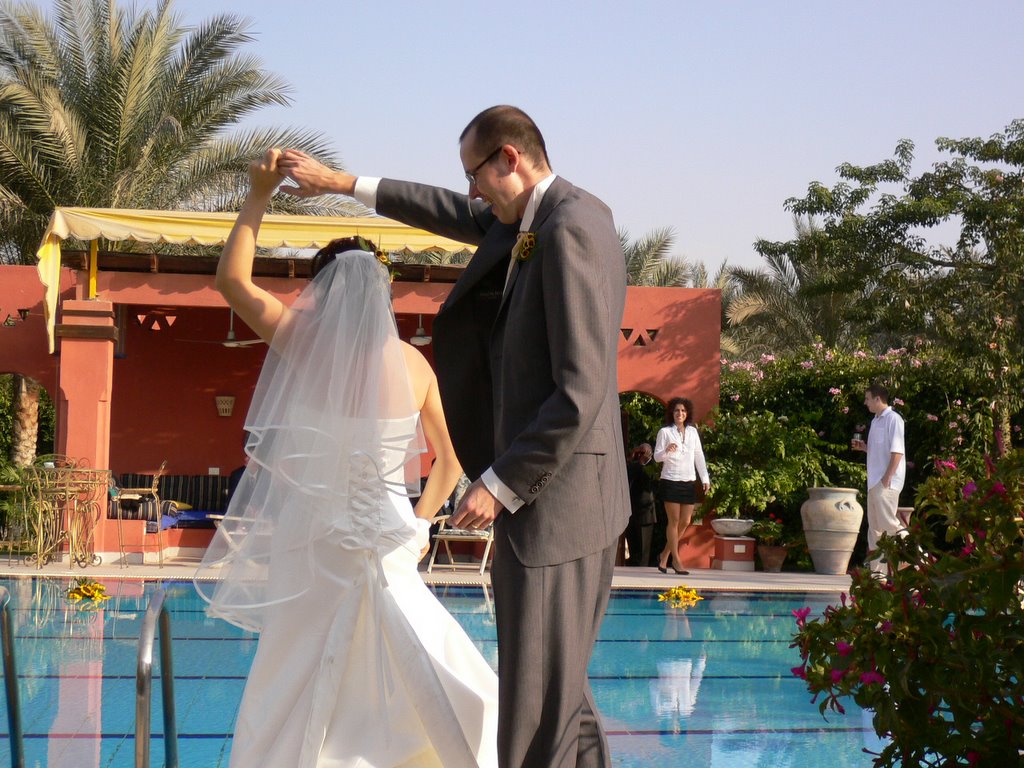
The bride and groom eventually called it a night and retired to one of the hotels near the Pyramids. Today they drove down the Sinai peninsula to spend their honeymoon in Sharm el Sheikh. I'm sure some sunshine will help them through the English winter ahead. I know that I will see them often in the years to come. The thought brings me a great deal of pleasure because they are a wonderful, lively, loving couple who will have much to bring to this world. Bless them and the parents who raised them.
Friday, November 04, 2005
Horses Are Here
The time came finally to move the horses. I had hoped to have the pipe corrals moved to the new land, but an attack of greed on the part of my landlords at the old land gave me a couple of weeks of hassles, negotiations and headaches instead. Using whatever passed for logic in their strange minds, they decided that I shouldn't take any of the construction that I'd paid for and placed in the fields. I tried to use the village approach to solving the problem and consulted the omda, the village authority, on the matter. He had no luck at all with the people who, despite having no legal basis at all, still claimed the right to my paddocks. It didn't seem to matter that I was leaving the perimeter fence, two storage rooms, a rebuilt wall, proper cement roof on the pump room and the watchmen's room, a fully equipped bathroom and feed bins for horses on the property. They insisted that I should not remove the pipe corrals and the shed that stood at one end of the paddocks. Since the people living in the village surrounding the land were all relatives of the landlords, my simply taking the pipes would have started a battle of sorts and that was something that I did not want for myself or my horses. Horses have a tough enough life in Egypt without angry humans gumming up the works. I've seen the results of people taking human disputes out on animals at some of the Nazlit Semman stables (like those in the photo above), and it isn't pretty.
When I got the news that negotiations had truly broken down and that I was going to have to go to the civil authorities, the police station in Badrashin, I was about to go riding with clients. Happily, they were understanding when I asked if they would mind riding more horses for less time as I had to move all of my horses rather abruptly to ensure that they would be out of the range of any angry humans. We put bareback pads on a couple of the geldings, and saddled Dory so that I could pony her three year old son along side. The horses could sense my concern and were a bit anxious on the way over. When we arrived at the new land, one of my grooms was waiting there for the horses to be sure that they would be all right. It was good that he was there as well, since one of the geldings tried to follow Dory back to the old paddocks rather than be left at the new ones.
Another trip to the old paddocks and we picked up two other geldings, the little mare Diva to pony, and the other grooms brought Fares and Stella by hand. When we collected the remaining six, we were told that these horses had been anxiously circling and calling as they waited for us to arrive.
The arrival of the group was greeted with loud calls by the horses who were waiting in the new paddocks and wondering just what was going on. Despite the fact that I'd been riding the horses to the new land for the past month to acquaint them with the place where they would be living in the future, the abruptness of the move caught all of us by surprise. Once everyone was in the same place, all of the horses settled down nicely and began enjoying the fact that there was much more to watch in the new place. A neighbour's mare being walked along the road in front of the paddock was an object of intense scrutiny, while the men working the land in the field next door seemed to be highly entertaining judging by the length of time the horses spent watching them.
 Not having the old pipe corrals posed a special problem for me, however. Fares and Bunduq, also known as The Grumpy Old Men, don't really get along that well with the other horses in the paddock. Whatever hopes I had that the new paddock being bigger would make a difference were dashed when Bunduq proceeded to herd the others around by threatening to kick them. However, with a space of about five or six metres between the paddock and the perimeter fence, my builder pointed out that it would be very simple to divide up the 80 metres of the paddock into about 7 smaller paddocks to use as feeding boxes or places to keep horses while we use the paddock for a lesson or something. Woven plastic mats were fixed to the perimeter fence to provide a wind break for Fares in particular.
 Initially the horses reacted to the larger paddock by running around like idiots, but once they got over that, an increased togetherness seemed to be the order of the day. If one of the horses was taken out of the paddock, the entire group followed along the fence line. To try to ease the transition, we decided that we would keep everyone on the property for the next couple of days so that they could get the idea that this was the place that they belonged.
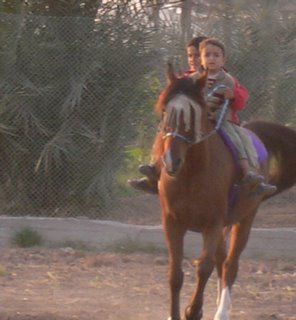 My builder's sons are delighted that the horses have been moved. Ahmed, the younger boy, had been asking to see "Doo" on a daily basis and the two of them come over for a ride on Bunduq at every opportunity. And he's such a good natured old guy, he obliges happily.
 Horses have a tough enough life in Egypt without angry humans gumming up the works. I've seen the results of people taking human disputes out on animals at some of the Nazlit Semman stables (like those in the photo above), and it isn't pretty.
When I got the news that negotiations had truly broken down and that I was going to have to go to the civil authorities, the police station in Badrashin, I was about to go riding with clients. Happily, they were understanding when I asked if they would mind riding more horses for less time as I had to move all of my horses rather abruptly to ensure that they would be out of the range of any angry humans. We put bareback pads on a couple of the geldings, and saddled Dory so that I could pony her three year old son along side. The horses could sense my concern and were a bit anxious on the way over. When we arrived at the new land, one of my grooms was waiting there for the horses to be sure that they would be all right. It was good that he was there as well, since one of the geldings tried to follow Dory back to the old paddocks rather than be left at the new ones.

Another trip to the old paddocks and we picked up two other geldings, the little mare Diva to pony, and the other grooms brought Fares and Stella by hand. When we collected the remaining six, we were told that these horses had been anxiously circling and calling as they waited for us to arrive.
The arrival of the group was greeted with loud calls by the horses who were waiting in the new paddocks and wondering just what was going on. Despite the fact that I'd been riding the horses to the new land for the past month to acquaint them with the place where they would be living in the future, the abruptness of the move caught all of us by surprise. Once everyone was in the same place, all of the horses settled down nicely and began enjoying the fact that there was much more to watch in the new place. A neighbour's mare being walked along the road in front of the paddock was an object of intense scrutiny, while the men working the land in the field next door seemed to be highly entertaining judging by the length of time the horses spent watching them.
 Not having the old pipe corrals posed a special problem for me, however. Fares and Bunduq, also known as The Grumpy Old Men, don't really get along that well with the other horses in the paddock. Whatever hopes I had that the new paddock being bigger would make a difference were dashed when Bunduq proceeded to herd the others around by threatening to kick them. However, with a space of about five or six metres between the paddock and the perimeter fence, my builder pointed out that it would be very simple to divide up the 80 metres of the paddock into about 7 smaller paddocks to use as feeding boxes or places to keep horses while we use the paddock for a lesson or something. Woven plastic mats were fixed to the perimeter fence to provide a wind break for Fares in particular.
 Initially the horses reacted to the larger paddock by running around like idiots, but once they got over that, an increased togetherness seemed to be the order of the day. If one of the horses was taken out of the paddock, the entire group followed along the fence line. To try to ease the transition, we decided that we would keep everyone on the property for the next couple of days so that they could get the idea that this was the place that they belonged.
 My builder's sons are delighted that the horses have been moved. Ahmed, the younger boy, had been asking to see "Doo" on a daily basis and the two of them come over for a ride on Bunduq at every opportunity. And he's such a good natured old guy, he obliges happily.
Subscribe to:
Posts (Atom)