Wednesday, December 27, 2006

Even Chickens Like To Eat Out

First of all, I want to wish everyone a belated Merry Christmas...or maybe it's an early one. We celebrate Christmas twice in Egypt, first on December 24/25 (Christmas Eve is often more celebrated by the Europeans) and second on January 7 with the Copts and Eastern/Greek Orthodox. Egyptians love a party and really have no problem with any excuse for one. This year the Eid el Adha, the Greater Feast that celebrates the willingness of Abraham to sacrifice his son in obedience to God's orders, will be starting on New Year's Eve so we have that as well. Crowded holiday season we are enjoying.
How did I spend my Christmas? First of all, my children are in the US this year so we aren't together. That is a bit sad, but life is like that. Airfares are expensive and school holidays are not so long. On Christmas Eve, I went to my friend Kati's home in Maadi for a Christmas Eve dinner as I've done for the past three or four years. Kati is a Finn raised in the Middle East who was married to a Lebanese businessman and has raised her three daughters in Egypt. The oldest who is the same age as my daughter is currently studying in the UK, her middle daughter couldn't make it home from San Diego where she is studying, and the youngest is still in school here. Kati's ex-husband and our friend Mona and her son Ali joined us all for dinner. Ali, is an irrepressible seven year old, who gave people a good excuse to buy toys to put under the tree and then had all of us playing with him. I'd been so busy out at the farm that I hadn't been into the city for almost a week and I gave a selection of farm produce: fresh lettuces, homemade pesto, and chicken and turkey eggs. A lovely evening. Then Boxing Day (December 26 for non Brits or Canucks) I found myself with an invitation to a Norwegian Christmas brunch with my neighbours. Norwegians eat an amazing selection of smoked and cured meats and fish for Christmas; moose salami, reindeer paté, various types of salmon, trout and herring. Eating out is such fun.

The poultry at the farm are becoming more and more entertaining. Every morning when I go to feed the parrots, ducks, turkeys, and chickens they all rush around to try out breakfast at every one else's house. The poultry eat the leftover birdbread and fruit/vegetable mix as well as their own corn and greens daily. The food in every flight cage is identical, so it must be the ambience that causes the moving around. The chickens live with the Cuban Amazons and sleep on a wooden curtain rod that serves as a long perch in the center of the cage, while the Amazons seem to prefer to perch in a corner near the top of the cage. It's quite funny to go out to the cages and see a long line of baladi hens on the long swing. I have about eight chickens, seven hens and one rooster. While a friend was visiting a while back we began naming them after explorers and got as far as Erik the Red for the rooster, Henry (for the Navigator for a beige hen who is always wandering out of her flight, Vasco, Pizarro, and a number of others. But they are pretty hard to keep track of. They give me about 5 small eggs daily.

The turkeys live with Ali the African Grey and Bamba the Bahamian Amazon. They also seem to prefer to sleep at altitude, having taken over a corner perch for the nights. Otherwise they patrol the ground looking for fallout from above. African Greys are interesting diners in that they will look through the bowl for the most delectable bits and toss anything in the way onto the ground. It didn't take the turkeys long to figure out that standing around under the parrot dishes was a very good idea. My housekeeper bought me the turkeys who are lovely bronze birds with low chortling vocalisations. They were supposed to be a male and a female and were originally called Uncle Tom and Aunt Jemimah, but as it happens they are both females and Uncle Tom is now called Oprah. They give big speckled eggs that are collected for eating since they aren't fertile. We are planning to have a male join us soon, but for now the eggs are delicious and I love the sounds of the turkeys. There are no plans to eat them. Instead , I'd prefer the eggs and to raise the young turkeys. Turkeys are surprisingly good flyers and I have to be careful to herd them gently back to their flight cage after breakfast so that they don't go airborne and frighten the other birds.

When I was considering ducks for the farm, I went online to learn something about ducks. According to the sources that I found, most domestic ducks are descended from two duck lines, either the mallards from Europe and North America or the Muscovy ducks from South America. Most of the ducks in the farming area are Muscovy or a mix of Muscovy and Mallard. I have one male, called Donald naturally, and then there are the girls, Daphne and Daisy. They have a plastic tub to play around in and they live in the flight cage with Fritzi the African Grey and his flock of budgies and the lovebirds. Donald is black and white with a small crest of feathers that rise up if he gets excited. There are two eggs in the nest box right now so hopefully we will have some ducklings soon. Again, these three will not be for dinner but for parenting. I get a kick out of the ducks because they are the least shy of all the birds and will eat out of my hand. Although the picture of the ducks shows a bare concrete floor, they all have chopped straw spread over the floors to give them some warmth in the winter winds and something to scratch around in.

The eggs that you get from properly fed poultry are absolutely wonderful. The shells are hard enough that you have to work to crack them and the yolks are a deep red orange. The larger eggs in the bowl are the turkey eggs, the large white egg at about one o'clock in the bowl is a commercial chicken egg and all the tiny eggs are my baladi chickens' work. My arugula and basil are adding the green touches.

Saturday, December 16, 2006

Downhome Cooking from Egypt


We have been planting plots of vegetables for the benefit of the guys working here, the people (mostly me) living here, and for sale if we get extra. One of the major perks of living in Egypt is the fact that the fresh fruits and vegetables here are truly FRESH and they are wonderfully delicious...so what better than having them immediately available? We've planted tomatoes, cabbages, molokheya, onions, garlic, sweet potato, regular potato, green beans, black beans, shallots, peas, corn, zucchini, peppers, eggplant, and probably a few other things.

While checking the vegetable plots the other day I spotted some leaves among the grasses in the area for animal feed and I began collecting them. I know the plant as khobeyza (lord knows if that's a correct spelling or not) and it is basically a weed. The word used to name the plant is the same word used for geraniums, but that doesn't necessarily mean that this is part of the geranium family. After all in Arabic, any mouse or rat is called by the same word, "far" and they are not so closely related as to be the same animal. One of my "have to do someday" items is to find out just what khobeyza is. What I did with it was much simpler to explain and I find it very tasty.

The leaves are plucked from the stems and set aside to wash carefully. Like spinach, this plant grows best in sandy soil and collects little bits of sand on the leaves. After carefully washing about 250 grams (about a half pound) of fresh leaves, I dropped them and a bunch (diameter about that of a quarter or slightly larger) of fresh coriander (likewise washed and picked over) into some hot soup, about the same amount of soup as vegetables. That isn't terribly clear since leaves take up a lot of space and soup doesn't, but basically you use about a cup of soup for half a pound of leaves. If it isn't enough, add more soup. No harm done. In my last cooking batch, the soup was some particularly rich beef broth that I'd prepared by boiling a couple of massive beef bones stolen from the dogs' stash in the freezer in a large heavy pot (Thank you, Nadim and Vanessa, once again for the Le Creuset that you left me) for 24 hours with onion, garlic and cardamom, but you can just use soup cubes for the broth if you are in a hurry.

Once the leaves are all sort of melted and cooked looking, and this only takes a few minutes, the soup/leaves mix is dropped into a blender and blended thoroughly to a creamy texture. This is then poured back into the pot and seasoned with a concoction of ground dry coriander seed, dried ground cumin seed, and crushed garlic which have been fried in butter until the garlic begins to brown. The amounts are about 1/2 to a teaspoon of the herbs and I use about 3 cloves of garlic, but then I am a garlic nut. Add a couple of tablespoons of washed dry short grain rice and cook the soup for about 30 to 45 minutes over a low heat until the rice is cooked. Season to taste with salt and pepper. You can add a soup cube if the soup part tastes a bit anemic. As you might note, I am not exactly a fanatic about measurements in cooking, but I believe that you have to work with your personal tastes too.

The resulting glop should be a dark green with soft bits of rice in it and quite thick. I particularly like it with grilled chicken and some plain white rice, but it could be eaten as a stew or soup, particularly if you add chunks of meat to it, also. I'm told that khobeyza is very rich in iron, which considering that it tastes a great deal like spinach, wouldn't surprise me. It is a rich dish and one really can't eat all that much of it, for all it is a vegetable, and it can be a bit overwhelming for some people's digestive systems.

The plants are most often found growing in the winter here, so Hussein (the gardener) has been bringing me those that he finds so that I can harvest the leaves and then we will replant the plants to ensure next winter's crop. It's easy to prepare the soup and freeze it until later, but this isn't really a dish that you want to eat in the heat of summer. It's very satisfying in the chill of an Egyptian winter evening. When one of my friends called me the other night as I was preparing this delicacy, I told him what I was doing and he went off into gales of laughter. Apparently, khobeyza is something like collard greens and pork bellies in Egyptian cuisine, sort of cooking for the very poor. I can't find it anywhere in any of my cookbooks or Egyptian recipe collections on the internet, so here it is for the first time ever. Only problem is that I don't know if you can find the same plant other places like California or the southern US or Europe where it might be expected to grow. If the US customs weren't so funny about things, I could probably mail some out.

If any plant experts are out there and read this, I'd be delighted for an identification.

Tuesday, December 12, 2006

So Good To Be Back

It's been a long time. I had a young friend of the family come to stay a month with me mid-November. Georganna went to high school with my son and daughter here in Cairo and then traveled to the US to study graphic design. She's an oil brat, raised all over the world by parents who get transfered to some pretty strange places every four years or so, and she's probably more comfortable in airports than most of us are in the corner store. While she was still in school, she was given an assignment of designing a children's book and contacted my daughter in New York wondering about where she was going to find a story for her book. Dependable daughter just told her to contact me since I have had a number of children's stories hanging around on my computer for a number of years, George did so, and I sent her a story. But her professor told her to wait to use it on her own, and we have ended up collaborating on a number of stories for four to roughly eight year olds that will hopefully teach them various things about Egypt in a gentle way. Having been away from Egypt for about five years, George felt that she needed some time here to absorb the time, the smells, the light, and the special balance between ancient and modern that infuses life here. Like many ex-Egyptians (what do you call an ex-pat from another country who would love to be able to stay here but hasn't been able to?) George has been frustrated by the astonishing lack of comprehension of the realities of life in Egypt and we both see the children's books as being a good possibility of reaching young minds before they are warped by the evening news, so we want the illustrations to be excellent. She traveled back to the States this morning with more than a thousand photographs to use as a base for her drawings for the stories.

One of the additions to the farm that we accomplished during her visit was a baladi oven, a wood-fired brick oven that was constructed behind the ridiculously large barbecue...well ridiculously large is relative because most of the men I've introduced to it begin drooling. The oven didn't take long to build from red brick and even before the mud coating was finished the grooms were building a big fire in the lower portion under the direction of the builder. The bread or the pan with a casserole goes into the upper portion of the oven where it rests on a thick plate made of some special concrete-like material that is heated by the fire in the lower part of the oven. Building a fire immediately in the oven apparently cures the cement properly. My housekeeper was looking forward to baking bread for her household and mine in the new oven but so far we haven't had the chance . Poor Magda, already the mother of five children, was pregnant with a sixth child and expected to give birth sometime in the next month or so. Last week one of her daughters came to say that she wasn't feeling well and the next thing I heard was that the baby aborted rather late in the pregnancy. She wasn't actually thrilled to be having a sixth child, but this definitely wasn't what she had in mind either. So life, already busy with my visitor, went into fast forward while George and I picked up the household slack, however slackly we did it.

Many days I was busy with clients at the farm and George went out with the faithful Mohamed Said to photograph parts of town, shops, museums, children, cats, houses....you name it...all over Cairo. Toward the end of her stay, however, a friend of hers from South Carolina en route to Lithuania for Christmas with her parents, stopped by. George and Asta wanted to go to old Cairo to see some of the old mosques, so I tagged along for the day. We started at Ibn Tulun, one of Cairo's oldest, built in 879 and modeled on a famous mosque in Samarra, Iraq. At the time of building, Cairo didn't exist as the capital of Egypt. This is one of the simplest mosques in Cairo, and to my mind one of the loveliest. The huge open area in the center of the mosque is open to the sky, while the arcades along the walls provide shelter from the sun. Just next door to Ibn Tulun is one of Egypt's less known museums, the Gayer Anderson house, which is probably best known as a movie set in the James Bond film, The Spy Who Loved Me...a film that plays hilariously with the geography of Egypt. The Gayer Anderson house was actually two adjoining houses dating to the 1500's and 1600's that were rented by a British army doctor and then renovated in the styles of various periods of Arab decoration. One of the most fascinating spots of this house is the series of small rooms overlooking the main audience hall. This hall was designed on the Mameluke model in which the male and female parts of the house were kept separate, so the audience hall was for the men of the house.
The women, on the other hand, had access to the events of the meeting from a vantage point high above the chamber. The wooden screens kept the women from the eyes of male guests below while also cooling the air that moved through them. Benches
provided places for the women to sit comfortably while listening to the male gossip and discussions below. Having been the victim of many, many business dinners during which the primary topic of conversation was usually a complex piece of machinery, the idea of being able to come and go, enjoy my own refreshments, and ignore the boring parts of the evening in private is rather appealing.


Most of the windows in the house are covered with the wooden mashrabiya screens, collected by the doctor from various buildings that were being demolished in the 1930's and 40's. Dr. Gayer Anderson's collection of screens, furniture, rugs, and marble fountains was donated to the Egyptian government for this museum when the doctor left Egypt. The house preserves the traditional spaces of medieval Egyptian homes, the winter rooms and the summer rooms and the interweaving of the sexes for us to wonder at.

From the museum and the mosque of Ibn Tulun we moved to a spot just under the wall of the Citadel where the Refa'i and Sultan Hassan mosques were built. The Refa'i mosque is the most recent, built in the 1800's and home to the tombs of many of Egypt's kings/khedives/sultans, as well as the tomb of the late Shah of Iran. The Refa'i is on the right of the passageway. It was built on the site of the tomb of a sufi sheikh from whom it takes its name. The stone work inside this massive building is astonishing. As time was getting along, we decided to move on to the much older Sultan Hassan mosque just across the road. Many years ago, in 1976 to be exact, I'd visited these same mosques with my husband on our first visit. Then, Cairo was in the grip of a housing crisis with many rural families having moved to the city.

I can recall families living in these enormous buildings and much activity of daily life taking place in the various corners of the buildings. Now that the families have moved out, the mosques are places of peace and tranquility. Both the girls found the mosques fascinating both architecturally and emotionally. Moving through the rooms that had been designed for schools in the 1500's and that were now, for the most part, empty other than isolated individuals praying, perhaps just resting, or chatting quietly with a friend. Given much of the sorts of things that one reads in the papers online or hears on television, it's a bit surprising to realise what havens of peace these places are in the rush of the city. It had been a long time for me since I'd seen these famous places, but I was very happy to renew acquaintance.

One of the tasks that the girls had was to buy Egyptian Christmas presents for their families. I took the chance to have some small gifts taken back to the US for my children and one of the items I sent back was a book that had been recommended to me by a good friend. "Sharon And My Mother In Law" by Suad Amiry. This book was based on a series of emails written to family and friends by Suad during the time when she was living in Ramallah, Palestine, while the Israelis had the area under curfew, making it impossible for the residents to leave their homes. Much of the incidents described in the book are disturbing, puzzling, or even heart-wrenching, but somehow Suad Amiry maintains a wry humour that brings even more poignancy to the tales. I've read many more "serious" books about Palestine, but I don't know when I've read one that made many things truly as understandable. This is definitely a book to read.

Sunday, November 19, 2006

Some New Things

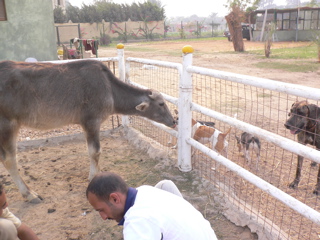
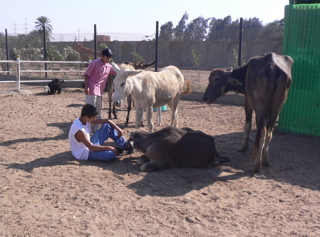
One of the things about having animals who decide to have babies is the waiting game. Sometime before we decided that George the donkey should be gelded, he decided that Margarita was the cutest thing in the world and acted on that thought. Sometime last spring we thought that Margarita was looking a little pudgy, but we didn't pay much attention until the pudge took on that special shape over the summer. The wait was on. We knew when George lost the family jewels, but how long before that was the nefarious deed done? Daisy appeared at about 10 am a month ago. She is a leggy fuzzball who takes after both of her parents. George is still our main wagon-puller extraordinaire, while Margarita mostly hangs out with the goats, sheep and water buffalo taking care of Daisy. We gave mother and daughter a couple of days alone to bond and sort out the mechanics of family relationships before we introduced them to the rest of the livestock. Now Daisy is bouncing around the goats and sheep very comfortably.

The rest of the animals in the paddock are more comfortable around humans than our baby donkey even if Daisy gets the larger amount of attention these days. Her level of comfort around humans will grow gradually as she gets plenty of petting from everyone. Visiting children (and some of us larger types as well) get a kick out of hanging out in the livestock paddock petting various creatures. We've closed in the paddock so that some of the rather boisterous dogs don't go bouncing in disturbing the sheep and goats. The donkeys and water buffalo established relations ages ago, but then some of the dogs are quite a bit larger than some of the smaller goats, so the situation isn't really the same.

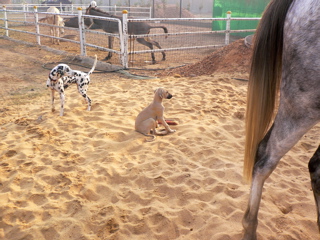
On the other side of the livestock paddock fence, we've had some new arrivals as well. About a year or so ago I was astonished to find that an old riding friend of mine from Alexandria had gone to the trouble to find out where I was now living.I've known Hafez for probably about 15 years and remember very well the graceful leggy hounds that used to accompany him riding at the Smouha Club there. Hafez has been a lover of Moroccan Sloughi's for years. Sloughi's were used to hunt gazelles in North Africa for centuries but found themselves on the hunted list long ago when French authorities felt that the dogs were a danger to gazelles and ordered them shot. For years Hafez has been trying to get me to take on a Sloughi and this year he succeeded. His female Zamorra, a lovely desert coloured mountain dog he'd brought back not long before, had a litter of fourteen or so a while back and I took my senior rat terrier over to help pick our new member. I knew that Terra would be fine with a pile of puppies bouncing around, and I figured that whichever pup showed herself to be comfortable approaching this crotchety matriarch would do just fine in the pack. One little female did just that, trotting up to Terra to introduce herself and Sabah (meaning morning) joined the funny farm. She is certainly a fitting resident.

At arrival, she was slightly smaller than the terriers, but now she's fast encroaching on Dalmation size. Both Great Danes and Slough's are sight hounds and love to run. When they aren't running they are very proficient in holding down some fairly large sections of lawn or sofa. Sabah and Morgana will be almost the same height but Morgana will outweigh Sabah by a significant amount, so I imagine that she will be a much better lawn retainer. Oddly enough, somehow Sabah seems to have figured out that she and Morgana share a lot of things and she follows Morgana around all day, sort of Morgana and Mini-Me. Watching the youngest terriers, the Dane, the Sloughi, and the Dalmation racing around the lawns is an utter delight.

Our last newcomer was another Dalmation, Disney. Well, we don't really know what her name actually was, so she's been dubbed Disney. Disney was a gift to a young woman living in Cairo, but she had to leave so she left the dog with a friend of mine who couldn't possibly keep her. She, in turn, dropped her off at the farm. She settled in with the grooms and was making progress dealing with the rest of the pack who sleep in the house with me, when a neighbour offered to take her into his landscape nursery. Although the land was fenced, someone left a gate open and Disney ran out into the road where she was hit by a car losing one of her hind feet in the collision. She came to the gate of the farm and I piled her into the jeep for a fast trip to the vet where her leg was amputated just below the hock. She had an overnight at the vet's place in town and then was brought home to move back in with the grooms. I'm waiting to take a photo of her when she's recovered a bit from the surgery and the abrasions from the accident. So now we have two Dalmations with a total of 6 usable legs between them. But she's already starting to join in the evening insanity on the lawn.

Tuesday, October 31, 2006

What A Way To Make A Living

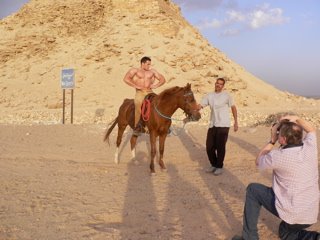
I got a rather vague phone call last night from a German photographer wanting to use some horses for a photo shoot near one of the pyramids. He said that they would be by the farm around noon today to talk to me about it and to arrange things. Noon came and went, but there was no phone call. Aside from the fact that we can always use the money, filming is some of my favourite work. Then at about 4 pm the phone rang and it was the photographer. He and the photography subjects were on their way to Sakkara and wanted me to meet them there for the shoot, but there was no way to get there in time and no one in the car seemed to know exactly where they were going. And who were the subjects? A couple of body builders. Body builders? That's a new one.


I sent my driver out to find their car and bring them to us so that we could do the shoot behind the pyramids of Abu Sir, time running out to be able to set it up at Sakkara before sunset. We chose horses for the shoot, Nazeer and Bunduq, my two steady fellows who have already done filming for the History Channel, and who are both average height for Egyptian Arabians, thereby making body builders look larger.

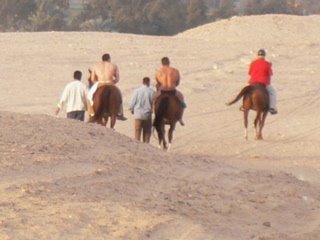
We all met up behind the pyramids of Abu Sir, two grooms and myself on horseback and the photographer and body builders in my jeep with my driver. They got ready, doing push ups and other exercises to warm up their already fairly impressive muscles, while the horses stood on watching. The photographer was doing a shoot for a sports magazine based in New York, and he started out with some stills of muscles being flexed in front of the pyramid. We moved on to a series of stills with the boys mounted on the horses (who were attired in bareback pads) in front of the pyramid. At this time of day the sun was shining low over the plateau to the west and lighting up the pyramid and the boys on the horses beautifully. Body builders don't have much time for horseback riding and these boys were not entirely comfortable sitting bareback on my geldings. I'm not sure how comfortable I would be sitting bareback half naked in a brisk wind in the middle of the desert either. The horses, having been through the whole waiting game of filming before, stood calmly for the flexing and twisting that was required to show all the work of the body builders to its greatest effect, and gradually the boys gained confidence. Dorika took a turn but was not at all impressed with the work, fidgeting and fussing while her victim posed in front of the awesome backdrop. She definitely does not think that filming is much fun and let everyone know. She is, however, very good at keeping the boys in line as they walked around one corner of the pyramid making their dignified way towards the photographer. So Dory came back to me and continued her work on the production end of things.
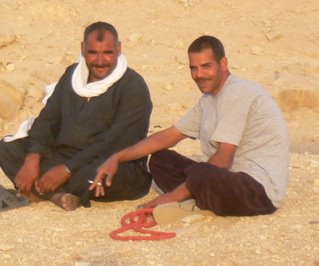
At this time of day the people at work on excavations in the area have gone home and the area is technically closed, but the watchmen were willing to allow us to shoot in the desert behind the pyramids as long as we avoided the working areas. Since no one wanted to see a horse and rider disappear into a shaft tomb, we were more than happy to oblige them and the watchman sat with one of my staff watching the rather strange (certainly by rural Egyptian standards) goings on.

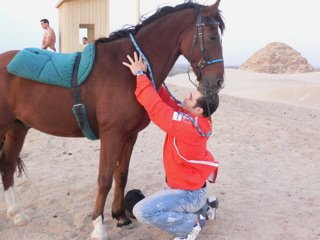
It wasn't all work and no play for the horses however. Dory was delighted to be able to show her son and Bunduq her heels during a brief run in the desert and one of the boys had Bunduq utterly entranced as he gave the horse a massage while we were waiting for the last of the photos to be taken. The little bay gelding's twitchings and sighs afforded everyone even more hilarity...I swear if he'd been able to roll over on his back for a tummy scratch like a dog, he would have done it. All in all a lot of fun and something completely different.

Friday, October 27, 2006

This Time They Have Something Right

IOL: Religious decree: Bleaching cream is a sin

Al Azhar in Old Cairo is one of the oldest universities in the world, originally a school attached to Al Azhar mosque during the European dark ages. Now, it accepts students of both sexes from all over the world and they study business, medicine, literature and engineering along with Islam. Al Azhar is the religious authority in Egypt to a large extent and is listened to all over the world. They have a service for people who write in with a question of how aspects of modern life interact with religion, and I must say that some of their decisions on various topics are not things that I can agree with. Lately someone wrote in to ask whether the use of bleaching creams by women to whiten their skin was counter the beliefs of Islam and the fatwa (decision) was that it was counter to Islam. By extension, the mufti is probably against make-up in any form...good luck on that one.

Even the pharaonic paintings in the oldest tombs have the same protocol. Men are painted brown and women are white or at least many shades lighter than the men. One could say that this shows an early understanding of the dangers of too much sun, or that it is indicative of the idea that a successful, wealthy man can show off his wealth by allowing his women to stay in the house relaxing and not working in the sun. The logic of it is one of those "whatever" issues as far as I can see, but there is a prevailing attitude in Egypt that women with whiter skin are more attractive than those with darker skin. You don't find people being denied employment or living space because they are "black" or "different" so much here. It definitely is not the same attitudes that exist in the US regarding black and white. It's much more a deeply ingrained aesthetic and it is bloody stupid.

I watch television in the evening while waiting to see if my children log onto the net so that we can chat, mostly things like CSI or if I can find a nice British crime drama or something. I'm sure this says something deep about me but let's not go there. I have a satellite connection to systems that are primarily broadcast from Saudi Arabia, the UAE and so on. The kinds of programs they broadcast and the contrast with the public morality of these countries is yet another story...I mean what do the sheikhs make of Sex and The City anyway? The thing that really drives me nuts is the fact that many of the commercials are for bleaching creams and that these commercials are made here in Egypt. A young woman is shown trying out for a position as a television announcer and failing because her skin isn't light and luminescent enough...she uses the cream and gets the job and notice from a nice young man. Give me a break.

I went to a large grocery store and was looking at moisturisers but many of them had bleaching creams added and I'm just not into that. So, I say in this case...Go Mufti. You got it right this time.

Tuesday, October 24, 2006

First Day of The Feast


Everyone figured that yesterday would be the first day of the feast, Eid el Fitr, that marks the end of Ramadan, but traditionally the feast is determined by a human viewing of the phase of the moon, and the particular human this year determined that the first day of the feast would be on Tuesday rather than Monday. An energetic burst of the work ethic on Sunday ensured that the work to be done on Monday would be minimal, so there everyone sat wondering what to do with themselves since they were fasting yet another day. They all looked so lost that I suggested it was a good day for a group ride to learn some of my trails and we saddled up five of the horses to go out for an hour. My grooms can ride, naturally, and as it turns out my gardener is also quite capable. Mohamed Said, my driver/accountant/right hand man, on the other hand, might have been on a horse a couple of times in his entire life, so we put him on Blue Boy a lovely big cushiony Anglo-Arab who used to belong to the Czech ambassador to Egypt, and popped him into the lineup. The guys had a great time pretending to be tourists and asking the names of crops, then cracking up at each other's silly answers. The grooms and gardener, Farag, Madah, and Hussein, encircled Mohamed protectively, but Blue Boy proved himself once more to be a most reliable babysitter. Having killed a couple of hours playing, the entire crew finished up work in the confidence that this morning they would be having their customary tea and cigarette in the morning.

I was wakened this morning at about 5 am by chanting. "Allahu Akbar. Allahu Akbar. La illaha il Allah." God is Great. God is Great. There is no god but God. The first time I ever heard the chanting on the first day of the feast we were living in Alexandria and there was a large and popular mosque about three blocks from our house. The first prayer in the morning on the first day of Eid el Fitr is traditionally held out of doors under the sky and I heard men and boys chanting this as they walked to the area near the mosque where the streets had been blocked off for the prayer. Out here in the villages, I heard first the muezzin for the closest mosque chanting, then a young voice in addition, and gradually the volume grew as men and boys gathered at the mosques chanting all the while. There is no way to sleep through the sound, and to be honest, I'm not sure that I would want to. Having identified the sound as praise rather than a local political uprising, it still brings chills but they are no longer of apprehension.

I had arranged with one of my grooms, Farag, to ride to the Shubramant/Zawia graveyards at 6:30 this morning as he wanted to pay his respects to his grandfather's grave and I wanted to see what was going on. One of the grooms sleeps over every night to help me if anything happens with one of the horses (injury or colic or such nightmares that happily seem to pass us by for the most part..knocking on wood) so Farag had the horses ready for us and we rode through our local village to the desert in the mist that almost obscured the rising sun. Despite the early hour, women and children were up and preparing for a day of festivity, sweeping areas before houses, laying out trays of oranges, guavas, grapes, bread and setting up small shops selling inexpensive toys for children. Most of the children were wearing new clothes as Eid el Fitr is the traditional day for the buying of new clothing.


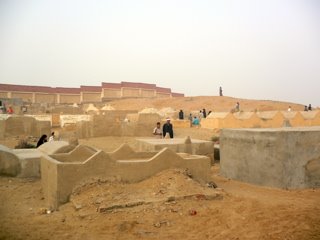
The tombs for Shubramant and Zawia are a few kilometres away through the desert so we let the horses have a good gallop on the way. It was so early that even the desert dogs were just lifting sleepy heads to watch us zip past...much to early to chase horses. As we approached the grave area, we spotted groups of young boys playing on the hills just within the desert, and the groups grew more numerous as we came into the tombs. These tombs are built just between a narrow strip of cultivated land and the walls of the Beni Yusuf army base, a crowded band of low rectangles, many of which bear low domes on top. Strictly speaking, under Islam when someone dies they are to be washed, wrapped in a long cotton cloth and buried in an unmarked grave in the desert. There is no way in heaven that any religion or force in the universe could get Egyptians to forego their tombs and the rituals associated with them. So much of the activity here on this morning is particularly Egyptian in nature rather than Islamic.

After the prayer families go to the family tomb where they sit and have a light breakfast of oranges, guavas, grapes and sweet bread. The children go off to find vendors of such village delights as plastic sunglasses, cheap plastic cap pistols, and the ubiquitous bomba's or cherry bombs, strange paper wads with some horrible exploding powder that makes a noise guaranteed to delight any young creature. Parents pray, visit with family and friends, and generally take it easy. We arrived at the tombs just after the end of the prayer and made our way on horseback through an area that is usually quite empty if there is no burial in progress. Today crowds of children floated across the path and had to be warned to avoid walking behind horses, while various adults were greeted by us both. At one point we passed a group of young men sitting smoking with obvious pleasure in the sunlight that was burning off the mist.

It was only about 7:15 as we left the tombs, but minibuses of families were arriving from the villages to pay their respects to ancestors as we were leaving. Farag noted that if we'd stayed another hour the horses wouldn't be able to move through the crowd. As it was the activity and the trucks and cars trying to make their way into the area were making life quite interesting for me in terms of photography and despite the lovely anti-jiggle feature of my little camera, many of the photos came out quite blurry.As we left the tombs to return to the farm through the back roads, we were still encountering families on their way to the tombs or children bedecked in holiday finery and happily waving toys. One little boy had some brilliant flourescent green plastic sunglasses obscuring half of his face as he waved a cap pistol at us, and a couple of girls carrying large balloons almost gave the horses a heart attack as they shook them causing the rice grains inside to rattle loudly. The geldings skittered around a corner, leaving us quite relieved that we were not planning any more outings today. The thought of a million kids on a combination of the sugar high from the Eid el Fitr cookies, a lack of sleep from getting up at 6 am, and armed with plastic weapons and rattling balloons just didn't bear consideration.

Kullu sena wa entu tayebeen