Sunday, November 06, 2005

Make a Joyful Noise

Yesterday was a very special day. It was November 5th, the birthday of my late husband and of a good friend, Erin Munro, but it was also the wedding of Mayan and Arthur. Mayan is the daughter of one of my best friends in Cairo, and the older sister of one of my daughter's best friends. There are a number of us who are close. Some of us are non-Egyptian wives, ex-wives and widows of Egyptians, some of us are Egyptians, but we all have such strong ties to Egypt that we've chosen to live here and make our lives here even if the relationship that brought us here initially is no longer there. Yesterday was utterly beautiful.
Mayan and Arthur met in the UK where Mayan (like her father in Cairo) is working as an architect in London. As they got to know each other, the realisation that they wanted to spend their lives together grew, leading to their wedding yesterday in a church in Heliopolis and a garden party celebrating the union out here in Sakkara. I was taking care of some sick animals and didn't make the noon wedding, but arrived at my neighbours' in time to greet the bride and groom as they arrived in (what else?) a shiny jeep decorated with flowers and ribbons. The crowd waiting for the couple exemplified part of what I love about this country. The bride's Christian Egyptian family was there as was her English family. The hosts were a Muslim family whose head is Egyptian/Moroccan while the wife is Egyptian/German. The groom's family are English and Dutch. The guests were from every possible background and nationality.
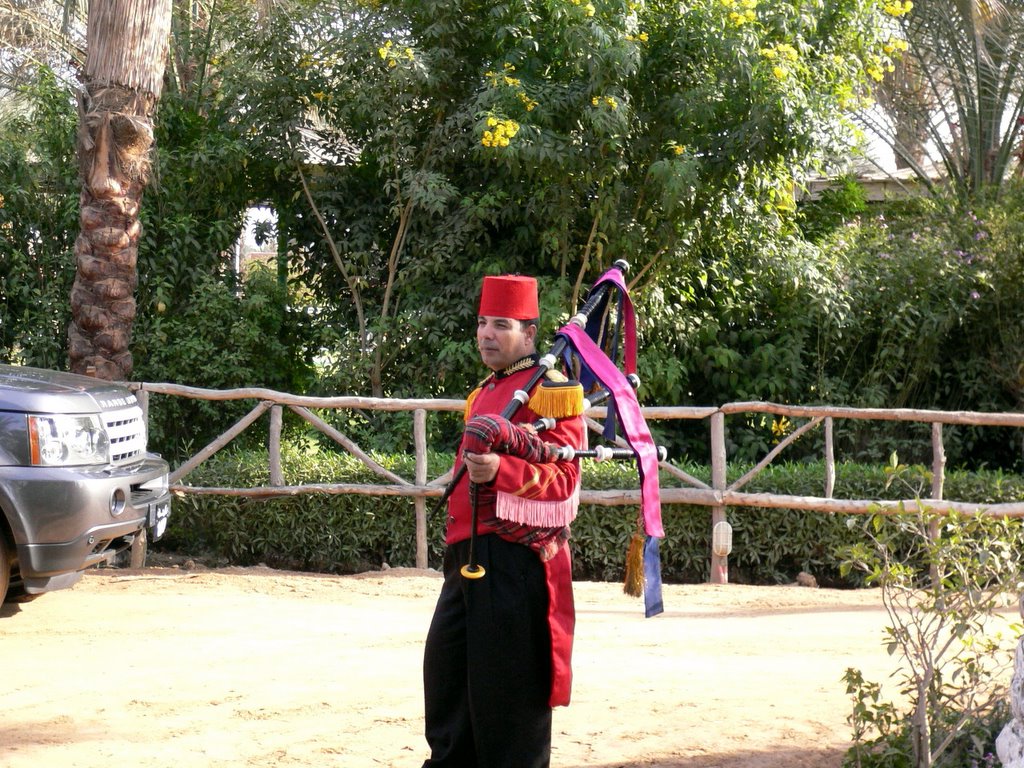
Egyptian weddings are fun. One of the traditions of them is the Zaffa, the procession of the bride and groom into the reception preceded by singers playing tambourines, pipers (you probably thought they were only Celtic), reed players, and dancers. A good Zaffa can wake the dead and make them dance. The tambourines provide a driving rhythm as the women in the audience ululate shrilly. This is a sort of trilling call involving movements of the tongue that I've never learned to do and is traditional at weddings and other joyful occasions. I've seen the processions to last as long as almost an hour when the wedding party was entering a hotel. Hotels and their visiting guests love weddings, although not always for the same reasons. The guests love them for the exotic beats and the dancers. The hotels love them because they make a TON of money on weddings. Our zaffa was only about fifteen minutes long since the bride and groom emerged from their sunflower-decked jeep at the end of a garden path between rows of date palms as the guests lined the path to watch, cheer and toss fake coins. About ten singers in pale blue satin waistcoats offered praises of the bride and groom and encouragement for the enjoyment of the festivities.
A group of six young women in red dresses danced down the path in front of the couple, two of the women wearing headpieces carrying brass candelabras bearing lit candles. The candle dancers didn't dance the entire way down the path, quite understandably. I think that those candelabras must be really heavy.
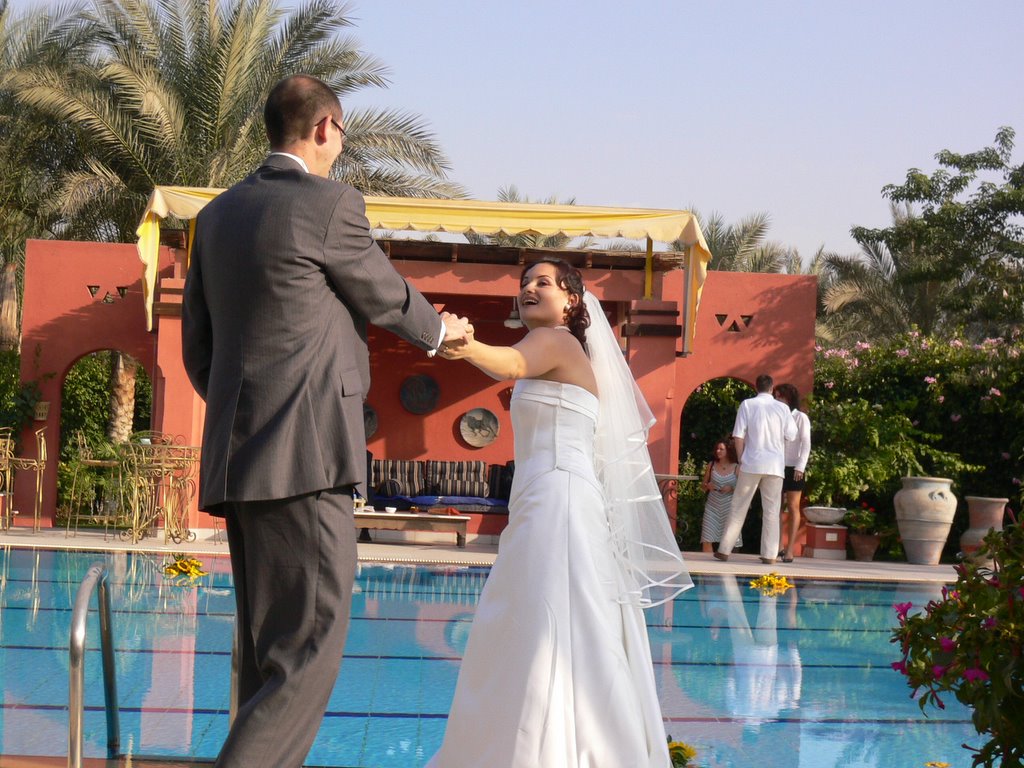
The procession led into the garden of the country house and to the deck of the swimming pool where Arthur and Mayan danced before the guests to the old rock and roll song "Happy Together". Old friends who hadn't seen each other for ages found time to catch up on gossip in the afternoon sun as we watched the wonderful fusion of two families from different parts of the world. First time visitors to Egypt sat with archaeologists and asked questions about working here, about archaeology and culture. Young people from at least four different countries compared parties as they mingled over lawns sprinkled with palms and gardenia bushes.

About sunset everyone moved into a currently empty horse paddock where a Cairo restaurant had set up tables of traditional Egyptian dishes such as koshari (a mix of pasta, dark lentils, rice, a spicy tomato sauce, and crispy fried onions), shawerma (slices of meat or chicken skewered on a rod and roasted, then sliced thin and mixed with tomatoes and onions in pita bread) fattah (a mix of crispy bread, meat, and a creamy vinegary sauce..excellent), kofta, kebab and shish tawouk (grilled ground meat, meat chunks and chicken chunks respectively) along with salads and cooked vegetables, some of them stuffed with rice. Local ice cream and desserts such as Om Ali (a sinful concoction of cream, crispy bread, nuts and raisins), fought for room with freshly made sweets cooked before us. I think that our visitors had a chance to sample some of the best of Cairo's cooking. And then the dancing started.
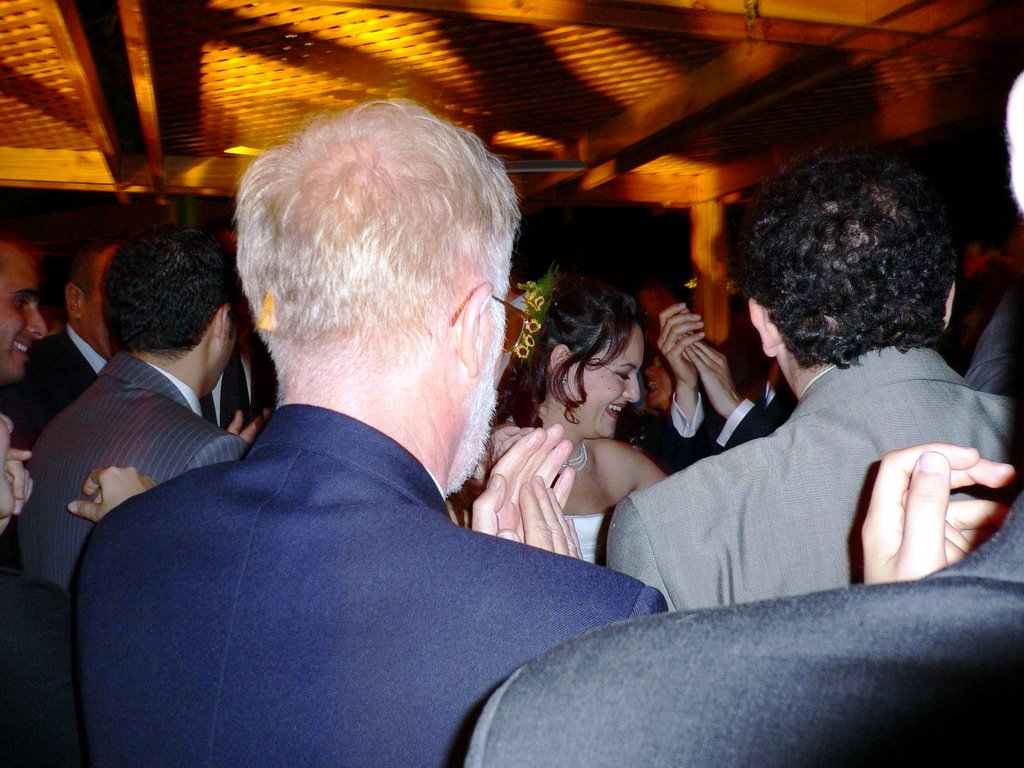
Disco, rock, and Arabic music poured out of the speakers set up in the garden and the younger members of the crowd proved that the night belonged to them. English matrons found themselves being pulled onto the makeshift dancefloor under a trellis to try their hips in an Arabic shimmy. Men young and old clapped hands over their heads in encouragement and appreciation of the women's efforts and then found themselves being pulled into the circle.

I watched the festivities until some of the evening's chill began to work its way into my bones. The autumn evenings here are cool these days and once the sun has gone down, leaving a crescent moon kissed by a single star in the velvet sky you'd better be either dancing or wearing a sweater.
After riding all week, my knees were not up to dancing and my light jacket wasn't up to the chill, so I retired around 8 pm. Most of us fogeys packed it in by around 9 pm, leaving the dance floor and the garden to the younger generation.
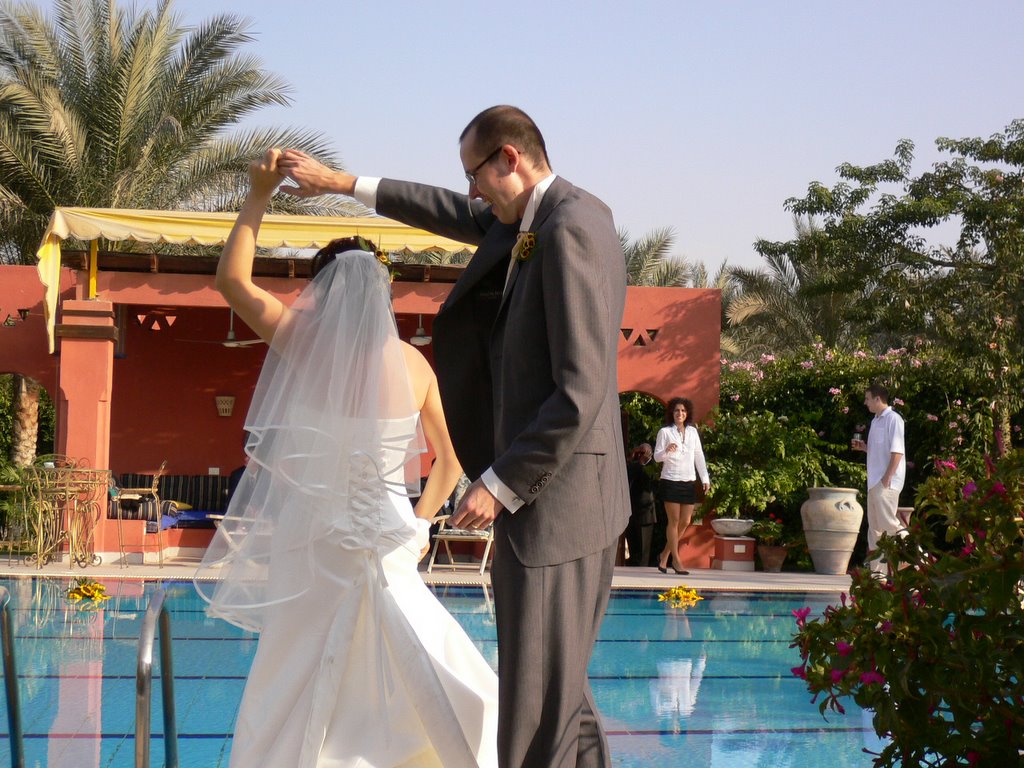
The bride and groom eventually called it a night and retired to one of the hotels near the Pyramids. Today they drove down the Sinai peninsula to spend their honeymoon in Sharm el Sheikh. I'm sure some sunshine will help them through the English winter ahead. I know that I will see them often in the years to come. The thought brings me a great deal of pleasure because they are a wonderful, lively, loving couple who will have much to bring to this world. Bless them and the parents who raised them.

Friday, November 04, 2005

Horses Are Here

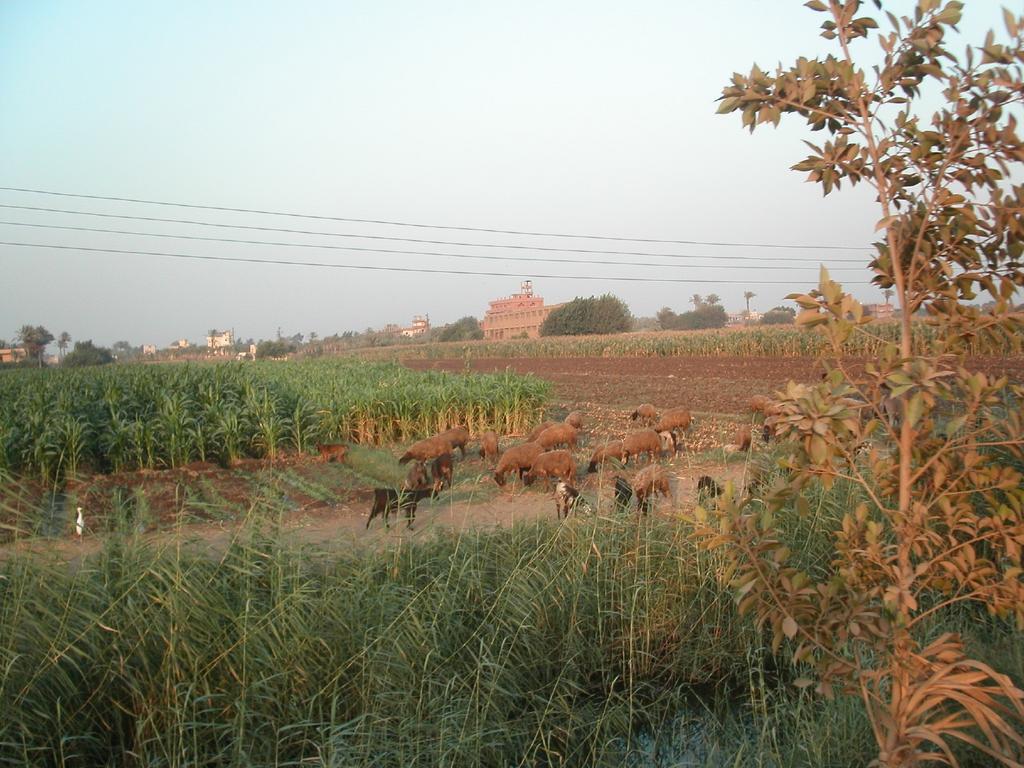
The time came finally to move the horses. I had hoped to have the pipe corrals moved to the new land, but an attack of greed on the part of my landlords at the old land gave me a couple of weeks of hassles, negotiations and headaches instead. Using whatever passed for logic in their strange minds, they decided that I shouldn't take any of the construction that I'd paid for and placed in the fields. I tried to use the village approach to solving the problem and consulted the omda, the village authority, on the matter. He had no luck at all with the people who, despite having no legal basis at all, still claimed the right to my paddocks. It didn't seem to matter that I was leaving the perimeter fence, two storage rooms, a rebuilt wall, proper cement roof on the pump room and the watchmen's room, a fully equipped bathroom and feed bins for horses on the property. They insisted that I should not remove the pipe corrals and the shed that stood at one end of the paddocks. Since the people living in the village surrounding the land were all relatives of the landlords, my simply taking the pipes would have started a battle of sorts and that was something that I did not want for myself or my horses. Horses have a tough enough life in Egypt without angry humans gumming up the works. I've seen the results of people taking human disputes out on animals at some of the Nazlit Semman stables (like those in the photo above), and it isn't pretty.

When I got the news that negotiations had truly broken down and that I was going to have to go to the civil authorities, the police station in Badrashin, I was about to go riding with clients. Happily, they were understanding when I asked if they would mind riding more horses for less time as I had to move all of my horses rather abruptly to ensure that they would be out of the range of any angry humans. We put bareback pads on a couple of the geldings, and saddled Dory so that I could pony her three year old son along side. The horses could sense my concern and were a bit anxious on the way over. When we arrived at the new land, one of my grooms was waiting there for the horses to be sure that they would be all right. It was good that he was there as well, since one of the geldings tried to follow Dory back to the old paddocks rather than be left at the new ones.

Another trip to the old paddocks and we picked up two other geldings, the little mare Diva to pony, and the other grooms brought Fares and Stella by hand. When we collected the remaining six, we were told that these horses had been anxiously circling and calling as they waited for us to arrive.

The arrival of the group was greeted with loud calls by the horses who were waiting in the new paddocks and wondering just what was going on. Despite the fact that I'd been riding the horses to the new land for the past month to acquaint them with the place where they would be living in the future, the abruptness of the move caught all of us by surprise. Once everyone was in the same place, all of the horses settled down nicely and began enjoying the fact that there was much more to watch in the new place. A neighbour's mare being walked along the road in front of the paddock was an object of intense scrutiny, while the men working the land in the field next door seemed to be highly entertaining judging by the length of time the horses spent watching them.

Not having the old pipe corrals posed a special problem for me, however. Fares and Bunduq, also known as The Grumpy Old Men, don't really get along that well with the other horses in the paddock. Whatever hopes I had that the new paddock being bigger would make a difference were dashed when Bunduq proceeded to herd the others around by threatening to kick them. However, with a space of about five or six metres between the paddock and the perimeter fence, my builder pointed out that it would be very simple to divide up the 80 metres of the paddock into about 7 smaller paddocks to use as feeding boxes or places to keep horses while we use the paddock for a lesson or something. Woven plastic mats were fixed to the perimeter fence to provide a wind break for Fares in particular.

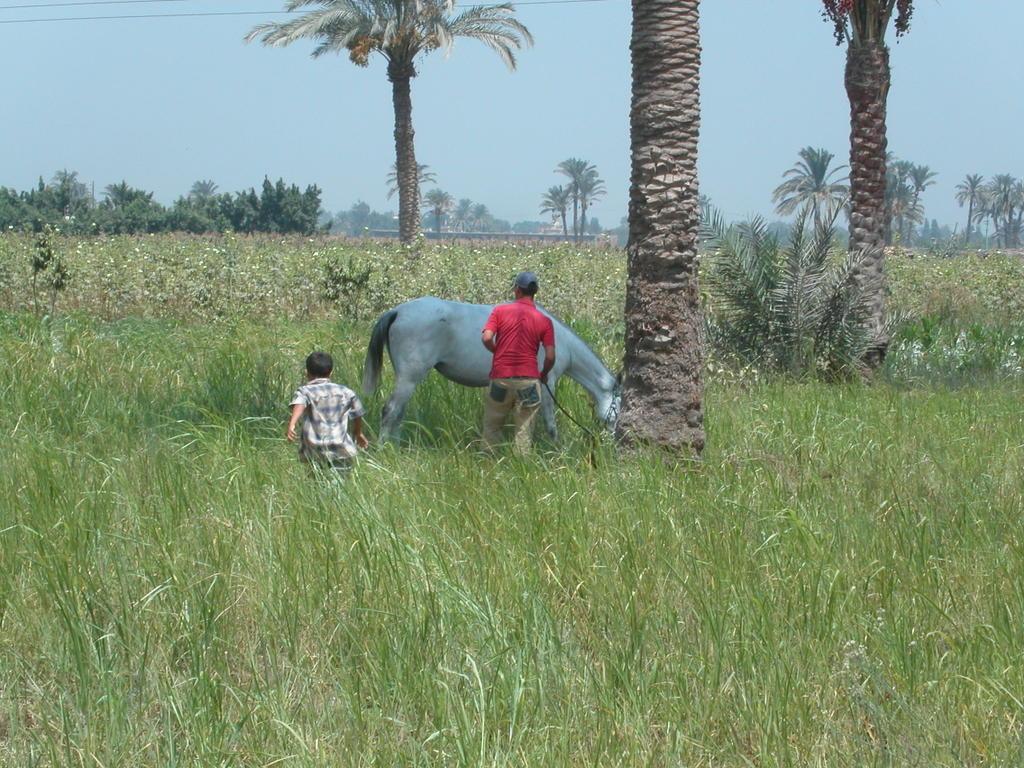
Initially the horses reacted to the larger paddock by running around like idiots, but once they got over that, an increased togetherness seemed to be the order of the day. If one of the horses was taken out of the paddock, the entire group followed along the fence line. To try to ease the transition, we decided that we would keep everyone on the property for the next couple of days so that they could get the idea that this was the place that they belonged. My builder's sons are delighted that the horses have been moved. Ahmed, the younger boy, had been asking to see "Doo" on a daily basis and the two of them come over for a ride on Bunduq at every opportunity. And he's such a good natured old guy, he obliges happily.

Thursday, October 20, 2005

Car Thoughts

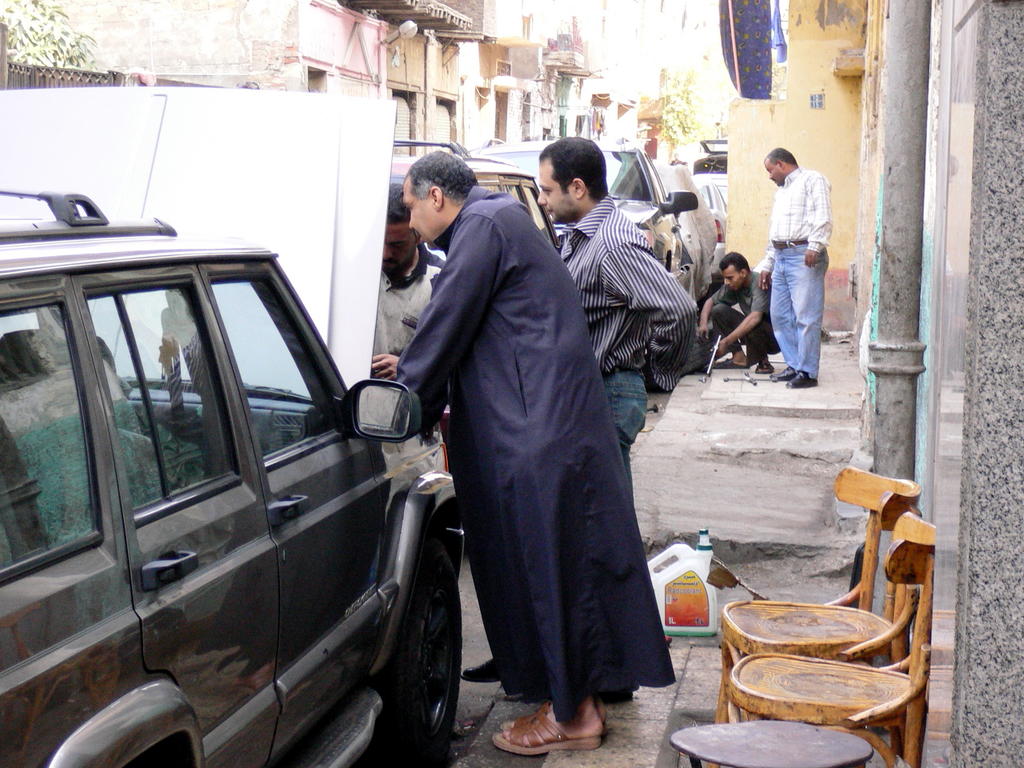
My jeep was acting up, or maybe it was down, because I would start it only to have the engine die shortly thereafter. I would put it into neutral and start Matilda up again, rev the engine a bit to encourage her and remind her of the supposed power under her hood, and then she would work. But this wasn't a plan of action for the long term, so I took her into my favourite mechanic. I explained the problem and my concern that I was more or less continually putting water into the coolant tank for the motor, another worrying sign. If there is one thing that I don't really want to be out here, it's without a car.

I packed my sanity kit, a novel and my iPod, into my purse and went off to visit Mohamed, my jeep mechanic. I really like Mohamed, which might be a bad thing since liking your mechanic could lead to not questioning his assumptions about your car and might also lead to a sinking feeling in the bank account. But nevertheless, I do like Mohamed and don't mind visiting him too much. He's a good mechanic and has worked hard to keep Matilda off the unemployment rolls. She was a present to me from my husband just before he died, but had a very unpleasant experience with a trailer truck carrying massive quantities of flour on a highway on ramp shortly after I received her. The truck's engine failed, as did its brakes as it was ever so slowly chugging up the on ramp and I was passing it to the left impatiently. Thank God. When the engine and brakes on the truck failed I was past the first trailer and catching up to the one just behind the cab of the truck. The first part of the truck came sliding down the on ramp towards me as I gunned the motor in a weird cold terror. My daughter was asleep in the back seat and her friend was sitting in the passenger seat in front keeping my company on our way home from a desert camping trip...just us girls. I watched in horror as the back left corner of the truck came to rest about the front right wheel of my car and I gave Matilda all the gas I could to keep the truck from pulling us backwards. The truck scraped along Matilda's passenger side, smashing the glass in the windows and waking my daughter in the process. When the corner of the truck had made its way to the back of the jeep, crushing the side in the process, the jeep leapt forward under the acceleration as the truck tipped slowly on its side dumping the load of flour bags right where we would have been if I hadn't have been so determined to pass. This experience has left Matilda with some scars, but Mohamed has done a good job of keeping her relatively healthy.

His workshop is an odd part of town near the old Arab aqueduct that used to bring water from the Nile to the Citadel far above and to the west. To reach it I have to drive through a pigeon market under an overpass in the shadow of the aqueduct and then down a narrow lane next to a school. On this day school was letting out for one shift of students while the next was getting ready to go in. Many of the government schools are so crowded that students attend in shifts. There is one small room where a car can be worked on, but much of the repair work is done in the street next to the shop. Customers can sit on wooden chairs on the sidewalk or on an old sofa in Mohamed's office while they wait. I found a chair and sat to observe the children passing.

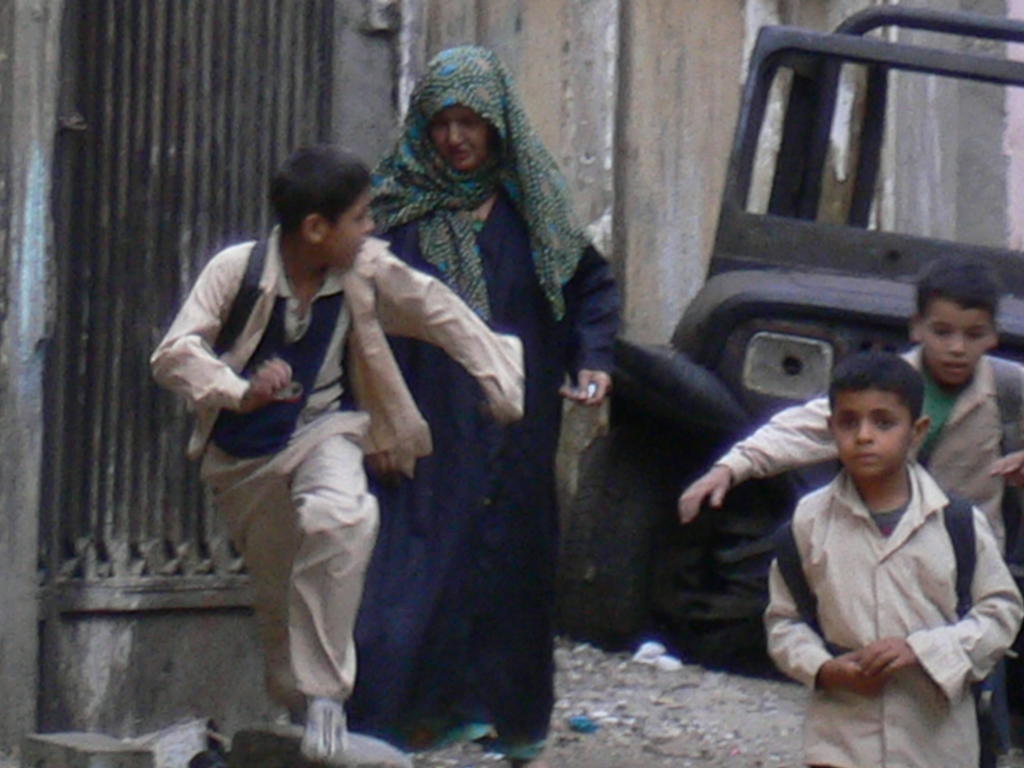
No one can say that the school system in Egypt is good for the children. It isn't good for the children, the teachers, or the country. Classes are huge, fifty or sixty children in many cases, and the teachers are undertrained, underpaid and overworked. I can't imagine what would be closer to hell than trying to teach a class of sixty kids who are all bouncing off the walls for lack of play space. Most inner city families live in tiny apartments and the only places for the children to play is in the streets. Add this to the fact that the school system is a pressure cooker for the children, demanding extensive memorisation and primarily rote learning that is often beyond the abilities of the age group and you get some kids with serious steam to let off. Trying to drive near a school during the release of students or as they are going in is a lesson in aggravation and patience. School is slightly larger than home, so there is something for the students to look forward to, but it certainly isn't the cheery place that many American and European students look forward to. Nevertheless, the students flood the narrow streets as they travel to and from school every day.
Theoretically, all children under the age of about 16 are supposed to be attending school, but not all of them do. Some of the poorer children go to work at very early ages to help support their families. This isn't good for most of these children, but that is how things happen here. If the main breadwinner of a family, in most cases the father, can no longer work, someone has to earn a living. If the mother can find work, then someone must take care of the children who are at home, otherwise if a child can find a job, then he/she will be helping to feed the family. Mohamed has a few of these kids working for him. His children are lucky. He sees that they get fed properly and they are learning a trade. Initially, they find tools or parts, simple jobs that young children can do, while later they learn more about the workings of a jeep. Having watched the misery of some of my friends' children struggling through masses of homework each night, I can see that some of the kids might find the option of working rather than school fairly attractive. Somehow for a ten or twelve year old boy, learning how to clean a fuel injection system is likely to be much more attractive than learning Arabic or English verbs or the history of Europe. When the options available to children are rather equally unpleasant, it's pretty hard to come down against working, in all honesty.
As an ex-teacher this is probably a fairly blasphemous thought to pass through my mind as I sat on my wooden chair against an old stone wall watching the mechanics paw through my poor Matilda's engine. They came up with a dirty injection system, a radiator with a slow leak, and the need for a service to be done on the car. I agreed to leave her overnight and waited for some friends to come pick me up on their way home from errands further downtown. Children boiled past the waiting cars, picking their ways past mechanics dismantling jeeps all along the sidewalks. Mothers, fathers and older siblings waited at the gate for released children, while some of those heading in to school did so with all the grace of a prisoner under armed guard.

Sunday, October 09, 2005

A Visit With Adam Henein

A week ago on Saturday my favourite riding partners opted to go on an exploration with me to see if we could find our way from the paddocks to the Wissa Wassef Museum. According to Google Earth, the route was very straigthforward, simply an extension of a route that we had explored before. So we ventured forth on the horses to find our way to the weaving center. That day was still hot, too hot to be riding in the desert, but in the farmland we had trees for shade and our trail took us into the wind blowing from the north. My village neighbours were working hard on the harvesting of zucchini squash from the fields near the paddocks, in preparation for Ramadan which would start a few days later. For some odd reason, the month of fasting is a major food-buying time, as Egyptians do a huge amount of socialising during Ramadan. Invitations fly to friends and familes to join for the breaking of the fast each night, resulting in something almost like a month long celebration of Christmas.

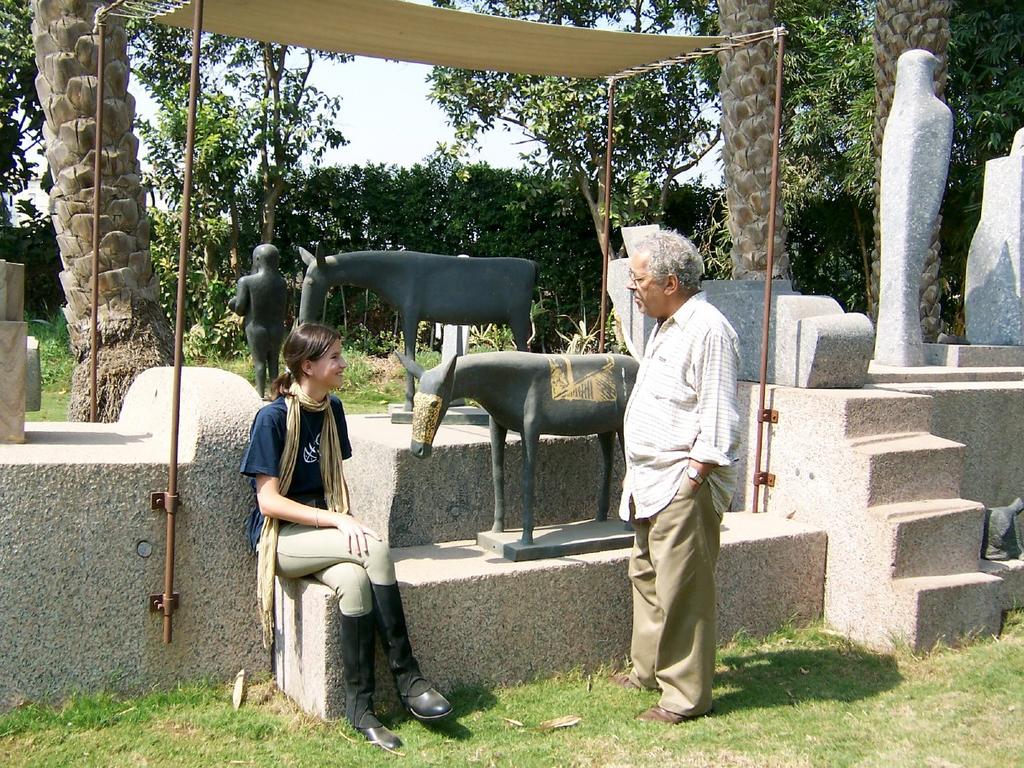
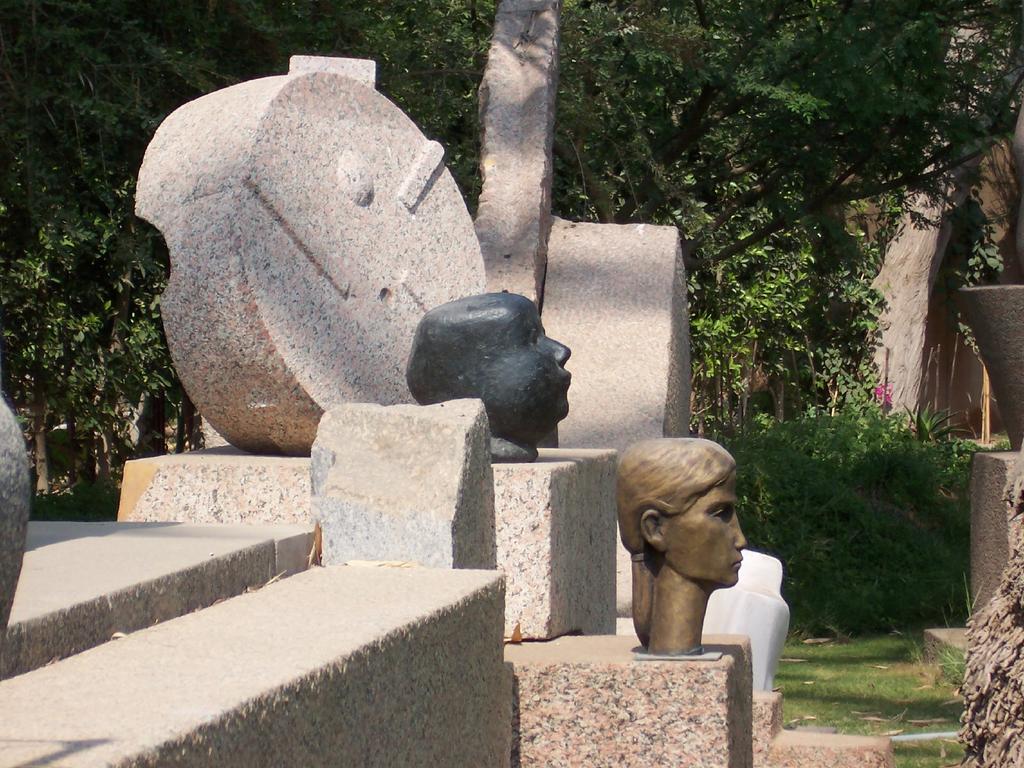
After a longish trek along canals, marking our progress by the restaurants and villas that we recognised on the other bank of the canal running parallel to the main road, we found ourselves outside the museum. We rode the horses in, to the astonishment of the doorman, explaining that we were visiting a friend who lives in the compound behind the museum. After a pleasant chat with Pat, we set out again seeking the best way home. Turning towards the expressway to the north, we passed a door that stood open. On inquiry it turned out to be the workshop of Adam Henein, a well-known sculptor who had cast a delightful bronze donkey that stands in the garden near the front gate of the Wissa Wassef center. Unfortunately the sculptor himself was not at home that day, being out of the country.

This weekend the weather was even better than last weekend and we decided to take the same trip to take some photos of the trail, since we'd both forgotten our cameras the week before. We set out as before, but the activity level in the fields was much lower now that the fast had begun. Much of the more difficult labour had been done shortly after sunrise so that the farmer and his family could rest during the heat of the day. With temperatures still above 30 C, this rest is necessary for people who are neither eating nor drinking during the daylight hours. We found our way to the atelier of Adam Henein and discovered to our delight that not only was he in, but he was quite intrigued by the fact that we had arrived on horseback and he invited us in to see his work and chat.

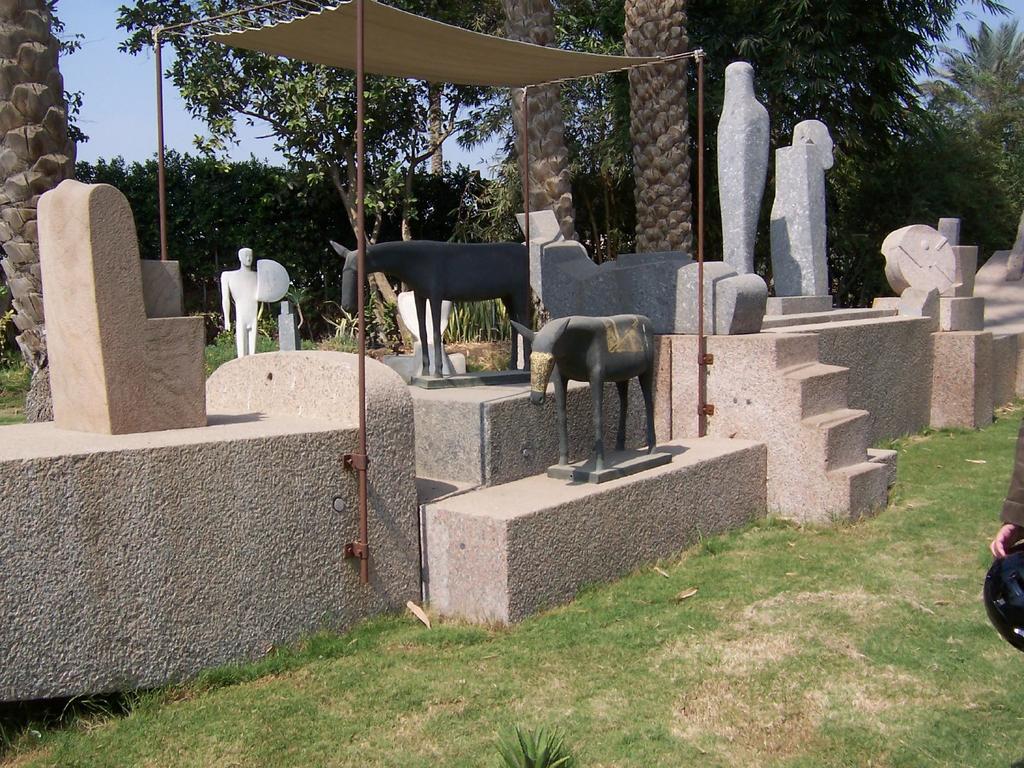
Adam Henein is a very lively older gentleman with wonderful lively eyes and a chuckle just hiding behind most of his sentences. We introduced ourselves and were ushered into his magical back garden which is dominated by a granite boat of pharaonic majesty, upon which various bronze and stone statues are placed. Due to a relatively recent theft, many of the smaller pieces are not left out in the garden anymore, but were brought out from the storage inside to be placed where we could view and admire them. And admire them we did! His work has shown in many of the major galleries in Europe and in New York, so this is not a forgotten artist at all. When we did some research on his career, dreams of owning one of his bronze donkeys took wing, since it would be highly unlikely that either of us could afford the piece. But the loss is less for me, since the artist is more or less a neighbour and I can always go and drool over the donkey in the Wissa Wassef garden.

Mornings like last Saturday remind me how blessed I am. I may never be able to afford an Adam Henein piece for my garden, however much I might love to have one of his donkeys, goats, or dogs adding its particular bronze charm to the more lively creatures that inhabit it, but I have had the pleasure of meeting one of Egypt's treasures. This was a morning that I will remember for a long, long time.

Wednesday, October 05, 2005

A Lady is Gone

A lady died last night. She was a widow with three sons of her original five still surviving. On the first night of Ramadan it is traditional that children break their fast with their mothers, a tradition that is the source of infinite amounts of conflict in many Egyptian homes when both the wife and the husband want to have iftar at their own mother's home. In most cases, this is solved by going the first night to one mother and on the next to the other. Last night two sons joined their mother for iftar and then sat chatting after the meal when she retired to her room to pray the evening prayer after the meal. When she didn't come out after an hour or so, it was assumed that she was napping, as she was in her early seventies and not in the best of health generally. Later in the evening when the sons got ready to go home, they went into the bedroom to say good bye and discovered that she was sitting in the chair in her bedroom in the position of prayer. Her legs had long ago become too arthritic to manage prayer kneeling on the floor. Her head dropped to her chest and her hands on her lap, it looked as if she'd fallen asleep in her chair, but the sleep that enveloped her was much deeper than any nap.

My mother in law and I didn't always see eye to eye. She wasn't wild about the idea of a foreign wife for her much adored oldest son and we were very different personalities. Once we moved to Egypt, we learned to work together over the years. I became accepted along with some of my funny ideas about childrearing as time went on and my children showed themselves to be decent young people and very good scholars, a trait that is well-respected in the family. Overall, our relationship was very good, I thought, until my husband died and the extent to which I was different from the rest of the family became rather more noticeable. There were conflicts and frictions, and although I was told by many Egyptian friends that these conflicts can occur even with Egyptian widows and their husband's family, I felt more and more unwelcome. Over the past year we had spoken rarely and I hadn't seen her for some time. We didn't have a great deal to talk about together and the experience had become more and more difficult. I was still hit hard with her death, although it was just the death that she would have wanted, in fact had spoken of for the past few years. For a devout Muslim, which she was, to die peacefully at prayer during Ramadan is an end to be richly desired.

She was a strong-willed woman who married very young and moved far from her family in Cairo and Alexandria to live in Khartoum, Sudan, in the late forties. In those days travel between the two capitals of Egypt and Anglo-Egyptian Sudan was a lengthy affair involving many days of train travel. She couldn't have been more than seventeen when she had her first son, with her second and third each following almost exactly a year apart in sequence. The first son was the victim of a fall on the train when the toddler fell, hitting his head, while his pregnant mother was caring for my husband who was an infant at the time. There was no medical help available until the train reached Khartoum a few days later, much too late for the boy. When many years later, she lost my husband unexpectedly she never really recovered from the loss. She often bemoaned the fact that a relatively young man had been taken while an old woman had been left behind. But who is to say how these things happen? Overall, somehow I think that they died their own deaths correctly.

She had my husband and three of his brothers to raise during the fifties and sixties in Sudan. They lived in a suburb of Khartoum known as Shaggara, or Gordon's Tree, where colonial villas were set on large lots. Her husband's family were rather well-connected, to say the least, as her sister-in-law was married to the President of Sudan after the split of Sudan and Egypt in the early 60's. My father-in-law, however, was an engineer in the Department of Irrigation and chose to move to Egypt when the division of countries occurred. When I first met them in the mid-70's, one of her sons was a career army officer, another was working in the hotel industry, while the third was still in secondary school. They were living in the upper floor of an old villa that had belonged to her grandfather, a musician to the Ottoman court and a founder of modern Egyptian music. Her mother, my husband's adored Momou, lived downstairs. The close proximity of the generations impressed me at the time. Later, the fact that my parents were both dead, my father before my marriage and my mother when my daughter was only a year old, but my in-laws were in Cairo was a deciding factor in our consideration of coming to Egypt. I wanted my children to have grandparents.

She was my husband's mother, she was my children's grandmother, and for many years she was the only mother that I had as well. This morning I did not go to her house to be with her sons and my son. I could not go. I should have gone. But my grief at losing so much over years of conflict and all at once, when she was finally taken as she wished to be, was simply something that I couldn't share with anyone. Somehow, I should have found a way to manage it, but I simply couldn't. Tomorrow the Quran will be read at a mosque in Heliopolis in your memory. I will be there for that. I'm sorry, Haboba. We may not have always liked each other, but I did love you.

Friday, September 23, 2005

Construction Village Style


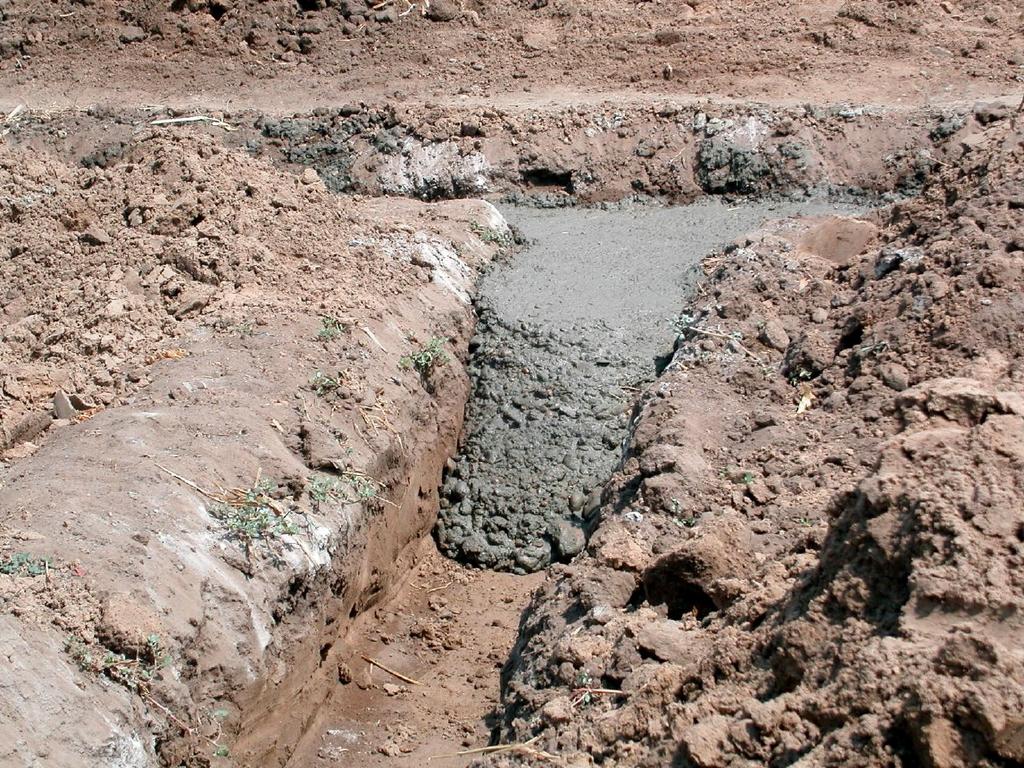
A couple of days ago I walked over to the land to check on progress. I found a couple of men working at digging trenches along lines that had been drawn on the soil in powdered lime, and another group of men mixing cement next to a large pile of sand and gravel. One man with a battered wheelbarrow was pushing loads of wet cement to the trenches where the wheelbarrow tipped its sloppy load into the trench to form the basis of the foundations of my new home. I'm building my house in the village fashion, which is to say, entirely by hand work and amazingly quickly. After watching the villagers put up a house with little more than some pencil drawings and powdered lime on the ground, one begins to believe that perhaps building pyramids wasn't such a huge task after all.

We have a very high water table in the Nile Valley, so foundations that go much deeper than about a metre run into standing water fairly quickly. This means expensive waterproofing for the foundations and such. For the villagers, any extra expense in building is a problem, making their situation and my own quite similar. So how do they build their homes? The walls are based with concrete set in trenches just under a metre deep. Then more concrete is poured on top of the base to create concrete walls that extend another half metre above the ground level. Brick walls are then constructed on top of the concrete, made of red brick with holes to improve the insulating quality of the brick. These walls are about 25 cm (just under a foot) thick.

Today, after having gone to see the work progress yesterday afternoon, I went to take some photos of the construction. I'd been warned that I'd better take the photos soon, or I would miss the entire building phase. Yesterday I'd found brick walls to the level of my chest on the concrete base. Today the walls were almost at the level to connect to the (as yet nonexistent) roof. As you can see in the photo, the standards of on the job safety in Egypt are absolutely the highest. The bricklayers stacked...what else?...bricks on empty 50 gallon drums to lay old boards to form a scaffold for finishing the wall. This particular wall is the outside wall of my new living room. Once the level of the floor has been raised and the tile or stone floor laid, I will be able to look out of the window to my horses in their paddocks.

Although the methods used to build the house are simple in the extreme, they are effective. A simple lead weight on a string, a plumb line is used to check that the wall of the bedroom (at right) is straight. One of the most important issues in the construction of the house is to ensure that there is a good flow of air throughout. Since the prevailing winds come roughly from behind the young man in the photo, windows on the walls behind him and to his right are vital. This is not exactly a palatial mansion that I am building. If anything, it's even smaller than the shoebox that I'm currently occupying, but at least it will be mine. The living room is the room at the right with the front door at the point where the dirt comes up to the level of the concrete. The bedroom is just beyond the young man measuring with the plumb line, while the kitchen is the room just in front of him. The bathroom will be just to the left.

While the house is small, the climate here is lovely and just outside of the kitchen and bathroom will be a 25 sq. metre patio under a grape arbour where I suspect I will be spending a lot of my time. Behind the house is a small garden with a stairway to the roof of the house where eventually I will build a two room apartment for my daughter. She is going to have the best view in the place and a terrace from which she can look out over the horses, fields and the desert. Right now the garden is full of wood for concrete pouring frames and some old bricks, but once we finish building, I will plant bushes, grass and whatever will make Molly the Corgi and Schmendrick the cat happy in their private garden. An openwork brick wall will ensure that the other dogs don't go back there from the patio and harass them. Molly is blind and Schmendrick only has three legs. They don't need any more problems. The little boy in the photo is the son of the contractor building the house. He can't wait for me to move in so that he can come and ride the donkeys and the horses. Since he lives just down the road, I expect to see a lot of Ahmed Saber.

Thursday, September 22, 2005

Lowlights of Autumn

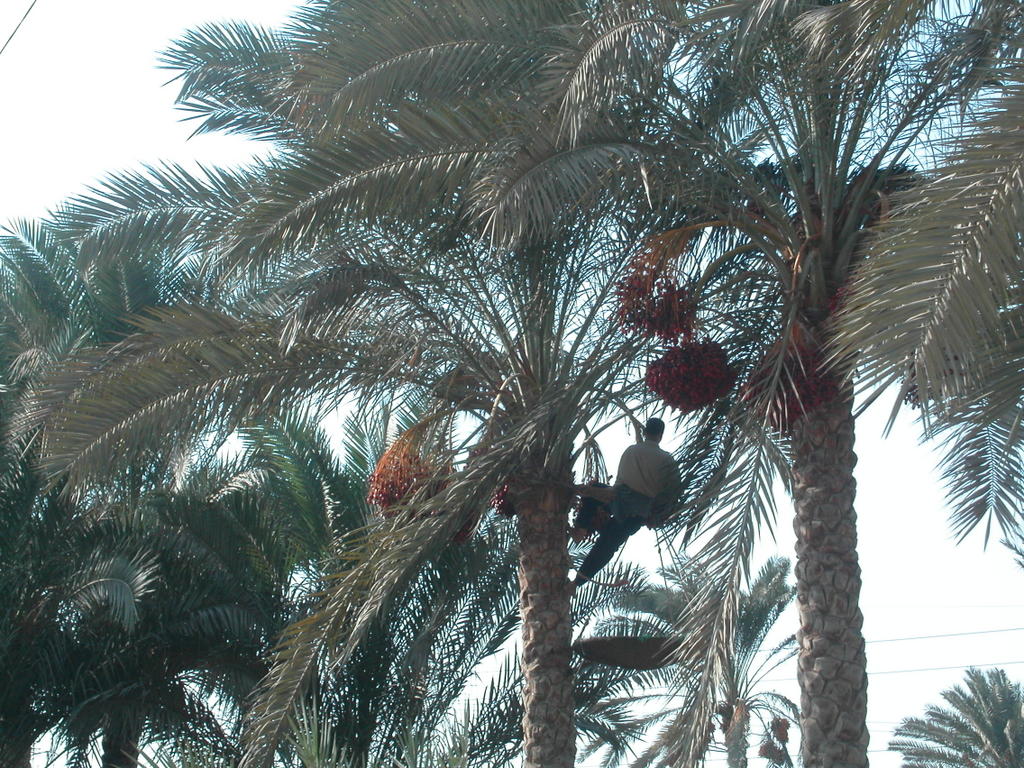
It's the first day of autumn and the temperature outside is 35 C or 95 F. Everyone I know is taking the afternoon easy if it's possible. But it is the time to get the fields ready for the winter berseem crop and the date harvest started last week. All over the countryside there are cornstalk shelters and walls being built to protect the drying dates from the predations of crows, rats, and youngsters, not to mention wandering cows who might like them too. And the cows are wandering in Egypt right now. We were riding in the desert an noticed a dark crowd of something on the sand about 100 metres ahead of us. As we got nearer, the horses' eyes almost bugged out of their heads because there in front of us was a herd of dairy cattle meandering along in the shade of the garden trees at the edge of the desert. My horses see cows all the time, but usually one or two or maybe four tied up in shelters next to their owners fields. They see cows being walked home in the evenings as the sun is setting, or they see a few cows walking out to the fields on the days when we go out riding early in the morning. But to see a group of about 30 cows walking along was a stunner to them. I have to give them credit; they didn't go nuts, spin and run off into the hills at the sight of all the bovine flesh on the hoof. But it was obviously a startling sight. I guess it's the first time I ever realised that horses can sort of count...at least in the sense that while one to four cows is fine, thirty is definitely overdoing it.

This is the time of year when visitors to Dahshur will see tents set up along the filling lake shore and flocks of cows and sheep grazing on the grass that will soon be covered with the water of the Nile. The authorities open the canals to the lake in the fall to provide water for the migrating waterfowl that travel south along the Nile, landing in the lake at Dahshur. This action is less out of concern for traveling ducks and geese than out of concern for the duck hunters from the military who use the lake in the late part of October. Still, they don't manage to shoot all of the birds by any stretch, so we can give them a bit of credit. This year I noticed the same herd of cows grazing in an empty field next to my land as I was visiting the site to sign the cement on the foundations of my house. I mentioned that I'd seen them in the desert just the day before and was told that they were visiting from Damietta. Now that is a stunner. Damietta is on the Mediterranean coast east of Alexandria, an easy 300 kilometres from here. And what are they doing here now? Apparently at the end of summer the cotton farmers spray their fields and to protect the dairy cattle from the spraying they send them walking the 300 kilometres north to Cairo where we don't grow cotton. As the spraying is done at the end of the summer when many of the summer crops are being harvested, the cattle have plenty to eat in the fields that have just been harvested. They make their way from field to field grazing on the stubble along the way. They'd been tidying up the fallen leaves and pruned mango branches from the gardens along the desert when we'd encountered them there.

For the rest of us who aren't harvesting dates, it seems to be the season for a summer flu, something wonderful that begins with a sore throat and turns into a nice chesty cough. I've had it for the past couple of weeks and the only way I can make headway is to stay home and be inactive. The riding trip where we saw the cows was just a simple walking tour out to the Japanese Hill to check that we could still see Dahshur, Sakkara, and Giza from the top (we could) and back, but the next day I felt like death warmed over. Even the dogs seem to be getting it or a canine version. Two of the Rat Terriers have been coughing at night so that the house sounds like a TB ward and now the Dalmation is kind of mopey and coughing a bit. The vet is sympathetic and has offered suggestions to help the poor canines, but basically this is something that we have to ride out. Now how am I going to get the dogs to drink warm lemon tea?