Wednesday, April 30, 2008

Journeying

When you set out on your journey to Ithaca,
pray that the road is long,
full of adventure, full of knowledge …
visit many Egyptian cities,
to learn and learn from scholars.
Always keep Ithaca in your mind.
To arrive there is your ultimate goal.
But do not hurry the voyage at all.
It is better to let it last for many years;
and to anchor at the island when you are old,
rich with all you have gained on the way,
not expecting that Ithaca will offer you riches.
Ithaca has given you the beautiful voyage.


C.P. Cavafy was a Greek Alexandrian who was born in the late 1800's and lived into the 20th century writing poetry that was inspired by his Greek heritage and his Egyptian upbringing. He wrote in English and Greek and likely spoke Arabic rather badly if at all, having been raised some of the his youth in the UK. He's always been one of my favourite poets. This poem seems important to me right now because at the end of the month I will be traveling to the US for two weeks to see my children who are both at the beginning of their travels, although they probably don't see things that way. My son is completing his graduate studies and going to work for at least a while in the US and my daughter is just at the start of her graduate studies which will likely take her to some fairly interesting places.

I am more than happy to be here on my farm enjoying the flow of visitors and the changes of seasons. I know that the children will be in that flow as often as they can arrange it, partly to keep an eye on their old mom who has a tendency to do odd things even at her advanced age and partly because Egypt with her Nile and desert is part of their being. Like my Greek friend, my Ithaca is here under the palms and the endless sun of Egypt. I don't know where my children's Ithaca will be, but I hope that the journey is a long one.


copyright 2008 Maryanne Stroud Gabbani

Thursday, April 10, 2008

The Extended Present of Survival

A couple of days ago I read a New York Times essay by Harriet Brown that quite simply knocked me over. The link to the article is the title here. She was talking about how after having gotten her two daughters through life-threatening illnesses, she was having trouble adapting to a more relaxed life. In some respects, all of us have been through the same situation. I have a daughter who flies home from her high stress university life and promptly comes down ill the moment she walks in the door. It seems to be that becoming a "daughter" with a mother who is available to care for her is the trigger that allows her to let it all out. She usually recovers in a day or so after her arrival and is fine again.

What really struck me about Ms. Brown's article was the comment that "In times of crisis, the brain goes into protective mode, a kind of extended present tense intended to get you through danger without wasting energy or emotional resources. After all, there is no evolutionary advantage to worrying about the future when the future may never come." I'm not a stranger to this extended present tense, but I've always thought of it as the response to an immediate emergency, that icy calmness that allows one to bundle a bleeding kid into the car to get to the emergency room for stitches. As I was reading about the extended illnesses of her daughters, I realised that I'd also relied on that extended present tense to get me through the Bad Years of reorganising my late husband's businesses to take care of the needs and desires of the banking community in Cairo. Friends and family wondered at my ability to simply deal with the multitude of blows, setbacks and complex problems that were my lot for those years. I'd get up in the morning, dress for whatever corporate duty lay in wait for me, and get on with my day. I was in a sort of emotional shock.

My kids, bless them, would turn me around at the kitchen door many evenings sending me out to my horses with a change of clothes and tell me to go ride. I would ride, sometimes for hours, silently through the countryside night listening to the sounds of families resting in front of their homes, chatting, watching television, playing...the sounds of normality that would heal the wounds of each day. But all that time, I couldn't think ahead clearly to plan anything, I couldn't think of who/what I had lost, memories were fuzzy and not useful to me. It took years to reach a point when I suddenly began writing poetry quietly during board(bored) meetings, tugging out tiny bits of feeling from the numbness within. Poetry was the only way I could access my feelings at that point. Everything had to be in bite-sized pieces because I seemed to be incapable of dealing with anything larger than a moment.

This idea of extended present tense has given me pause to think as well about the people around me. I wonder how many people that I deal with on a daily basis get into the habit of this extended present tense in defense against the difficulties of life. I live among people for whom the only guarantee is that they and their families will someday die...the old "death and taxes" as sureties but they are too poor to pay taxes. Visitors here look at the villagers and ask how do they live with.... a million things that might occur to someone, but I'll bet that much of their life is spent in that present tense where the future has no meaning and the past has no bearing. I'm sure that when your life is a mess in general, survival mode becomes normality.


copyright 2008 Maryanne Stroud Gabbani

Sunday, April 06, 2008

Obviously An Endangered Species


In preparation for a general strike called to protest the rising prices and level salaries, the powers that be seem to have decided to round up some of the local bloggers who have been instrumental in calling for the strike. Living out in the boonies, I wasn't planning on going into town anyway and I have no plans on spending any time at all out in the current sandstorm, so I imagine that I'm probably safe. I'm also not all that convinced that a march or strike is going to be all that effective in fighting the inflation that afflicts Egypt and so many other places as well. I do find it interesting to note that there is a statute on the books, "Article 124 of the Penal Code punishes all those who shirk their work obligations with a prison sentence of 3 months to one year" and I wonder why it isn't used against the clerks in government offices who'd rather drink tea than work...or maybe against the plumber who gives you three appointments one after another and never shows up for any of them..

As a general rule, I don't comment that much on politics. It's not a healthy thing to do in Egypt as can be seen in the article to which the title links. On the other hand, as a housekeeper I'm a great believer in the disinfecting power of sunlight, so let the light shine.

copyright 2008 Maryanne Stroud Gabbani

Sunday, March 30, 2008

A Problem For Everyone


There have been stories in the press here and abroad about the problems at the government bread bakeries due to flour shortages. We are definitely in the midst of a serious problem in Egypt with inflation, especially as it affects food. But we are not alone, as detailed by the writer of the Globe and Mail article I've linked to with the title. People are experiencing similar problems all over the world.

I don't go into the city that much, especially since there is almost nothing that can be done there that doesn't cost money, and with a farm to support, I really don't want to go about spending unnecessarily. Today I went into Maadi to pick up a replacement pair of glasses and to do my month's grocery shopping. Shopping every day the price increases sort of sneak up on you, but shopping once a month, they smack you in the face. I have to admit that I'm spoiled rotten by having the wonderful Mohamed...driver, accountant, supervisor of workers, right hand man....who does my day to day shopping. He has the advantage of living near one of the best fruit and vegetable markets in Cairo but we've been watching the price fluctuations in that realm with a jaundiced eye.

Going to the market once a month for the essentials puts a special light on pricing. I am a boring shopper. I buy the same basics month after month: some chicken breasts, corn meal for parrot bread, skim milk and skim milk yogurt, some oil, some rice, lentils, chick peas...simple stuff. It's only me in the house after all and I like my food real and freshly cooked, so I don't need too much.
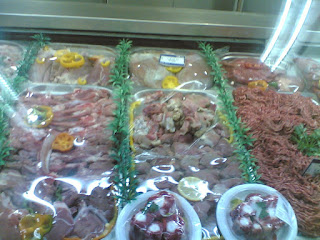
I do this shopping in one of the largest supermarkets in Maadi. There are things that I like that I can find in a place like that, such as cherry preserves, that I like. Yeah, like I said, I'm a bit spoiled. Metro, the supermarket, has a cheese section, a meat section, a poultry section, a fish market, and a delicatessen...it's a normal supermarket. Last time I was there, I bought a tray of chicken breast for about 30 LE...that's for about 8 half breasts. Today the same tray was over 40 LE. My skim milk that was about 3.5 LE 6 months ago is now almost 5 LE a litre. A small jar of nice green pepper salsa, locally produced, was 3.5 LE last month and is 5 LE this month. Rice that was 2.5 LE is now almost 5 LE.

As I wandered around the aisles gazing in horror at the costs of living exploding before me, I noticed that there was almost no one else in the store. Ordinarily, I'd see families doing their shopping, mothers with toddlers in tow picking up cereal and pampers, all nationalities...but today there was an older gentleman moving about looking at more things than he was buying and a young woman picking up item after item only to put them down with a snort of disgust. The store, while not empty, was significantly less crowded than I'd ever seen it.

My staff have been telling me about the price increases over the past months, but it isn't the same thing as walking in and being assaulted by the price increases at every turn. We are living and working in a farming area where we can grow some of our food. How are people who are on very limited incomes in cities and have no way to provide for themselves going to manage?

In my reading about the price issues in the grain trade I've seen that there are some interesting issues involved in the shortages and high prices. One of the issues that one article was discussing was the abnormal trading and pricing patterns over the past few years since investment funds were allowed to trade commodities. This means in addition to stocks and bonds, these investment funds could speculate on commodities that are the bases of our food supply. As the widow of a grain trader, I have some understanding of the general workings of this field, and I really think that the trading of something as important as food should not be in the hands of speculators. I realise that everyone in the grain trade is also speculating to a certain extent, but at the end of the day they are trying to move the grain from Point A to Point B. Mutual funds aren't moving food from producers to consumers. I also have to question the wisdom of the current field of biofuels. If we are using food for people to power vehicles that many of the people needing food don't even have...what is the point? It's all very well to try to develop a renewable fuel source, but do we want to compete with our own cars and buses for our food supply? These aren't just Egyptian concerns and problems. They are affecting us all. Shortages in rice, corn, and wheat are causing price increases in staples and meats all over the world. A Canadian friend of mine confided that a loaf of bread in her area was about $2.50. Looks like we are all in this together.

copyright 2008 Maryanne Stroud Gabbani

Tuesday, March 25, 2008

Five Years Old Today


Today is my blog's 5th birthday. I don't know about the rest of you, but I can't believe that I've been writing this thing for the past five years. That's longer than I've worked at any job other than being a mother. (By the way, don't expect any logic to the photos accompanying this post. They are totally random other than for the fact that I chose them today.) When I started the blog I was definitely inspired by the Baghdad Blogger. I read his work and could feel and sense the life in Baghdad during the days prior to the American invasion. After answering all sorts of questions from people who, in the wake of 9/11, couldn't fathom what a more or less normal Canadian mother type was doing in a "dangerous, anti-western, fundamentalist" country like Egypt, I rather hoped that I could bring readers a sense of life in Egypt.

In 2003 there seemed to be a sense that life in Egypt was very serious, rather dangerous, and a bit frightening. At that point I'd been living here for about fifteen years and one of the reasons that I loved living here was the general love of life and laughter that was so much a part of society and family here. Somehow, I guess that my message came across because after some time I seemed to have accumulated a number of readers many of whom have stuck with me over the years, and a surprising number of them have even ended up here at the farm for a cup of tea or a horseback ride. Just today, I had a group of women from Cairo come out on a Community Services Association trip and one of them told me that she'd been reading my blog for years.

So now as I embark on a second five years of blogging about everyday life in Egypt, I've had some time to think about what on earth possibly convince me to do this. I still think that just opening a window onto one of the most welcoming and warm cultures in this world is important. I really love sharing Egypt with people who haven't had the chance to experience Egypt, and I hope that some of them decide to come to see for themselves as a result of reading about this amazing place.

Then there is the feedback that I've gotten from Egyptians both living here and abroad...that has been inspiring. When I get an email from someone who tells me "Yes, this is my country. I recognise it. Thank you.", I feel truly honoured. As a relative newcomer to Egypt, having come here in mid-life, it's a wonderful feeling to hear that somehow I've been able to capture life here in my adopted land. I only hope that I can continue to do so.

I hope that the next five years in Egypt will be peaceful for most of us. This isn't a peaceful area of the world and we've had our share of problems here. Domestically, many of us are worried about what will come after Mubarak. Will his son succeed him? Will he do a good job? Will the military accept a non-military president here? How is Egypt going to handle the pretty crazy inflation rate that we are suffering from these days? I'm looking at how I can increase my staff's basic pay rate so that they can support their families, but at the same time I have to be able to afford my expenses. Inflation is a nasty, nasty business that is affecting all of us. I read my news reports and notice little things like the fact that we are now competing with two new breweries in Egypt for barley for the horses and forage is also becoming more expensive as farmers are competing with villas for land. Guess who is winning... I guess the only way to find out is to keep going. I'll be here if you will.


copyright 2008 Maryanne Stroud Gabbani

Tuesday, March 11, 2008

The Second Day on the River


The next morning we had breakfast at Kom Ombo and then set sail for Edu. This was my favourite part of the trip, heading down the Nile with the northwind in our faces. We passed farms much like those of my area, and fishermen working their boats in the river while their children played on sandbars nearby. Mango, orange, and banana orchards lined the river, but the date palms here in the south were not as well-trimmed as those in our neighourhood.

We weren't the only ship on the river. In addition to the fishing skiffs, there were some smaller motor craft for travel or cargo and, of course, other cruise boats. Since we were all supposed to be going through the locks at Esna that evening, sometimes things looked like an old fashioned river boat race. The weather had warmed up quite a bit, but most of us were looking abit askance at some of the travelers on other boats who were sunbathing on the top deck. Maybe our boat was colder on the topdeck or something but we were quite happy in tshirts.

When we got to Edfu we were told that we would take a horse-drawn carriage to the temple and back. To my delight, the majority of the horses presenting themselves to us at the riverside were in excellent condition. As a horse owner and someone who works with horses, I really can't tolerate working abused horses. The Brooke Hospital group have been working really hard in Upper Egypt constructing shades where the horses can rest and visiting veterinary services.

The temple at Edfu is amazing. It is wonderfully preserved temple that was constructed for the most part during Greco-Roman times and was buried in sand until the 1800's. I remember being incredibly impressed with its halls and decoration years ago. Many of the halls are stained with soot near the ceilings from people taking shelter in them many centuries ago.

After Edfu, we set sail once again, heading for the locks at Esna. At times we could see desert on one side or another, and there were some beautiful buildings along the river. One sand coloured house in the traditional Nubian style particularly caught my eye. The way that it blended into the surrounding desert hills was lovely.

Finally, as the sun was setting, we came to Esna where we moored with a number of other boats while waiting our turn to pass through the locks. South of Esna the river is significantly higher than it is below Esna. Nile cruisers traveling south from Luxor wait in pairs to enter the lock, have about 4 metres of water pumped in to raise them to the southern level, and then after the southbound boats leave the lock, the northbound boats, like ours, enter to have the lock pumped out to lower us to the northern level. From Esna we traveled north to Luxor to find ourselves moored at the corniche in Luxor the next morning.
copyright 2008 Maryanne Stroud Gabbani

Wednesday, February 27, 2008

Cruisin'

This has been a week for old friends in many senses of the word. For the past year, one of my childhood friends has been working out the details of a visit to Egypt with her husband, a woman friend of hers and the woman’s husband. At the very last minute, her friend’s husband couldn’t make it on the trip and we had to reorganise a few things. They had planned to come to Cairo for a few days to see some things and catch their temporal breath at the farm. Flying to Egypt from California does really knock one’s time sense askew in a big way. Then they had booked five days during which they would take a three day cruise from Aswan to Luxor with a following flight to Sharm el Sheikh for a couple of days. When one of the party couldn’t come, they invited me to join them and after working out the logistics of getting away from the farm and work for five days, I did. We flew up to Aswan early in the morning to catch the Movenpick Royal Lily, a lovely boat for a vacation. The rooms were beautiful and the food was great. Each day we visited some of the sites along the Nile between Aswan and Luxor and in between we would sail along some gorgeous countryside. It was my first Nile cruise, despite the fact that I’ve lived here for about twenty years.

In Aswan before we sailed, we hopped into a minibus with a guide to visit three sites, the unfinished obelisk, the Aswan High Dam, and the Temple of Philae. My only other visit to Aswan was in about 1992 with my brother and his family at New Years. We had driven up from Luxor (this was in the old days when you could still do that easily) and we opted to see the High Dam, Abu Simbel, which involved a flight from Aswan and back, and a felucca trip to the west bank for a camel ride. This trip involved seeing two new things and revisiting one old friend. The High Dam hasn’t changed much and standing on top looking out at Lake Nasser was a familiar sight. The site of the unfinished obelisk, on the other hand, was totally new and interesting. The site is an enormous granite quarry, where for thousands of years the ancient Egyptians cut the famous red Aswan granite for pyramids, obelisks, and other statues. I’m not sure how many of you have had to buy countertop for a kitchen but Aswan granite still goes for a pretty penny in the market today. The unfinished obelisk is a 42 meter slab of granite that cracked as it was being carved and was then left in place. Undamaged obelisks were carefully removed from the site of their carving and placed on barges that could be floated to the Nile directly from the quarry via a canal that’s only recently been discovered.

Driving from the quarry to the High Dam we crossed channels where the Nile flows out of the dam and some of the old rocky empty channels that are used for excess run off. Aswan’s main characteristic is the amazing amount and variety of rock. The High Dam hasn’t changed in the 16 years since I was here last. It’s still high, still windy and the view of the lake is still lovely. The jury is still out as to whether it was a Good Thing or a Bad Thing as well. In addition to losing many important archaeological sites to the lake, Egypt and the Mediterranean Sea lost the important silt that was washed down the river yearly. This has cost the farmers of Egypt a lot and the fishermen of the Med perhaps even more, since the silt gave nutrients to the fish of the area. At the time that they were building the dam, no one was interested in ecological impact statements so we are pretty much stuck with the results.

Our next stop was one that I’d wanted to see for ages, the Temple of Philae which is between the old Aswan Dam and the High Dam. Like many sites in this area it has been relocated to keep it from being lost in the waters, but unlike Abu Simbel and others, the relocation didn’t involve that much of a move. It was built in Greco-Roman times to honor the goddess Isis, whose tears over the loss of her husband/brother Osiris were believed to be the source of the Nile flood. The carvings there are beautiful and interesting, as the Greeks who were then ruling Egypt added their own little touches to the décor. The juxtaposition of the huge raw boulders of the river, the harsh stone of the riverbank, and the lovely workmanship of the temple were a marvel, as were the warm tones of the stone and the cool clarity of the unpolluted sky and the sapphire of the lake. I grew up near the sea and any time spent by water always seems a blessing, twice so in the desert like the high deserts of California or in Egypt where water that pours over the hot rocks gleams with a light more lovely than any diamond.

We returned to the boat where we laid into dinner with the special gusto of those who have been hiking over rocks and learning more than they’d bargained for as the boat sailed for Kom Ombo. Kom Ombo is the site of a temple to the crocodile god Sobek and to Horus. Apparently this area of the Nile was notorious for its crocodiles and one reason for the temple was to try to encourage the crocodiles to play nicely with the locals, while on the other hand Sobek was a fertility god and this seems to have been a temple for the practice of medicine. There are carvings on one of the walls that detail medical practices and tools. We visited the site by moonlight as there was a full moon, at least a 10 on the romance scale. There was plenty of light to see the carvings between the moonlight and the illumination provided by the antiquities staff. As we walked to and from the temple along the Nile embankment, I was struck with the loveliness of the night (definitely the most powerful feeling) and with the enormous numbers of visitors to this part of Egypt. There must have been at least ten cruisers the same size as ours tied up along the river bank and in many cases they were moored in flotillas at least three deep. That night we slept the deep sleep of weary travelers who had risen at 3 am to spend a day time traveling on the river.


copyright 2008 Maryanne Stroud Gabbani