Sunday, May 23, 2010

A Walk Along A Mameluke Street

A couple of weeks ago a close friend of mine, Patricia Canfield, decided to take one of the walks in Cairo sponsored by ARCE (The American Research Center in Egypt). ARCE offers some amazing tours of Cairo and sites further afield for very reasonable prices. You do have register with ARCE beforehand and to show up on time for the bus as they absolutely depart at the advertised hour, but the tours are some of the best in Egypt. Pat is a freelance writer living here for some twenty odd years and when she showed me the photographs and told me about the places she'd seen, I begged her to write it up for me for my blog. These days my arthritic knees have taken me away from any ideas I have of three hour walks, although knee replacement surgery scheduled for this summer should have me back pounding the pavements, however gingerly, in the fall. Here is her story:

Al Mu’izz Li Din Allah Street

One of the highlights of tours to Cairo is the Khan El Khalili which is an intricate warren of over 1,000 shops, craftsmen and workshops and an astonishing group of Medieval and Islamic monuments which have occupied the same cramped area for well over 1,000 years.
The most spectacular group of these monuments is on Al Mu’izz Street which is part of the main thoroughfare that ran through the Medieval walled city. It is an area called Bayn El Qasrayn (Between the Two Palaces). This was the Mameluke (1250 – 1517 AD) ceremonial parade route which ran between the two palaces of the Royal complex. At that time it was said to be wide enough for 10,000 troops on horseback to pass. These palaces were built on the site of the earlier Fatimid (969 – 1171 AD) era buildings which were the heart of what was then the city of Al Qahira (Cairo).
An extraordinary group of these monuments was painstakingly restored and has recently been reopened to the public. These three adjacent complexes below were built by Mamluke Sultans who traveled extensively during military campaigns and incorporated much of what they saw into their own buildings.
The oldest complex was built by Sultan Al-Mansour Qalawun (1279 – 1290) and is a magnificent grouping of the highest examples of Islamic architecture. It included a Maristan or hospital that handled hundreds of patients each day with a highly specialized medical staff and surrounded the patients with beautiful gardens and soothing musicians. An eye hospital still exists on the site. There was a Madrasa or religious school. However, the most spectacular feature is the Mausoleum which is an absolute treasure trove of marble inlay, intricately carved gilded wood, Islamic calligraphy and stucco that looks like lacework and which houses a cenotaph with several royal burials.
The next building was constructed by Qalawun’s son, Sultan Al-Nasir Mohamed, who was one of the most prolific builders in Cairo’s history. A white marble Gothic style doorway that was brought from Syria opens into the passage which separates the Madrasa from the Mausoleum. The door to the entrance is well-aged silver and marble inlaid floors form a carpet like passage between areas. Colored stained glass windows play with light and color throughout the buildings.
The third building of this contiguous façade is the Khanqah (Sufi monastery) and Madrasa of Sultan Al-Zahir Barquq (1382 – 1399). There are exquisite examples of gilded Arabesque stalactites on the domed ceiling and bands of Koranic inscriptions stretching across the walls of marble inlay and carved Mashrabiyya wood. Colored glass mosque lamps are hung from chains in graceful groupings.
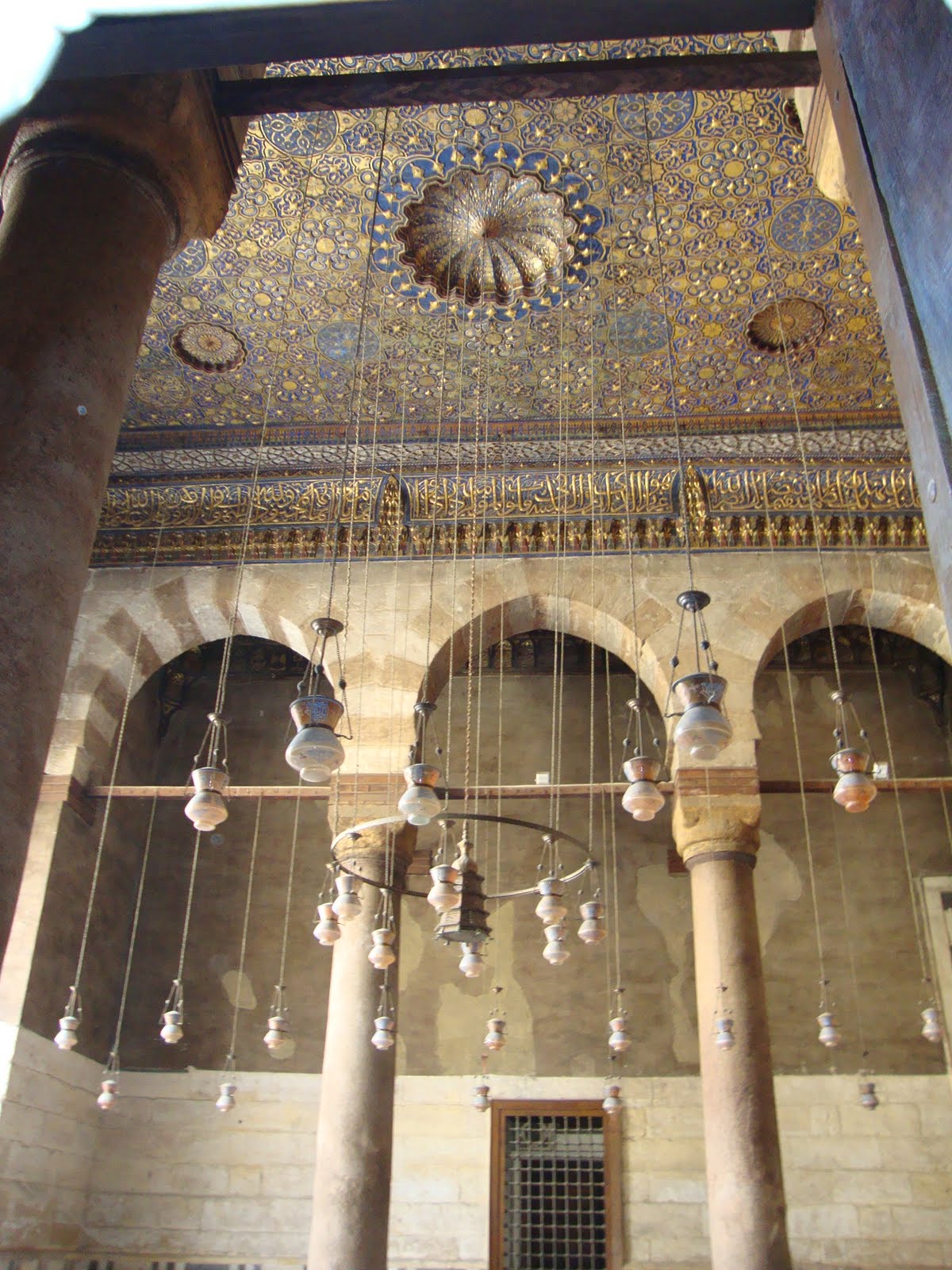
From the street, you can see the interplay of light and form in the recesses which give so much texture to the buildings and the minarets that top the structures are a study in different styles of design and calligraphy. It is a place that constantly affords you a new sight to study and a new treasure at which to marvel.


copyright 2010 Maryanne Stroud Gabbani

Thursday, May 13, 2010

Earth Calling the University of Oregon...

Arabic Literature (In English) is a wonderful blog about what Arabic literature can be found for those of us who love it but don't read Arabic well enough to be able to read it in the original. The title here links to one of those head scratching posts about people and places whose logical processes seem to be missing a few cogs. The University of Oregon has an Arabic language department that is being moved to the Religous Studies school. Huh? I live all day in Arabic and never talk about religion at all. You can follow the connection in the blog post to the original student news report about the switch and the confusion it has engendered.

Arabic is a language spoken in many, many dialects and accents in many countries in this world. Classical Arabic is the form that is the Arabic of the Quran and the Arabic that all countries recognise as being the purest form. It is, however, not just a language of religion. The comment from the university that "Arabic is being folded into the religious studies department because the department can support Arabic students reading advanced literature and documents, most of which are Islamic in nature" totally ignores the fact that Egyptian author Naguib Mahfouz was awarded the Nobel Prize for literature and that there are many marvelous novels being written and published in Arabic all the time. To assume that "advanced texts" are religious in nature demonstrates a total lack of comprehension of the the Arab world.

Gongratulations, University of Oregon. You win this month's dolt award.


copyright 2010 Maryanne Stroud Gabbani

Thursday, May 06, 2010

Working together?

I've recently found a very nice blog about Arabic literature in translation. This morning I read a post that exemplifies much of the discussion on the list regarding raising reading in Egypt to an acceptable activity. Reading is not high on the list of things to do to relax here. Most Egyptian students are so traumatised by the school system that they are happy never to read anything more complex than a road sign for the rest of their lives. And there is no culture of parents reading stories to their children in the evening to encourage kids to think that reading can be a pleasurable activity.

Now we have lawyers (do they read for fun?) wanting to sue to have the classic 1001 Arabian Nights and a prize winning novel Azazeel banned for being a bad influence on society and insulting Christians respectively. There is something seriously wrong with people's priorities here. A novel is, after all, just a story. No one ever has claimed one to be fact although many novelists like Salman Rushdie have fallen afoul of critics (many of whom have obviously never read the books) who don't want anything untoward to appear in print.

I would suggest seriously that since 99.9999% of the population here spend a vast amount of time watching television and much less reading that the lawyers start their crusade elsewhere. Can I nominate Sex In The City and/or Desperate Housewives or Weeds as being far more detrimental to public values and probably much more widely viewed than anything in print. Of course that would mean taking up the lances against Orbit Showtime Network which is based in the UAE I believe, that liberal country where giving your wife a peck on the cheek in public can result in police action.

Sometimes life simply is too weird.

copyright 2010 Maryanne Stroud Gabbani

Tuesday, April 20, 2010

Evolution


About five years ago my farm was a flat pepper field...enough cayenne to launch a rocket but little else. I began building with the paddocks for the horses, since they were the most important inhabitants here, and the fence to keep the dogs in away from the neighbour's chickens. As I built I tried to visualise how I could see the farm developing, and I must say that life is much more inventive than imagination.

I'd started taking clients out riding in the desert and countryside before I built, but now we have companies in Europe and North America sending us people. We even have a tourism schedule of a week on/week off but happily the companies aren't filling the time. I'd really rather they don't. Mohamed has branched out from being the driver and assistant manager here into cooking and photography, both things that he's found to his surprise he's very good at...so good at the cooking part that our clients are now begging us to write a cookbook so that they can make some of his amazing recipes at home. That sounds like a summer project.

We've provided a base for workshops for trainers, Zsuzsu Illes came to do work with riders at the farm and to teach us how to make the most of the saddles that we have with the right pads last fall and this spring Steve Edwards came to show us how to use his mule saddle on Amira and to film a training video with her. And Maggie and Nelson Mieske made their first (of hopefully many) trips from Qatar to work with our farriers here. Nelson was delighted to find them so eager for lessons and feedback, and already quite proficient despite the fact that there are no schools for farriers in the Middle East as far as we know. We'd love to remedy that, but everything must be done in increments.

One of the things that I had in mind for my farm was for it to be a place where people of any age could just come to enjoy animals and nature. We made sure that the plant life is nontoxic, that the animals are friendly and well-cared for, and over the years more and more people are coming just to enjoy that.

This spring was our second Cairo Girl Scout camp out. About 30 girls from a number of different schools in Cairo came to spend the night in tents on the garden lawn, to learn about camping skills in workshops, to play with goats and donkeys, to try riding horses, and to ride in the donkey cart. A hike through a neighbouring landscape nursery gave them a chance to appreciate the plants that we grow out here and they all had a great time around the campfire in the evening.

My plan in building my farm is for me to have a home for myself and my animals and to have a place that welcomes visitors, so that (very selfishly) I don't have to schlep myself into town all the time to see my friends. It's a lovely thing to see a project grow with its own energy in the way that you want.


copyright 2010 Maryanne Stroud Gabbani

Tuesday, April 06, 2010

Busyness


It's the day after Shem el Nessimand we are all sitting around feeling entirely too well fed. This year the Coptic and Western Easters fell on the same day with Shem el Nessim the day after..three Easters in two days is definitely a record. Shem el Nessim is the official start to summer here and the mannequins at the malls are showing signs of summer readiness. All of this catches me a bit by surprise since we really didn't have a winter this year.

It's been a winter full of riding, mostly in tshirts with just the odd light jacket. No winter winds whistling down the dunes from the North Coast this year, although we did get a spectacular sound and light show one night when a thunderstorm brought the first hail in about 20 years to Cairo. We had a lot of internet issues after the storm, I suspect brought on by lightning strikes to the monster palm trees that are used to disguise relay towers here.

We've had our share of interesting visitors this spring. Steve Edwards who trains mules in Arizona came to visit my friend Bill the mule man here. Bill attended clinics at Steve's place and brought a saddle for our mule Amira. This saddle is so much more complicated than a horse saddle that we were all delighted to have Steve come out to show us how to use and adjust it properly. He also gave us mule-training tips and taught the staff how to make three and four strand rope out of old baling twine.

Steve and his wife Susan were filming the action here to be shown on RFD-TV in the US and to use on a cd about mule training. I rode out to the pyramids of Abu Sir on Figgy while Steve rode Amira, so now Figgy gets to join his big brother in being a film star. Next week I have some endurance friends from Michigan joining us, Maggie and Nelson Mieske, who are currently in Qatar where Maggie is teaching English at the university in Doha while Nelson works with horses there. Maggie is planning to do some riding with me as I have a mother and daughter visiting Egypt on a riding holiday here, while Nelson will be set up with some of the local farriers to help them hone their skills. Life is fun.
copyright 2010 Maryanne Stroud Gabbani

Monday, March 15, 2010

Harder To Call Home?

A recent article on TheNextWeb says that Telecom Egypt is blocking Skype after March 13. Whether this will include Skype on computers as well as on iPhones and mobiles remains to be seen. As someone with a couple of kids in North America, I'm sure not happy about it. I'll be interested in hearing comments from people who find that this is true...and even more interested if it isn't.


copyright 2010 Maryanne Stroud Gabbani

Thursday, March 04, 2010

Seeing In A New Way


This has been a very busy spring for me. We've been trying out a new type of work, equestrian tourism, at the farm and all of us have been spending a lot of time in the saddle. As well, I've had some friends come to visit during February, right in the middle of one of the riding tours of course, and wanted to have some time to arrange some things for them. Laurie and I have been friends on email for over 15 years and friends face to face for almost 10 years. We got to know each other on Equine-L so it was only natural that, having recently retired from her work, she should decide to come and visit me in Egypt and go riding. What might not seem so completely natural is the fact that she brought a friend along to "see" Egypt who is blind. I was a bit taken aback at the idea of Gail wandering around our stretch of the Sahara with only someone calling out directions, but all went well and will be in a Sarcophagus post soon. When we were planning activities for Laurie and Gail the seeing issue was an interesting parameter. We talked about museums, but as Gail said "Once you've felt one glass case, you've felt them all". So true.

BUT...I'd read that the Egyptian Museum was instituting special tours for the blind so I called them. Mona, the assistant to the director Dr. Wafaa el-Saddik, told me that so far the tours had been done for school children and not for adults but she would see what they could do. I was totally delighted when Mona called me back to say that they would be happy to do a special tour for Gail, but not nearly as delighted when I realised that I wouldn't be able to participate because I would be working with some riders.

The museum has taken their tours for the blind very seriously and has engaged blind guides to give them. They know the pieces that they present to visitors and also understand how best to "show" them. So not only are blind visitors benefiting from this new service but it is creating work for blind guides as well. Because Gail and Laurie don't speak Arabic, Dr. Wafaa arranged a translator to go with them as well to enable the conversation among everyone concerned. The lovely photographs of Gail examining pieces were taken by a professional photographer since photography is forbidden in the museum.

Gail and Laurie had a great time exploring the museum and many of the more ordinary patrons were rather jealous that she was allowed to touch things while they were being told not to...but there have to be some perks to being blind after all. The last day of their visit we went to the Coptic Museum as well where many of the displays on the ground floor are stone carvings that could be "seen" by Gail. No one minded that she was "seeing" them with her fingers there as well, but without an official photographer to take photos inside the museum, I could do nothing with my camera for my sighted friends to enjoy.


copyright 2010 Maryanne Stroud Gabbani