Monday, June 09, 2008

Very Misplaced Sympathy


Every so often, I read something that I just want to send to everyone I know. DB Shobrawy's post on Mideast Youth was just one such post. He quotes a well-meaning post regarding some Egyptian children who the writer imagines as fanaticized beggars. Hmmm. There are a few missing steps there and a lot of unwarranted assumptions. One of the assumptions seems to be that one must have a lot of stuff to be happy. To be honest, when I spend time in the US I tend to feel overfed every second of the day and shopping becomes painful. I mean, what do you really need all that stuff for?

I know that it is really nice to be able to order in Mexican food from a particular province, and having vitamin water must be terrific. But do you really need it? Last time I talked to a nutritionist, the major use of water was to hydrate a thirsty body. Theoretically, you get your vitamins from your food, but I can rather understand if people don't get much in the way of vitamins from foods in the US. I washed some dinner plates that had contained salad and the lettuce didn't even wilt in the hot soapy water. What is in that stuff anyway? I love to buy the little roast chickens from the chicken man in our village. They taste wonderful and you actually have to chew them. My daughter and I bought a roast chicken at an excellent grocery in New York, and it tasted like marshmallow. You don't need teeth to eat chicken in New York.

A lot of tourists are taken aback at children begging at tourist sites in Egypt. My late husband used to go ballistic whenever he saw people giving them money, and rightly so. He would point out that most of them were doing it for entertainment rather than to stave off starvation, and that giving them money simply taught them that they didn't have to work to make a living. He very reasonably didn't want them learning that lesson...but it was amazing how upset some people could get when he objected. I have a rule where I live. I never give kids anything. Nothing, zip, nada, mafeesh. If there is a family in true need, the neighbourhood pitches in and I will do so with all the others, but I never pass out candy, toys, or money to kids. As I tell them, no one has given me anything lately, but if they ever do, I'll come back and buy a package of biscuits to share.
copyright 2008 Maryanne Stroud Gabbani

Friday, June 06, 2008

So Now We Know

The news clippings (the title provides a link) this morning were full of the announcements by the Supreme Council for Antiquiities that a new pyramid had been found in the Sakkara Antiquities Area. This pyramid, called a "headless pyramid" by its initial finder the German Egyptologist Lepsius over 150 years ago, had been lost when covered with sand over the years. Lately the SCA has been rediscovering the site and in the process having to find a way of disposing of all the sand, rock and rubble that had covered it.

For about a year now, people riding their horses in the desert just east of the Step Pyramid at Sakkara have been treated to increasing mounds of sand, stone, and unfortunately as well, some garbage in the area fondly known as the Boneyard, the Antiquities Council dumping site. While the sand, stone, pottery shards and bone are fairly naturally occurring items, the sheer volume of the dumping has been quite impressive. Happily, the garbage dumping has been rather less in volume and hopefully now that the archaeologists have found what they were looking for, will be even less.

Dr. Hawass is probably quite right in his statements that only a third (I'd guess even less than that) of the antiquities in the Sakkara area have been found. I'm quite sure that the locals of the village of Abu Sir, who have been as intimately involved in amateur archaeological expeditions in the area as their more famous colleagues from Gurna in the Luxor area, would agree with me. I would like to suggest, and in fact I have suggested, to the Antiquities Council that the dumping of debris so close to the area is perhaps not the most brilliant idea in the world.

Most fishermen and divers know that the surest way to attract sharks to the area of a boat is to dump trash overboard in the vicinity of boat. The sharks will come for the trash and stay for a meal of the fish that are being caught or the odd diver. Human sharks are no different. By dumping truckloads of sand and rock in which can be found the odd pottery fragment, piece of alabaster pot, bead, bit of pharaonic woodwork or even mummy wrappings, the local scavengers are being lured to an area in which ideally, for the sake of Egyptology, they really shouldn't be scavenging.

copyright 2008 Maryanne Stroud Gabbani

Wednesday, May 07, 2008

Ever Higher


After the protest in April, the Egyptian government announced that they would be raising the salaries of the public sector employees by 30%....everyone was very happy. Then in the last couple of days it's been announced that there are going to be price rises in the neighbourhood of 50% or more in many fairly central areas. Gasoline for cars is going up from about LE 1.4 to LE 1.9 a litre and the propane bottles for cooking are going up about 50% as well. While Egypt has been subsidising a lot for the population for years and no one can continue that forever, most of the population are utterly unaware of the fact that they've been in a protective bubble all this time. So their perception of all this is not at all friendly or understanding. There seems to be a prevailing attitude here that everything is on a "need to know" basis...and no one really needs to know. But it's time, I believe, for the Egyptian government to realise that one way or another the people of the country will learn about things and it's usually better to learn it from the government...seems to me that was the argument for sex education in the 60's too as I recall..better not to learn it in the streets? Be that as it may, a concerted effort on the part of the powers that be here to let the populace understand that at some point even government money runs out might be a good idea.

But the math here is not very good because even with the salary increases, with the gas price increase the inflation rate will still outrun the salary increases by a significant amount. The price of gas is going to be added on to all the food prices, the cost of transport of everything, right down to my hay trucks. And then I notice that they only put a 10% tax increase on cigarettes. Ok, boys, smarten up. By increasing the price of cigarettes by 100%, they are still cheaper than anywhere else in the world AND you might actually get people to stop smoking and costing the entire system tons of money in health costs. But dollars to donuts, the guys doing these figures are smokers.

copyright 2008 Maryanne Stroud Gabbani

Wednesday, April 30, 2008

Journeying

When you set out on your journey to Ithaca,
pray that the road is long,
full of adventure, full of knowledge …
visit many Egyptian cities,
to learn and learn from scholars.
Always keep Ithaca in your mind.
To arrive there is your ultimate goal.
But do not hurry the voyage at all.
It is better to let it last for many years;
and to anchor at the island when you are old,
rich with all you have gained on the way,
not expecting that Ithaca will offer you riches.
Ithaca has given you the beautiful voyage.


C.P. Cavafy was a Greek Alexandrian who was born in the late 1800's and lived into the 20th century writing poetry that was inspired by his Greek heritage and his Egyptian upbringing. He wrote in English and Greek and likely spoke Arabic rather badly if at all, having been raised some of the his youth in the UK. He's always been one of my favourite poets. This poem seems important to me right now because at the end of the month I will be traveling to the US for two weeks to see my children who are both at the beginning of their travels, although they probably don't see things that way. My son is completing his graduate studies and going to work for at least a while in the US and my daughter is just at the start of her graduate studies which will likely take her to some fairly interesting places.

I am more than happy to be here on my farm enjoying the flow of visitors and the changes of seasons. I know that the children will be in that flow as often as they can arrange it, partly to keep an eye on their old mom who has a tendency to do odd things even at her advanced age and partly because Egypt with her Nile and desert is part of their being. Like my Greek friend, my Ithaca is here under the palms and the endless sun of Egypt. I don't know where my children's Ithaca will be, but I hope that the journey is a long one.


copyright 2008 Maryanne Stroud Gabbani

Thursday, April 10, 2008

The Extended Present of Survival

A couple of days ago I read a New York Times essay by Harriet Brown that quite simply knocked me over. The link to the article is the title here. She was talking about how after having gotten her two daughters through life-threatening illnesses, she was having trouble adapting to a more relaxed life. In some respects, all of us have been through the same situation. I have a daughter who flies home from her high stress university life and promptly comes down ill the moment she walks in the door. It seems to be that becoming a "daughter" with a mother who is available to care for her is the trigger that allows her to let it all out. She usually recovers in a day or so after her arrival and is fine again.

What really struck me about Ms. Brown's article was the comment that "In times of crisis, the brain goes into protective mode, a kind of extended present tense intended to get you through danger without wasting energy or emotional resources. After all, there is no evolutionary advantage to worrying about the future when the future may never come." I'm not a stranger to this extended present tense, but I've always thought of it as the response to an immediate emergency, that icy calmness that allows one to bundle a bleeding kid into the car to get to the emergency room for stitches. As I was reading about the extended illnesses of her daughters, I realised that I'd also relied on that extended present tense to get me through the Bad Years of reorganising my late husband's businesses to take care of the needs and desires of the banking community in Cairo. Friends and family wondered at my ability to simply deal with the multitude of blows, setbacks and complex problems that were my lot for those years. I'd get up in the morning, dress for whatever corporate duty lay in wait for me, and get on with my day. I was in a sort of emotional shock.

My kids, bless them, would turn me around at the kitchen door many evenings sending me out to my horses with a change of clothes and tell me to go ride. I would ride, sometimes for hours, silently through the countryside night listening to the sounds of families resting in front of their homes, chatting, watching television, playing...the sounds of normality that would heal the wounds of each day. But all that time, I couldn't think ahead clearly to plan anything, I couldn't think of who/what I had lost, memories were fuzzy and not useful to me. It took years to reach a point when I suddenly began writing poetry quietly during board(bored) meetings, tugging out tiny bits of feeling from the numbness within. Poetry was the only way I could access my feelings at that point. Everything had to be in bite-sized pieces because I seemed to be incapable of dealing with anything larger than a moment.

This idea of extended present tense has given me pause to think as well about the people around me. I wonder how many people that I deal with on a daily basis get into the habit of this extended present tense in defense against the difficulties of life. I live among people for whom the only guarantee is that they and their families will someday die...the old "death and taxes" as sureties but they are too poor to pay taxes. Visitors here look at the villagers and ask how do they live with.... a million things that might occur to someone, but I'll bet that much of their life is spent in that present tense where the future has no meaning and the past has no bearing. I'm sure that when your life is a mess in general, survival mode becomes normality.


copyright 2008 Maryanne Stroud Gabbani

Sunday, April 06, 2008

Obviously An Endangered Species


In preparation for a general strike called to protest the rising prices and level salaries, the powers that be seem to have decided to round up some of the local bloggers who have been instrumental in calling for the strike. Living out in the boonies, I wasn't planning on going into town anyway and I have no plans on spending any time at all out in the current sandstorm, so I imagine that I'm probably safe. I'm also not all that convinced that a march or strike is going to be all that effective in fighting the inflation that afflicts Egypt and so many other places as well. I do find it interesting to note that there is a statute on the books, "Article 124 of the Penal Code punishes all those who shirk their work obligations with a prison sentence of 3 months to one year" and I wonder why it isn't used against the clerks in government offices who'd rather drink tea than work...or maybe against the plumber who gives you three appointments one after another and never shows up for any of them..

As a general rule, I don't comment that much on politics. It's not a healthy thing to do in Egypt as can be seen in the article to which the title links. On the other hand, as a housekeeper I'm a great believer in the disinfecting power of sunlight, so let the light shine.

copyright 2008 Maryanne Stroud Gabbani

Sunday, March 30, 2008

A Problem For Everyone


There have been stories in the press here and abroad about the problems at the government bread bakeries due to flour shortages. We are definitely in the midst of a serious problem in Egypt with inflation, especially as it affects food. But we are not alone, as detailed by the writer of the Globe and Mail article I've linked to with the title. People are experiencing similar problems all over the world.

I don't go into the city that much, especially since there is almost nothing that can be done there that doesn't cost money, and with a farm to support, I really don't want to go about spending unnecessarily. Today I went into Maadi to pick up a replacement pair of glasses and to do my month's grocery shopping. Shopping every day the price increases sort of sneak up on you, but shopping once a month, they smack you in the face. I have to admit that I'm spoiled rotten by having the wonderful Mohamed...driver, accountant, supervisor of workers, right hand man....who does my day to day shopping. He has the advantage of living near one of the best fruit and vegetable markets in Cairo but we've been watching the price fluctuations in that realm with a jaundiced eye.

Going to the market once a month for the essentials puts a special light on pricing. I am a boring shopper. I buy the same basics month after month: some chicken breasts, corn meal for parrot bread, skim milk and skim milk yogurt, some oil, some rice, lentils, chick peas...simple stuff. It's only me in the house after all and I like my food real and freshly cooked, so I don't need too much.
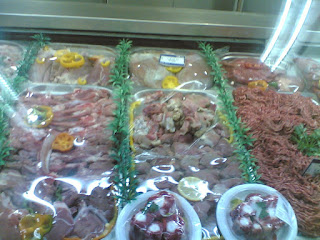
I do this shopping in one of the largest supermarkets in Maadi. There are things that I like that I can find in a place like that, such as cherry preserves, that I like. Yeah, like I said, I'm a bit spoiled. Metro, the supermarket, has a cheese section, a meat section, a poultry section, a fish market, and a delicatessen...it's a normal supermarket. Last time I was there, I bought a tray of chicken breast for about 30 LE...that's for about 8 half breasts. Today the same tray was over 40 LE. My skim milk that was about 3.5 LE 6 months ago is now almost 5 LE a litre. A small jar of nice green pepper salsa, locally produced, was 3.5 LE last month and is 5 LE this month. Rice that was 2.5 LE is now almost 5 LE.

As I wandered around the aisles gazing in horror at the costs of living exploding before me, I noticed that there was almost no one else in the store. Ordinarily, I'd see families doing their shopping, mothers with toddlers in tow picking up cereal and pampers, all nationalities...but today there was an older gentleman moving about looking at more things than he was buying and a young woman picking up item after item only to put them down with a snort of disgust. The store, while not empty, was significantly less crowded than I'd ever seen it.

My staff have been telling me about the price increases over the past months, but it isn't the same thing as walking in and being assaulted by the price increases at every turn. We are living and working in a farming area where we can grow some of our food. How are people who are on very limited incomes in cities and have no way to provide for themselves going to manage?

In my reading about the price issues in the grain trade I've seen that there are some interesting issues involved in the shortages and high prices. One of the issues that one article was discussing was the abnormal trading and pricing patterns over the past few years since investment funds were allowed to trade commodities. This means in addition to stocks and bonds, these investment funds could speculate on commodities that are the bases of our food supply. As the widow of a grain trader, I have some understanding of the general workings of this field, and I really think that the trading of something as important as food should not be in the hands of speculators. I realise that everyone in the grain trade is also speculating to a certain extent, but at the end of the day they are trying to move the grain from Point A to Point B. Mutual funds aren't moving food from producers to consumers. I also have to question the wisdom of the current field of biofuels. If we are using food for people to power vehicles that many of the people needing food don't even have...what is the point? It's all very well to try to develop a renewable fuel source, but do we want to compete with our own cars and buses for our food supply? These aren't just Egyptian concerns and problems. They are affecting us all. Shortages in rice, corn, and wheat are causing price increases in staples and meats all over the world. A Canadian friend of mine confided that a loaf of bread in her area was about $2.50. Looks like we are all in this together.

copyright 2008 Maryanne Stroud Gabbani