Well, what I've done is to move into my new house and try to get settled. My daughter is in New York waiting for her visa to clear so that she can find work and apply for grad school. My son just finished working here in Cairo and decided to take a cheap holiday before heading back to the US for grad school in Boston, so he and his girlfriend headed off to Syria, a country that he'd visited on a business trip a while back. He's been to Greece, Cyprus, and Lebanon, but said that Syria was truly an unappreciated jewel. We listened to stories about the landscape, the architecture, the food and the people...I was impressed. So off they flew to Damascus, where they spent a couple of days before heading north to Aleppo to visit crusader castles.
That was before Israel began bombing Lebanon again. The kids weren't even aware that the situation had gotten that hot until I sent them a message to make sure that they were okay. So now they are sitting in Aleppo waiting to see what tomorrow brings. Fortunately a young friend of ours is with the Egyptian embassy and is in touch with them. Right now, the friend is on the Lebanese border helping Egyptian refugees from Lebanon who are trying to escape the Israeli bombing. There is concern that with all the support from the US, Israel will feel safe enough to bomb infrastructure targets in Damascus tomorrow or the next day, which will make it pretty hard for the kids to make their Tuesday flight home. Other than the fact that my son suggested that most of the cab drivers report to the Syrian security police, war has simply not been part of the agenda during this visit.
So tonight my daughter and I chatted online while she waited for her boyfriend who happens to be in Ramallah in the West Bank where he's been teaching at a Quaker school. Unfortunately the school was hit by a missile earlier this month and when he came online, he could report that the Israelis were shelling Ramallah. His parents were there earlier in July, just got home in fact, and were quite horrified at the situation. They'd always thought that their son was a bit overboard on his pro-Palestinian stance, but now said that they have no way to explain to people back home just how awful things really are. His mother, who is a good friend of mine, says that it defies description and all the media is working against the information.
I have another friend in Canada who lives in a rural area and is convinced that the US is pushing to have a nuclear war in the Middle East sometime by this fall. When he wrote to me to suggest that I should come back to Canada where I might be cold but I'd be safer, I thought that he was being an alarmist. Maybe he knew something... but I sure hope not.
Friday, July 14, 2006


Saturday, July 01, 2006
No Need To Warm This House
Long break from the blog from this end but we were moving to the farm last week and are still suffering the consequences. Moving has to be one of the most miserable experiences in the entire world, and I got myself through this one by telling myself that I’d just be dying in this house so I wouldn’t have to go through it again. We used the hadad’s (the iron-worker) pickup and the donkey cart along with the labour of all my grooms and as many of the neighbourhood teenagers as could be rounded up to get things out of the old house and into the new.  Since it was done over the course of about three days and I was usually needed at the old house, furniture and boxes got piled willy-nilly all over the new house. The bedroom was set up almost immediately by the carpenter as everyone recognized that sleep was going to be a priority.
Mona the parrot spent the first night on a desk in the study to keep her from being harassed by the dogs, while the other parrots remained in their old cages since the painters had not finished painting the inside of the new ones. In Egypt, just as most other places, you have to choose whether you have more money or more time when you are building. Having more time than money, a lot of jobs have been rather slow in being finished. The cat and the fox also spent the initial night in their old digs as some of the plumbing for the laundry room in their garden hadn’t been completed.
The first morning in my new house….what can I say? The stove wasn’t hooked up yet, but the microwave worked so I could have my morning tea. I was up at 6 am to look out the bedroom window at the horses grazing happily in the rosy light of dawn, a rosy light that would take on more the appearance of the fires of hell as the day wore on. We have been having one of the hottest summers in some years these days, with the usual north wind barely keeping up a puff to cool us. The first order of business was getting the electrician to wire up the fans throughout the house, fans that he’d dismantled in the old place just yesterday.
As it turned out the cat, fox and parrots were much easier to move than I’d expected. Schmendrick the cat settled into his new garden happily and is pleased to find that he has a window into my bathroom and can expect scratches and cuddles there on a regular basis. Thea the fox was less impressed and promptly took off for better surroundings. The Amazons had to be captured with a bag to be moved, but the Greys could be picked up and put into cat carriers. Once they were in their new flight cages, they seemed to be rather intrigued by the similarities to the old layout, but the new things to watch and look at were okay.
 The dogs have settled in very well and love having all the space to run in, if only it weren’t so hot. Most of the day they spend sleeping in the shade…or on the bed if they get the chance…and then the play starts once the sun sets. The fact that there is no grass yet in the front garden does mean that we are sweeping about a kilo of sand out of the house each morning, but what can you do?
While the dogs have been getting used to the area and the new noises, I’ve been leaving the front door open at night so that they could get out to bark instead of waking me up. Last night, however, was the last one for that practice. At about 3 am the dogs were going nuts, but inside the house rather than along the fenceline, so I hauled myself out of bed and walked into my recently almost-cleared living room to find George the donkey standing there in the middle of the room looking around with great interest. I shooed him out to find Margarita standing at the front steps and Gameela the gamoosa over by the bird cages.
The three of them were having an exploration in the cool night air. My suspicion is that the donkeys were lured by the irrestistible aroma of dry dog food, something that they love but which is not really very good for them. I used to feed the dogs outside, but right now the dog food is indoors to preserve it from donkey predation. And from now on the dogs will be shut in at night … or is it that the donkeys will be shut out?
 Since it was done over the course of about three days and I was usually needed at the old house, furniture and boxes got piled willy-nilly all over the new house. The bedroom was set up almost immediately by the carpenter as everyone recognized that sleep was going to be a priority.
Mona the parrot spent the first night on a desk in the study to keep her from being harassed by the dogs, while the other parrots remained in their old cages since the painters had not finished painting the inside of the new ones. In Egypt, just as most other places, you have to choose whether you have more money or more time when you are building. Having more time than money, a lot of jobs have been rather slow in being finished. The cat and the fox also spent the initial night in their old digs as some of the plumbing for the laundry room in their garden hadn’t been completed.

The first morning in my new house….what can I say? The stove wasn’t hooked up yet, but the microwave worked so I could have my morning tea. I was up at 6 am to look out the bedroom window at the horses grazing happily in the rosy light of dawn, a rosy light that would take on more the appearance of the fires of hell as the day wore on. We have been having one of the hottest summers in some years these days, with the usual north wind barely keeping up a puff to cool us. The first order of business was getting the electrician to wire up the fans throughout the house, fans that he’d dismantled in the old place just yesterday.
As it turned out the cat, fox and parrots were much easier to move than I’d expected. Schmendrick the cat settled into his new garden happily and is pleased to find that he has a window into my bathroom and can expect scratches and cuddles there on a regular basis. Thea the fox was less impressed and promptly took off for better surroundings. The Amazons had to be captured with a bag to be moved, but the Greys could be picked up and put into cat carriers. Once they were in their new flight cages, they seemed to be rather intrigued by the similarities to the old layout, but the new things to watch and look at were okay.
 The dogs have settled in very well and love having all the space to run in, if only it weren’t so hot. Most of the day they spend sleeping in the shade…or on the bed if they get the chance…and then the play starts once the sun sets. The fact that there is no grass yet in the front garden does mean that we are sweeping about a kilo of sand out of the house each morning, but what can you do?
While the dogs have been getting used to the area and the new noises, I’ve been leaving the front door open at night so that they could get out to bark instead of waking me up. Last night, however, was the last one for that practice. At about 3 am the dogs were going nuts, but inside the house rather than along the fenceline, so I hauled myself out of bed and walked into my recently almost-cleared living room to find George the donkey standing there in the middle of the room looking around with great interest. I shooed him out to find Margarita standing at the front steps and Gameela the gamoosa over by the bird cages.

The three of them were having an exploration in the cool night air. My suspicion is that the donkeys were lured by the irrestistible aroma of dry dog food, something that they love but which is not really very good for them. I used to feed the dogs outside, but right now the dog food is indoors to preserve it from donkey predation. And from now on the dogs will be shut in at night … or is it that the donkeys will be shut out?
Saturday, June 10, 2006
A Change In The Tides
I find it interesting that one of the comments on my last post was a commendation on talking about something of more substance than my rather ordinary life. The fact that I write more about the day to day problems and pleasures of living here has nothing to do with the existence of problems in Egypt nor with my awareness of them. I've lived in the US, Canada, and Egypt with extended visits to Mexico, and every place I've lived has had problems. If there are humans, there are problems. We create them, expand them, expose them, and try sometimes to extinguish them, usually with little success. When I lived in the US, I was often uncomfortable with the paeans of praise for the "system" that ensured the "free" press, the benefits of living in the country that was the "leader of the free world". I could see some major glitches with the system even as a child and I found it very difficult to believe that everyone everywhere else in the world was miserable mostly because they did not live in the US. In fact, as I've grown up and had children of my own, I've seen that pretty much everyone's life is made up of a vast majority of tedium, drudgery, and worry. What we have to slog away at, what we worry about, varies from place to place, depending on our financial circumstances, but really it is all the same. Since I do believe that the good that we see and do in our lives lightens the load that we all bear, the "fluff" of non-problematic issues is actually more important than it might seem.
 That in mind, I received an email today from an old friend of mine, a retired naval officer that I met as a rider in Alexandria, who is now living in Cairo. Hafez is a product of the old times in Egypt prior to the revolution, but he served in the Navy for years. The link he sent me today was to an Aramco website about the making of a movie that will hopefully become available for viewing in the near future. This was a documentary made in 1964 about the last time that the Nile flooded, the swan song before the Aswan High Dam stopped the yearly flood. I've spent time talking to friends of mine here about the Nile flood. Spending a lot of time in the countryside and villages on horseback offers a lot of time to consider some of the less pressing items in life. As I have thought about the building of pyramids with visitors here, the issue of the Nile flood has shown itself to be a vital one. The old photo of the pyramids across flooded fields shows an area that is now wall-to-wall apartment blocks in Giza. Imagine the havoc with those flooded.
Very few places in the world have had the kind of life that the Nile Valley has in the past. Summers here are hot, very hot. The season for growing grains and vegetables is actually best in the winter rather than the summer. Lettuce wilts, carrots get woody, crops such as peas and beans are crisper and fresher in the winter. Until the advent of the High Dam, there was a period from the end of June to October (essentially the summer) when the entire valley was underwater. Nowadays with the floodwaters contained by the High Dam and distributed throughout the year in irrigation, it's hard to imagine the disruption that the inundation caused. As you can read in the linked article, the final inundation was a generous one and the infrastructure of the cities of Egypt were affected by the rising waters.

When one considers the idea that an entire population of a country was essentially on holiday for four months a year, the idea of pyramid building becomes rather less preposterous. After all, people had to do something. Of course, as Egypt became more urban and industrialised, the four month holiday was more of a four month headache. One of my friends was telling me how the island of Zamalek, now a center for embassies, schools, galleries, and general sort of Egyptian yuppie culture, used to be divided into two islands during the flood period. My mind can't even begin to comprehend the chaos that would ensue if this were to happen now. Telephone lines, electrical power lines, water pipes, all of the things that we take for granted as part of our comfortable modern life, would have been at risk during the four month flood. Sometimes, it's good to realise that the good old days may have been old, but weren't necessarily good.
That in mind, I received an email today from an old friend of mine, a retired naval officer that I met as a rider in Alexandria, who is now living in Cairo. Hafez is a product of the old times in Egypt prior to the revolution, but he served in the Navy for years. The link he sent me today was to an Aramco website about the making of a movie that will hopefully become available for viewing in the near future. This was a documentary made in 1964 about the last time that the Nile flooded, the swan song before the Aswan High Dam stopped the yearly flood. I've spent time talking to friends of mine here about the Nile flood. Spending a lot of time in the countryside and villages on horseback offers a lot of time to consider some of the less pressing items in life. As I have thought about the building of pyramids with visitors here, the issue of the Nile flood has shown itself to be a vital one. The old photo of the pyramids across flooded fields shows an area that is now wall-to-wall apartment blocks in Giza. Imagine the havoc with those flooded.Very few places in the world have had the kind of life that the Nile Valley has in the past. Summers here are hot, very hot. The season for growing grains and vegetables is actually best in the winter rather than the summer. Lettuce wilts, carrots get woody, crops such as peas and beans are crisper and fresher in the winter. Until the advent of the High Dam, there was a period from the end of June to October (essentially the summer) when the entire valley was underwater. Nowadays with the floodwaters contained by the High Dam and distributed throughout the year in irrigation, it's hard to imagine the disruption that the inundation caused. As you can read in the linked article, the final inundation was a generous one and the infrastructure of the cities of Egypt were affected by the rising waters.

When one considers the idea that an entire population of a country was essentially on holiday for four months a year, the idea of pyramid building becomes rather less preposterous. After all, people had to do something. Of course, as Egypt became more urban and industrialised, the four month holiday was more of a four month headache. One of my friends was telling me how the island of Zamalek, now a center for embassies, schools, galleries, and general sort of Egyptian yuppie culture, used to be divided into two islands during the flood period. My mind can't even begin to comprehend the chaos that would ensue if this were to happen now. Telephone lines, electrical power lines, water pipes, all of the things that we take for granted as part of our comfortable modern life, would have been at risk during the four month flood. Sometimes, it's good to realise that the good old days may have been old, but weren't necessarily good.
Thursday, June 01, 2006
I Never Thought Of Myself As Subversive

Asthmatic bronchitis and travel to see kids abroad have a way of keeping a person too busy to follow up on friends and the usual internet contacts. My eye was caught today by a USA Today blog post to the effect that it was dangerous to blog in Egypt today. Whoa Nelly! I had to follow that link.
The story that followed is one that is familiar to us here without the mention of the blogging so much. Alaa Seif al-Islam and a number of other young activists, many of whom happen to blog, were arrested (kidnapped is a more descriptive word of the process) in conjunction to demonstrations in Cairo for the independent judiciary and press. These young people have been very badly treated and with the resilience of the young are willing to keep at their activities. Americans of my generation will recall similar stories with regards to demonstrations against the US government during the war in Viet Nam. Many of the young people then were also subject to some pretty rough treatment by police who were more sympathetic to the military than the demonstrators. I point this out lest people are too quick to say, "But that would never happen here!" It did and it does. Government machines work to protect themselves everywhere.
There are links in the story that am posting from to Alaa and Manal's blog from Cairo and many other blogs, including templates for protests of the treatment of the demonstrators. Do follow and read. Do not imagine for a moment that you are free of the possibility of this happening to you, no matter where you live. This can happen to anyone.
Thursday, May 11, 2006
Food For Thought With My Breakfast
I'm sitting in New Jersey having breakfast with a friend (tea with milk as in Egypt and leftover spinach quiche...not uncommon in Egypt as well) and checking my email. I have an arrangement with Google News to send me an alert for any news stories with the word "Egypt" or "Ojai" or "avian influenza" in them. The "avian influenza" alert is obviously to keep up on the situation, although my concern for my parrots is down to nothing. The birds that died at the Cairo zoo were ducks, geese, and chickens. Egrets, parrots and other birds were untouched, and it's highly likely that it was transmitted via the common habit at the zoo of buying cheap and dubious meat for feeding animals. Likewise, it likely came to Egypt via illegal poultry smuggling as they are finding in many other parts of the world. The "Ojai" alert is to check that my brother and his family haven't been either washed away in a winter flood or burned out in a late summer wild fire in the Southern California town where I grew up.
The "Egypt" alert gets me the most news reports, most of which I don't bother to read since they number in the high hundreds daily. I especially skip the annals of the football team in New Egypt, Illinois, (sorry, guys), but sometimes there are things worth a seriious read. This morning, this article by a freelance Canadian writer for Al Jazeera Online caught my eye. Al Jazeera is definitely worth a read, even if it isn't your cup of tea, just for its thought-provoking quality. I don't like to blog politics because I think that is highly available online. But this quote really stopped me:
"The idea that all Islamic fundamentalists are bent on the destruction of the West and its decadent lifestyle, reveals more about our view of ourselves as the centre of the world than it does about the terrorists and their motivations."
He properly notes that the primary victims of terrorism are usually the local population rather than visitors, but his comment that the real target might be those in the Middle East who try to bridge gaps between cultures is interesting. I suppose that maybe I should worry, but I don't. First I feel very comfortable in my social setting in the country...hey, most terrorists would get lost trying to find my place and as soon as they started asking directions, red flags would be flying all over the neighbourhood. And second, I somehow doubt that these guys read English-language blogs.
So I promise not to go all political while on holiday here. I'm thoroughly enjoying the lack of dust here and haven't had to take ANY of my asthma medications at all. I think that by the end of ten days, my lungs will have relaxed and gone back to a normal state. Time away from dust has always been the best cure for the asthma, since the inflammation has a chance to reside. I'm off to look at a possible apartment for my daughter this afternoon, a broom closet with a bathroom and corner kitchen for $820 a month...a cheap apartment in New York. The price one must pay for urban living...I couldn't do it but she is young and really wants to attend NYU for her graduate school. I unloaded the half suitcase of Egyptian cotton tshirts at her dorm room yesterday on my arrival. The world turns and now she asks for Egyptian products since they are cheaper and of better quality material than the local American.
I'm assured by email and mobile phone messaging that my creatures are all well, though the dogs are rather miffed. Poor Tracy is bearing the brunt, but only for ten days. Hope all of you are well.
Sunday, May 07, 2006
Out of Desert Poverty, a Caldron of Rage in the Sinai - New York Times
It's pretty easy to sit and wonder what on earth could turn someone into a suicide bomber if you are sitting in relative comfort. Suicide, in itself, is difficult to comprehend for most of us. Dr. Kay Redfield Jamison has written an excellent and extremely readable book on the subject called Night Falls Fast that helps a great deal. According to her, suicide is essentially an act that is an expression of utter despair and hopelessness of a nature that most of us will be most happy never to experience. This despair and hopelessness may have its roots in a biochemical imbalance, as it would with someone suffering from severe depression. These are the suicides that most people are more familiar with. On the other hand, I recall talking to a psychiatrist friend of mine not long after my husband died, when I had banks and companies chasing me with open jaws, and expressing a concern that my longterm nemesis, chronic depression had resurfaced. My friend looked at me for a while and then told me not to worry. "It isn't that you are just feeling bad right now, Maryanne. The truth is that your life is perfectly horrible. There is a difference between depression and a totally unlivable life." He offered to prescribe something that would help me to make it through the rough times and made a point of telling me that when life got better I wouldn't be needing the help.
But what do you do when life simply isn't going to get better? When every door and window is locked and you have no hope of moving to a livable situation? I hate to say it, but I think I can understand and I believe that governments all over the world need to examine their policies to see that people are not cornered in the way that those who have committed suicide bombings are cornered. It's one thing when hopeless people kill themselves, a tragedy that harms everyone who loves them, but when they are so hopeless that they go out and try to kill others, who often have little or nothing to do with the original hopelessness, it is doubly tragic.
But what do you do when life simply isn't going to get better? When every door and window is locked and you have no hope of moving to a livable situation? I hate to say it, but I think I can understand and I believe that governments all over the world need to examine their policies to see that people are not cornered in the way that those who have committed suicide bombings are cornered. It's one thing when hopeless people kill themselves, a tragedy that harms everyone who loves them, but when they are so hopeless that they go out and try to kill others, who often have little or nothing to do with the original hopelessness, it is doubly tragic.
Saturday, May 06, 2006
Imho-Who?
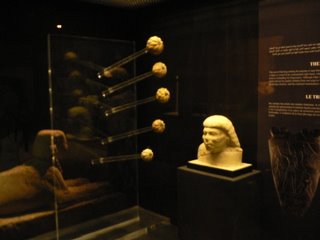
I had a chance to see one of Egypt's new jewels today. My friend Nathalie came to ride, and we decided to go to the new Imhotep Museum just inside the main gate of the Sakkara complex. I have a wonderful trail that wanders through the fields and ends at the entrance to the Sakkara antiquities area. In the past, I'd ridden up to the main gate with friends, been asked to pay the entrance fee and we'd gone in. If someone wanted to visit one of the sites, the others would hold the horses while the visitor looked around. Often we would leave through the desert to return. Lately I'd gone to the main gate and been refused entrance even when we offered to pay the fee with the guard saying that horses were a security risk. Considering that they don't have the trunk space of a Peugeot, I could never really figure that one out. Nathalie, however, has a diplomatic pass and no one said a word.
I'd seen the museum as they were building it below the hill that the cars climb into the Sakkara complex and had ridden past the construction site a number of times. This time we rode down the driveway into a carpark that was not very crowded. We were asked for Nathalie's pass a number of times, each time the official looking in disbelief at the horses. We found a kind soul who was willing to hold the horses while we checked out the new museum.
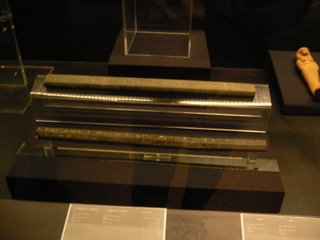
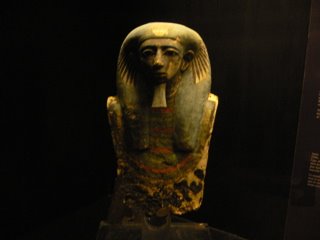 Double glass doors parted and we walked into a welcome wall of airconditioning. The museum is in honour of the pharaonic patron saint of the Sakkara pyramid and all the other pyramids, the architect Imhotep who designed the step pyramid for King Djoser so many thousands of years ago. Unlike the cluttered Egyptian Museum, the exhibits are sparse and for the most part well-labeled. The labeling process is still underway and we had to ask one of the employees to confirm our suspicions that the stone rods in the second picture here were in fact measuring rods. Now you know how they measured the pyramids.
 Throughout the darkened rooms, glass cases of artifacts were lit to show the stoneware, the tools, the decorative objects and parts of some of the walls of the Sakkara complex. Some of the tools shown are essentially identical to those that I see workmen carrying today. The continuities in Egypt are both frustrating and charming.
 One of the exhibits was particularly welcome to me. A couple of years ago the History Channel contacted me to supply them with horses for an episode of "Digging For The Truth". My horses appear (most beautifully I must say) in perhaps all of two minutes of the show, but at one point the narrator was interviewing Salima Ikram who was showing him the faience tile wall in the interior of the Step Pyramid. The interior is too unstable to allow visitors for the most part, so they've taken a part of the faience wall and reassembled it in the museum for visitors to enjoy. The blue pottery tiles were created to replicate the mats that used to hang on the walls of the houses of the time. The turquoise tiles are lovely in the limestone walls.
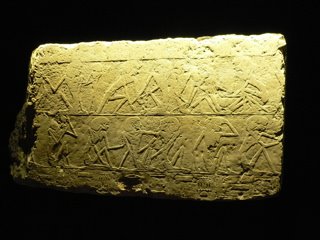 One of the most stunning pieces in the museum is a frieze of starving Nubians that were carved to commemorate the pharoah's visit to Nubia. The people are carved in exquisite detail in the most difficult style of frieze carving, excised from the background layer. This means that the important figures are standing out from the background and the artist had to do much more work to carve everything else away. It also allows for much more detail, in this case the pinched faces and prominent ribs of starving people. This is the only depiction like this that I've ever seen and Nathalie as well found it extraordinary.
The other room that was very impressive, but of which I have no photos because my battery died, was the Lauer Library. This is a reconstruction of the library that existed in Lauer's house at Sakkara where he worked from the time he was about twenty years old until he was almost one hundred, excavating and reconstructing the Sakkara complex. You can see his desk with some of his writings and the book cases with his reference books and those that he published about the site. His career was one of the most impressive in the history of Egyptology.
When we left the cool of the museum, a wall of heat from the desert, the counterpart of the climate control of the museum, hit us like a truck. More visitors had arrived and we looked around for the horses, finding them parked along with various cars and buses in the parking lot. Nathalie was going to be late for lunch with her husband and the weather was turning windy and hot, so we made our way back through the fields to the farm, and none too soon. I brought the dogs home with the intention of going into Maadi to see a friend, but phone calls and small chores interfered with my departure until with a roar a sandstorm descended on the house from the desert. Palms bent almost double and I could barely make out the garden fence from my front door. The power went out and the sky was so dark that I went about lighting candles. The dogs and I sat indoors hiding out and feeling sorry for the parrots who actually didn't seem terribly bothered by all the racket. Now we are simply hoping that it will all blow over tonight and leave us in peace.
Subscribe to:
Posts (Atom)